Installation guide
 Owner’s manual


Is Amana a low-end brand?
Yes. Amana is widely positioned as a value-focused, budget-friendly appliance brand; for an Amana NED5800HW1 dryer, that typically means straightforward features, practical performance, and lower upfront cost compared with many premium lines.
What “low-end” usually means in real-world use
Amana dryers are designed to be simple and serviceable. You generally get fewer specialty cycles and fewer premium convenience features, but you still get the core essentials: heat, airflow, and drum tumbling.
Common expectations:
- Fewer advanced options (steam, app connectivity, specialty sensors)
- More emphasis on basic cycles and controls
- Lower purchase price and simpler repairs
- Performance depends heavily on venting and maintenance
How to get the best results from your NED5800HW1
Even a basic dryer can dry fast and evenly when airflow is strong and the load is matched to the cycle. We recommend using the cycle guidance and venting checks in the NED5800HW1 owner’s manual.
Quick best practices:
- Clean the lint screen before every load
- Avoid overloading; leave room for tumbling
- Use timed dry for bulky items when needed
- Verify strong airflow at the outside vent hood
- Keep the vent run short and free of crushed ducting
When “budget brand” feels like a problem (and what to check)
Most complaints we see trace back to airflow restrictions or wear items, not the brand name.
| Symptom | Most common cause | Typical fix |
|---|---|---|
| Long dry times | Restricted venting | Clean/repair vent system |
| No heat | Heating circuit issue | Diagnose heater, thermostats, thermal fuse |
| Thumping/squealing | Drum support wear | Inspect rollers, idler, belt |
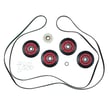
If you’re chasing noise or vibration, a maintenance bundle like the dryer repair kit 4392067 is often used during a drum support service.
Why it matters
Brand “tier” affects features and price more than basic drying ability. For the NED5800HW1, good airflow and routine care are the biggest drivers of drying speed, fabric care, and part life.
Last updated: January 2026
How do you know if a thermal fuse is blown on an Amana dryer?
On an Amana dryer such as model NED5800HW1, a blown thermal fuse typically shows no electrical continuity when tested with a multimeter. With power disconnected, remove the fuse and check resistance across its terminals; a good fuse reads near 0 ohms, and a blown fuse reads open (no continuity).
What you’ll notice when the thermal fuse is blown
Common symptoms on an electric dryer include:
- Dryer will not start or stops shortly after starting
- Drum may tumble but there is no heat (some failures show as “no heat” complaints)
- Cycle times get longer before the failure (often due to restricted airflow)
- Lint buildup or a very hot cabinet or exhaust area
How to test the thermal fuse (continuity test)
- Unplug the dryer (or switch off the breaker). For access and safety notes, follow the NED5800HW1 owner’s manual.
- Access the thermal fuse (commonly mounted on the blower housing or exhaust duct area).
- Pull the wire connectors off the fuse terminals (grip the connector, not the wire).
- Set your multimeter to ohms (Ω) or continuity.
- Touch one probe to each terminal.
- Good fuse: ~0 Ω or continuity tone
- Blown fuse: OL, infinite resistance, or no tone
What to do next if it’s blown
A thermal fuse usually blows because the dryer overheated, so we fix the cause before running the dryer again.
| What to check | What “good” looks like | What to do if not good |
|---|---|---|
| Lint screen and housing | Clear airflow | Clean thoroughly |
| Vent duct to outside | Strong airflow, no kinks | Clear/replace ducting |
| Blower wheel | Spins and moves air | Inspect/replace if damaged |
| Heating control parts | Normal cycling | Test related thermostats/sensors |
If you’re replacing the fuse, use the exact replacement listed for this model, such as the thermal fuse W10909685.
Why it matters
The thermal fuse is a safety device that opens when temperatures get too high. Replacing it without correcting airflow restrictions can cause repeat failures and longer dry times.
Last updated: January 2026
How long should an Amana dryer last?
An Amana dryer like model NED5800HW1 typically lasts 13 years. You can keep it in the upper end of that range by maintaining airflow (lint screen and venting) and addressing wear items early, such as drum rollers and the idler pulley.
Typical lifespan and what affects it
Most electric dryers fall into a predictable lifespan range; what changes the outcome is heat, airflow, and mechanical wear.
- Vent restriction (long runs, crushed flex duct, clogged vent hood) increases heat and run time
- Lint buildup inside the cabinet or exhaust path raises operating temperature
- Overloading accelerates belt, roller, and idler wear
- Frequent high-heat cycles add stress to heating and temperature-sensing parts
- Garage or cold-area installs can cause longer cycles if temperatures drop below recommended levels
Maintenance schedule we recommend
Use the NED5800HW1 documentation as your baseline for care and cleaning intervals: NED5800HW1 use and care guide.
| Task | How often | Why it helps |
|---|---|---|
| Clean lint screen | Every load | Improves airflow and drying time |
| Check vent airflow and vent hood flap | Monthly | Prevents long dry times and overheating |
| Remove lint from exhaust vent | About every 2 years (more with heavy use) | Reduces heat stress and fire risk |
| Cabinet lint cleaning (service) | About every 2 years | Protects motor and heater area |
Parts that commonly determine “repair vs replace” timing
If your NED5800HW1 is noisy, squealing, or thumping, these wear parts are common culprits and are often worth replacing to extend life:
- Dryer drum support roller WPW10314173 (rumbling or thumping)
- Dryer idler pulley W10837240 (squeal, belt tension issues)
- Dryer blower wheel WP697772 (loud vibration, weak airflow)
- Thermal fuse W10909685 (dryer won’t heat or stops due to overheating)
Why it matters
A dryer that takes longer to dry is not just inconvenient; it runs hotter and longer, which shortens the life of the heating system, motor, and drum support components. Good airflow and timely replacement of wear parts are the biggest drivers of long service life.
Last updated: January 2026
What is the most common problem with the Amana dryer?
For the Amana NED5800HW1 dryer, the most common problem we see is poor drying performance (long dry times or clothes still damp). In most cases, the root cause is restricted airflow from lint buildup or venting issues, which also leads to overheating and heat-related part failures.
Most common symptoms customers notice
- Drying takes much longer than normal
- Clothes feel warm but still damp
- Dryer runs but heat seems weak or inconsistent
- Burning smell or “hot” laundry (overheating)
- Dryer shuts off early or cycles act “off”
What usually causes it (in order)
Airflow problems are the top driver of long dry times on this model. The use and care guidance emphasizes checking the vent system for good airflow and using the correct venting size.
- Lint screen or air outlet grille blocked (the outlet grille is just inside the door, behind the lint screen)
- Crushed, kinked, or clogged vent duct
- Wrong vent size (most installations require 4 inch (102 mm) vent material)
- Oversized loads that cannot tumble freely
- Room temperature below 45°F (7°C) affecting sensor cycle performance
Quick checks we recommend first
- Clean the lint screen and confirm the air outlet grille is not blocked by a fabric softener sheet.
- Run a timed heated cycle and check airflow at the outside vent hood.
- Inspect the full vent run for kinks, long runs, or heavy lint buildup.
- Verify the dryer is level so clothes contact the moisture sensors properly.
When airflow is good but drying is still poor
If venting checks out, the next most common culprits are heat and temperature-sensing parts.
| Symptom | Likely area | Example part for NED5800HW1 |
|---|---|---|
| No heat or weak heat | Heating circuit | Element, heater 5400w WP3387747 |
| Overheats, then stops heating | Safety cutoff | Thermal fuse W10909685 |
| Heat cycles oddly, temps seem wrong | Temperature sensing | Dryer thermistor WP8577274 |
Why it matters
Restricted airflow does not just slow drying; it can cause overheating that shortens the life of the heating element, thermostats, and thermal fuse. Keeping the venting clear is the best way to prevent repeat failures.
For model-specific venting, leveling, and troubleshooting steps, use the NED5800HW1 owner’s manual.
Last updated: January 2026