Installation guide
 Owner’s manual
 Error Codes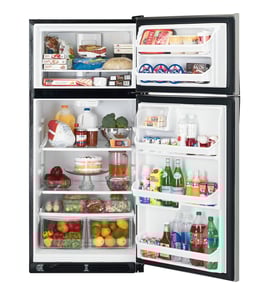
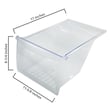


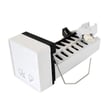

What is the upper part of a fridge called?
On a Kenmore top-mount refrigerator like model 25378893016, the upper section is the freezer compartment. It’s the coldest area of the appliance and is designed to keep foods frozen; on some models it also houses an automatic ice maker.
What you’ll typically find in the upper (freezer) compartment
- Freezer shelves or door bins for frozen foods
- Cold air vents (often at the back wall) that help circulate cold air
- An ice bin and ice maker area (if equipped)
- Defrost-related components behind the rear panel (not user-accessible)
Freezer vs. refrigerator compartment (quick comparison)
| Area | Main purpose | Typical temperature target |
|---|---|---|
| Upper compartment (freezer) | Long-term frozen storage, ice production (if equipped) | 0°F |
| Lower compartment (fresh food) | Short-term refrigerated storage | 37°F |
Why it matters
Knowing the upper section is the freezer helps when you’re troubleshooting cooling issues and organizing food. For example, leaving space between packages improves airflow and freezing performance, and avoiding overloading the freezer with warm food helps it freeze faster.
Helpful tips for better freezer performance
- Leave space between packages so cold air can circulate.
- Avoid putting hard-to-freeze items (like ice cream) in the freezer door; store them deeper inside.
- Do not block the cold air vents.
- Level the refrigerator so the doors close tightly.
- Use the temperature settings recommended in the 25378893016 owner's manual.
Last updated: January 2026
How to tell cubic feet of Kenmore refrigerator by model number?
For Kenmore model 25378893016, the most reliable way to get cubic feet is to look up the capacity in the product specifications section of the 25378893016 owner's manual. If you cannot find a listed capacity there, you can estimate cubic feet by measuring the usable interior space and converting cubic inches to cubic feet.
Fast ways to find capacity (best to least precise)
- Check the specifications section in the 25378893016 owner's manual for “capacity” or “cu. ft.”
- Look for a model/serial plate inside the fresh food compartment (often on a side wall or ceiling) and compare the full model number to published specs
- Estimate capacity by measuring interior dimensions and converting (works well for a quick comparison)
- Use the model prefix as a clue: Kenmore 253 models are commonly Frigidaire-built; capacity varies by configuration, so confirm by specs when possible
How to estimate cubic feet from measurements
- Empty the compartment enough to measure the usable interior.
- Measure width x depth x height in inches for:
- Fresh food section
- Freezer section
- Convert each section to cubic feet, then add them.
Conversion: cubic feet = (W x D x H) ÷ 1728
| What you measure | What it represents | Tip for accuracy |
|---|---|---|
| Fresh food interior | Refrigerator capacity | Measure to the inside liner, not the door bins |
| Freezer interior | Freezer capacity | Exclude bulky ice maker housings if they reduce usable space |
| Total | Approx. total capacity | Expect your estimate to be slightly higher than “usable” rated capacity |
Why it matters
Capacity helps us match the right shelves, bins, and storage components, and it also helps when comparing energy use and airflow needs in a top-mount refrigerator.
Last updated: January 2026
How much top clearance does a fridge need?
For Kenmore top-mount refrigerator model 25378893016, the installation guidance calls for 3/8 inch of clearance at the top (and sides) and 1 inch at the rear for proper air circulation and easier installation. Some configurations with exposed back coils need more top space.
Recommended clearances for model 25378893016
Use these minimums when placing the refrigerator into a cabinet opening or against a wall:
- Top: 3/8 inch
- Sides: 3/8 inch
- Back (rear): 1 inch
- Toe grille (front bottom): keep open, do not block airflow
| Location | Minimum clearance | Purpose |
|---|---|---|
| Top | 3/8 in | Ventilation and heat release |
| Sides | 3/8 in | Air circulation and fit |
| Back | 1 in | Airflow plus room for connections |
When you may need more than 3/8 inch on top
Your Use and Care information notes that if you see black coils or tubing on the back (an air-cooled condenser), you should leave 3 inches of clearance at the top to improve airflow.
Why it matters
Refrigerators shed heat through airflow around the cabinet. Too little clearance traps heat, increases compressor run time, and can lead to warmer temperatures and higher energy use.
For the model-specific wording and diagrams, use the 25378893016 installation guide and the 25378893016 owner's manual.
Last updated: January 2026