Installation guide
 Owner’s manual
 Error Codes



What size gas line for Whirlpool gas range?
For the Whirlpool SF362LXSB0 gas freestanding range, we recommend a 3/4-inch rigid gas supply pipe to the range location. If you are connecting to LP (propane), the piping or tubing can be 1/2-inch minimum; undersized pipe on long runs can cause low gas flow and poor burner performance. See the installation guide for the approved connection details.
- Natural gas: 3/4-inch rigid pipe to the range location
- LP gas: 1/2-inch minimum piping or tubing (your LP supplier typically sizes the system)
- Use a manual shutoff valve in the same room, outside the range
- Use a new CSA-approved gas supply line/connector where permitted
- Avoid kinking or damaging flexible connectors when moving the range
A flexible connector is often used for the final connection, but the home supply line still needs to be properly sized.
| Connection type | Typical use | Common sizes mentioned | Key caution |
|---|---|---|---|
| Rigid pipe | Supply line to the range area | 3/4-inch recommended | Long runs need adequate diameter |
| Flexible metal appliance connector | Final hookup to the regulator (where codes allow) | 1/2-inch or 3/4-inch I.D., typically 4 to 5 ft long | Do not kink or crush |
Correct gas line sizing helps your Whirlpool range maintain proper gas pressure and flow. When the line is too small (especially on longer runs), you can see slow ignition, weak flames, or an oven that struggles to heat consistently.
- Install and keep access to the manual shutoff valve
- Tighten and leak-test all gas connections after installation
- Use the range’s gas pressure regulator as designed
- For LP conversions, use a qualified service technician and follow the conversion instructions in the documentation
Last updated: February 2026
What is the life expectancy of a Whirlpool gas range?
A Whirlpool gas range typically lasts 13 to 15 years with normal household use. For your Whirlpool SF362LXSB0 gas freestanding range, consistent cleaning, correct installation, and addressing heating or ignition problems early helps you reach that expected lifespan; see the maintenance and safety guidance in the SF362LXSB0 owner's manual.
Most gas ranges fall into a predictable service-life range, but real-world results depend on heat exposure, cleaning habits, and how quickly small issues are repaired.
- Usage frequency: daily cooking shortens life compared to light use
- Heat stress: frequent high-heat baking and broiling accelerates wear
- Cleaning habits: keeping burner ports and the oven cavity clean reduces corrosion and ignition issues
- Installation quality: a stable, level range with proper gas connection reduces component strain (see the SF362LXSB0 installation guide)
- Timely repairs: replacing a weak igniter or failed sensor prevents secondary damage
If your range is approaching the end of its service life, these are the most common patterns we see:
- Oven takes a long time to preheat or will not reach set temperature
- Burner ignition becomes slow, inconsistent, or requires repeated clicking
- Temperature swings that burn food on one rack and undercook on another
- Control or display problems that return after a reset
- Gas odor, soot, or persistent yellow flames (stop using the range until it is corrected)
| Symptom | Common cause | Example part for SF362LXSB0 |
|---|---|---|
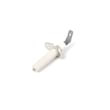
| Oven will not heat or heats weakly | Igniter not drawing enough current | Range oven igniter WP9758079 |
| Oven temperature seems inaccurate | Sensor drifting out of range | Oven sensor WPW10181986 |
| Cooktop clicking or ignition issues | Spark ignition problem | Spark module WPW10331686 |
Knowing the typical life expectancy helps you decide whether to maintain and repair your SF362LXSB0 or plan for replacement. A simple repair, such as replacing an igniter or sensor, often restores normal baking performance and extends usable life.
Last updated: February 2026
What does f3 e0 mean on a Whirlpool gas stove?
On the Whirlpool SF362LXSB0 gas freestanding range, the F3 E0 error code points to a problem with the oven temperature sensor circuit (sensor open or shorted). In most cases, fixing the sensor connection or replacing the sensor restores normal baking and temperature control.
- Cancel the cycle and let the oven cool completely.
- Turn off power to the range at the breaker (the control uses electricity even on a gas range).
- Inspect the sensor harness connection at the back of the oven cavity (loose plug, corrosion, pinched wires).
- Look for damaged wiring where it passes through panels or near sharp edges.
- Restore power and test Bake; if the code returns, plan on replacing the sensor.
For model-specific control and troubleshooting guidance, use the owner's manual.
If the wiring and connector look good, the most common fix is replacing the oven sensor.
| Symptom | Most likely cause | Part to consider |
|---|---|---|
| F3 E0 returns quickly after reset | Failed oven sensor (open/short) | Oven sensor WPW10181986 |
| Code appears intermittently | Loose connection or damaged harness | Inspect/repair wiring, then retest |
The oven sensor tells the electronic control the actual oven temperature. When the control cannot read the sensor correctly, it may stop heating, overheat, or shut down to prevent unsafe temperature operation.
- Run a 350°F bake test and confirm the oven preheats normally.
- If temperatures seem off but no error returns, follow the calibration steps in the owner's manual.
Last updated: February 2026
What is the most reliable 36 inch gas range?
A “most reliable” 36-inch gas range depends on build quality, how simple the controls are, and how easy it is to get service and parts in your area. Your Whirlpool SF362LXSB0 is a 30-inch freestanding gas range, so we use general 36-inch guidance and recommend confirming fit, gas type, and installation requirements in the installation guide.
We focus on designs that reduce failure points and make maintenance straightforward.
- Fewer electronics and simpler control boards (fewer expensive failures)
- Sealed burners with sturdy grates and easy-to-clean spill containment
- A proven ignition system and readily available igniter parts
- Strong temperature control and a replaceable oven sensor
- Good parts availability for common wear items (igniters, valves, knobs)
- Local service coverage for the brand you choose
Use this as a practical filter when comparing models.
| Check | What “good” looks like | Why it matters |
|---|---|---|
| Burner ignition | Lights quickly and consistently | Weak ignition is a common complaint and repair |
| Oven heat accuracy | Holds temp without big swings | Impacts baking results and component stress |
| Parts availability | Common parts are easy to source | Keeps repairs affordable over the life of the range |
| Service access | Local techs will work on it | Reduces downtime and surprise costs |
Even though SF362LXSB0 is not a 36-inch model, the same reliability drivers apply. On gas ranges, the most common “no heat” or “won’t light” repairs often involve ignition and sensing components. If you are troubleshooting your current range, these model-matched parts are commonly involved:
- Range oven igniter WP9758079 (bake ignition)
- Range oven igniter WP8054129 (broil ignition)
- Oven sensor WPW10181986 (temperature feedback)
- Range gas valve assembly WPW10293048 (gas flow control)
A 36-inch range is a bigger investment, and reliability is usually determined less by one “best brand” and more by choosing a configuration that is serviceable: simple ignition, stable temperature control, and parts you can replace without replacing the whole appliance.
Last updated: February 2026