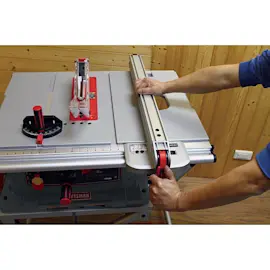
Owner’s manual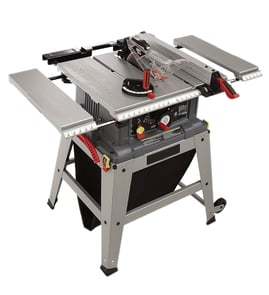

Are craftsman table saws any good?
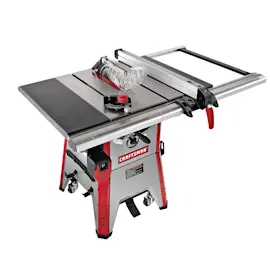
Yes; Craftsman table saws are a solid choice for many DIYers and serious hobbyists, and the Craftsman 351221160 is built as a rugged, shop-style 10-inch hybrid saw designed for precise cutting and continuous service. For best results, setup and alignment matter as much as the brand name.
What “good” means for the Craftsman 351221160
This model is positioned as a stationary, professional-style saw with features that support accuracy and repeatability.
- Designed for a 10-inch blade and shop use
- Built for precise cutting performance on wood up to about 3-1/2 inches thick
- Uses a riving knife and clear blade guard with anti-kickback features
- Has an extra-large solid granite table for stability
- Includes a heavy-duty precision rip fence with calibrated front rail
- Cabinet is enclosed and ported for a 4-inch dust hose
For the model-specific operating and safety details, use the 351221160 owner's manual.
Where owners typically love it (and where they get frustrated)
Most satisfaction comes from stability, power, and repeatable settings; most frustration comes from alignment, blade choice, and technique.
| Area | What to expect | What improves results |
|---|---|---|
| Rip cuts | Strong performance when the fence is aligned | Verify fence parallel to blade; use a sharp blade |
| Crosscuts | Accurate with a tuned miter gauge and square setup | Calibrate 90° and 45° stops |
| Dust control | Good with a collector connected to the 4-inch port | Vacuum cabinet and mechanisms regularly |
| Dado work | Supported with the correct insert and setup | Use the proper dado insert; reinstall guard after |
Quick checks that make any table saw “good”
These steps prevent most “mixed review” experiences (burning, binding, out-of-square cuts, slow blade speed).
- Use only blades rated 4000 RPM or higher
- Keep the table insert flush with the tabletop
- Confirm blade is square to the table at 90° and 45° stops
- Use outfeed support for long panels; do not pull stock from the rear
- Keep the motor area and internal mechanisms clean; vacuum frequently
If your cuts are not accurate after setup, use table saw bad angle cuts for targeted troubleshooting.
Why it matters
Table saw “quality” shows up in safety and accuracy. A stable table, aligned fence, correct blade, and proper guarding reduce kickback risk and help you get clean, repeatable cuts.
Last updated: February 2026
How much is a Craftsman professional table saw 351221160?
A Craftsman 351221160 (10-inch premium hybrid table saw) typically sells in the mid-range used-market price band, most often around $400 to $500 depending on condition, included accessories (rip fence, miter gauge, blade guard), and local demand. For model-specific features and setup details that affect value, use the 351221160 owner's manual.
What changes the price the most
- Condition of the granite table: chips, cracks, or rusted hardware reduce value.
- Fence and miter accuracy: a smooth, square-cutting rip fence and miter gauge raise value.
- Safety parts included: riving knife, clear blade guard, and anti-kickback fingers.
- Electrical setup: clean 120V operation, or a properly configured 240V plug and circuit.
- Dust collection readiness: intact 4-inch exhaust port and clean cabinet.
Quick value checklist for this model
Use this as a fast way to judge whether a listing is priced fairly.
| What you check | What “good” looks like | Why it affects price |
|---|---|---|
| Starts and reaches speed | Motor runs smoothly without bogging | Weak start or slow spin points to motor/brush issues |
| Cut quality | No burning, binding, or wandering cuts | Often indicates blade condition or alignment |
| Height and tilt controls | Handwheels turn smoothly | Stiff mechanisms can mean internal wear or pitch buildup |
| Included accessories | Guard, riving knife, insert(s), fence | Missing parts add replacement cost |
Why it matters
Price is closely tied to how safely and accurately the saw can cut. A 10-inch hybrid saw like the Craftsman 351221160 is built for continuous shop use, so a well-maintained unit with complete guarding and a true fence is worth paying more for.
If you are comparing listings
- Confirm it is designed for a 10-inch blade.
- Ask whether it has been used for dado work and if the correct insert is included.
- Verify the saw is wired correctly for the voltage being used (120V vs 240V).
For setup and operating specs that help you evaluate a used saw, follow the inspection and adjustment guidance in the 351221160 owner's manual.
Last updated: February 2026
Are all table saw arbor nuts the same size?
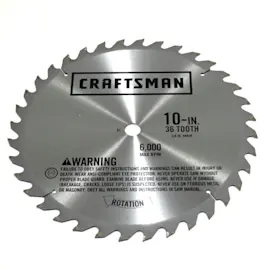
No. Arbor nuts are not all the same size or thread; they must match the saw’s arbor shaft. For the Craftsman 351221160, the manual specifies using only 10-inch blades with a 5/8-inch arbor hole, so the arbor nut and flange are sized for that 5/8-inch arbor setup. See the 351221160 owner's manual for the blade change procedure and arbor hardware details.
What’s standardized and what isn’t
Some blade and arbor dimensions are common, but the nut itself is not universal.
- Blade arbor hole is often standardized by blade size (many 10-inch blades use 5/8-inch arbor holes).
- Arbor nut thread diameter and pitch vary by manufacturer and model.
- Nut wrench size (the hex size you put a wrench on) can also vary.
- Flange thickness and diameter can differ and affects blade support.
- Left-hand vs right-hand threads vary by saw design.
What this means for Craftsman 351221160
Your saw is designed around a 10-inch blade and a 5/8-inch arbor hole requirement.
| Item | What to match | Why it matters |
|---|---|---|
| Blade | 10-inch diameter, 5/8-inch arbor hole | Ensures the blade seats correctly on the arbor |
| Blade rating | Rated at or above 3800 RPM | Helps prevent blade failure at operating speed |
| Arbor nut | Must match the saw’s arbor threads | Prevents stripping, loosening, or runout |
How we recommend choosing the correct arbor nut
Use model-specific identification instead of guessing by blade size.
- Confirm the model number is 351221160.
- Use the exploded views and key numbers in the 351221160 owner's manual to identify the arbor nut and flange.
- If the nut is damaged, replace the nut and inspect the flange and arbor threads.
- Avoid “universal” arbor nuts unless they explicitly match the thread specs for your saw.
Why it matters
The arbor nut clamps the blade and flange to the arbor. A mismatched nut can loosen during cutting, cause blade wobble (runout), and lead to poor cut quality or binding.
Related DIY help
Last updated: February 2026
Can you use an 8 inch blade on a 10 inch table saw?
Yes, you can physically mount an 8-inch blade on the Craftsman 351221160 table saw if it fits the arbor, but we do not recommend it for normal cutting. This saw is designed for a 10-inch blade, and the manual specifies using only 10-inch blades with a 5/8-inch arbor hole and the proper RPM rating; follow the 351221160 owner's manual for safe, correct setup.
What the manual requires for this model
For the Craftsman 351221160 (a 10-inch tilting arbor saw), the blade requirements matter more than the table saw size label.
- Use only 10-inch diameter blades for normal operation
- Use a 5/8-inch arbor hole
- Use a blade rated at or above the saw’s required RPM (the manual calls out a minimum rating)
- Keep guards in place whenever possible; install the blade, flange, and arbor nut correctly
When an 8-inch blade is commonly used (and what to watch)
An 8-inch blade is most commonly used for non-through cuts such as dado work (depending on your setup and accessories). The tradeoff is reduced cutting depth and potentially more exposed blade area relative to the guard and riving knife alignment.
- Cut depth decreases (you lose about 1 inch of max depth compared with a 10-inch blade)
- Guard and riving knife fit can be affected; alignment is designed around a 10-inch blade
- Kerf and riving knife relationship still matters; the blade kerf must be wider than the riving knife thickness
- RPM rating still applies; never use a blade rated below the saw’s operating speed
Quick comparison
| Blade diameter | Typical use on a 10-inch saw | Main downside |
|---|---|---|
| 10-inch | Ripping, crosscutting, general work | None (this is the designed size) |
| 8-inch | Specialty/non-through cuts (when compatible) | Less depth; guard/riving knife compatibility issues |
Why it matters
Using the correct blade diameter and matching it to the riving knife and guarding reduces binding, stalling, and kickback risk. The manual also warns against using cutting tools not designed for the saw and against using tools below the required speed rating.
Last updated: February 2026
What not to do with a table saw?
For the Craftsman 351221160 table saw, do not cut freehand, reach over or behind the blade, crosscut using the rip fence, or make adjustments while the blade is rotating. These actions greatly increase kickback risk and put your hands in the blade path; follow the safety rules in the 351221160 owner's manual.
Never do these high-risk actions
- Do not perform any operation freehand; always guide the work with the rip fence or miter gauge.
- Do not reach behind the cutting tool to hold down the workpiece or remove scraps.
- Do not do layout, assembly, or setup work on the table while the blade is rotating.
- Do not crosscut using the rip fence, and do not rip using the miter gauge.
- Do not feed material into the blade from the rear of the saw.
- Do not pull the workpiece through the blade; start and finish the cut from the infeed side.
Safe habits that prevent kickback and binding
Kickback is one of the most common causes of table saw injuries. These habits reduce the chance the workpiece pinches the blade or gets thrown back.
- Stand to either side of the blade, not in line with it.
- Keep hands out of the blade path; use a push stick for narrow rips.
- Use featherboards to keep the work tight to the fence or table (especially for non-through cuts).
- Remove small cutoffs with a long stick after the blade stops; do not grab near the blade.
Quick guide: fence vs. miter gauge
| Operation | Use this guide tool | Do not use this |
|---|---|---|
| Ripping (with the grain) | Rip fence | Miter gauge |
| Crosscutting (across the grain) | Miter gauge | Rip fence |
Why it matters
Most “don’ts” come down to two hazards: (1) losing control of the workpiece (kickback) and (2) putting your hands where a slip can contact the blade. Using the correct guide tool and keeping your body out of the kickback line are the biggest safety wins.
Related DIY help
If your cuts are wandering or the saw is fighting the wood, use our troubleshooting steps in table saw bad cuts and table saw bad angle cuts.
Last updated: February 2026