Installation guide
 Owner’s manual


What is the most common problem with the Maytag dryer?
For the Maytag MED5630HC1 dryer, the most common issue we see is poor drying or no heat caused by restricted airflow (a clogged lint screen or blocked/crushed vent). That restriction can also overheat the dryer and lead to a blown thermal fuse or other heat-related failures. See the MED5630HC1 use & care manual.
Quick checks we recommend first
- Clean the lint screen before every load; wash it with a nylon brush every 6 months if residue builds up.
- Run the dryer 5 to 10 minutes and check for strong airflow at the outside exhaust hood.
- Inspect the vent run behind the dryer for crushing, kinks, or too many turns.
- Avoid plastic or foil venting; use 4-inch rigid or flexible metal vent.
- Do not overload; tightly packed loads dry slowly and can trigger airflow warnings.
If the dryer runs but won’t heat or dries very slowly
Airflow problems are the most common root cause, but these parts are also commonly involved in heating complaints:
| Symptom | Common cause | What to check next |
|---|---|---|
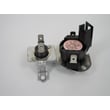
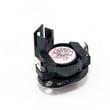
| Runs, no heat | Blown thermal fuse | Test and replace thermal fuse W10909685 if open |
| Runs, long dry times | Vent restriction or lint buildup | Clean venting; confirm strong exhaust airflow |
| Stops early on Sensor cycles | Moisture sensing issue or load not contacting sensors | Clean sensor bars; reduce load size |
If the drum won’t turn or the dryer is noisy
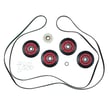
A second very common Maytag dryer complaint is tumbling problems (squealing, thumping, or a drum that will not rotate). These are usually wear items in the drum support and belt drive system.
- Thumping after sitting: flat spots on drum rollers can diminish after a few minutes.
- Squealing or rumbling: inspect rollers and idler pulley.
- No tumble: check the belt and idler system.
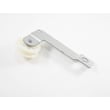
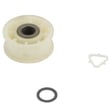
Helpful parts often used for these symptoms include the dryer idler pulley W10837240 and dryer drum support roller WPW10314173.
Why it matters
Good airflow protects the heating system, improves dry times, and helps prevent repeat failures. On MED5630HC1, the control can also indicate airflow trouble (for example, a Check Vent light during Sensor cycles), so fixing venting issues saves energy and reduces breakdowns.
Last updated: January 2026
What is the life expectancy of a Maytag dryer?
A Maytag dryer typically lasts 10 to 15 years with normal household use. For your Maytag MED5630HC1, regular airflow and lint maintenance (as outlined in the MED5630HC1 use and care guide) is the biggest factor in reaching the high end of that range.
What most affects lifespan on the MED5630HC1
These habits reduce wear on the motor, heater system, and drum support components:
- Clean the lint screen before every load.
- Keep the exhaust venting clear; remove lint buildup from the full vent run at least every 2 years.
- Avoid overloading; loads should tumble freely for proper drying and less strain.
- Use Sensor Cycles when possible; they reduce overdrying and heat stress.
- Level the dryer so the drum and support rollers wear evenly.
Quick maintenance schedule (simple and effective)
| Task | How often | Why it helps |
|---|---|---|
| Clean lint screen | Every load | Improves airflow and drying performance |
| Wash lint screen (remove residue) | Every 6 months | Prevents longer dry times from screen buildup |
| Clean exhaust vent run | Every 2 years | Reduces heat stress and improves efficiency |
| Check vent hood airflow outside | Monthly | Catches clogs or crushed venting early |
When “old age” is really a fixable wear part
If your dryer is getting noisy, taking longer to dry, or squealing, it is often normal wear items rather than the dryer being “done.” On the MED5630HC1, common wear-related fixes include:
- Drum support roller wear (thumping, rumbling): dryer drum support roller WPW10314173
- Idler pulley wear (squeal): dryer idler pulley W10837240
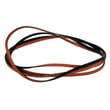
- Belt wear (slipping, thump, no tumble): dryer drive belt 661570V
Why it matters
A dryer that is vented well and kept clean runs cooler and dries faster. That reduces cycling time and heat stress, which are two of the biggest drivers of early failure in any electric or gas dryer.
Last updated: January 2026
How to fix E1 error on dryer?
On the Maytag MED5630HC1 dryer, “E1” is not a standalone user-fixable code; it typically appears as part of an alternating “F# E#” service code (for example, F1 E1). When an F# E# code appears, the control has detected a condition that requires service.
What to do first (safe, model-appropriate steps)
- Touch POWER/CANCEL to stop the cycle.
- Unplug the dryer (or switch the breaker off) for 1 minute, then restore power.
- Start a Timed Dry heated cycle and see if the code returns.
- If the display shows “Loc” instead, press and hold CONTROL LOCK for 3 seconds to unlock.
These display behaviors and control lock steps are covered in the MED5630HC1 use & care manual.
When to stop troubleshooting and schedule service
If the dryer shows an F# E# code again after the reset, we recommend professional diagnosis. That code format indicates the electronic control is detecting a fault it cannot correct during normal operation.
- Avoid repeated restarts that could overheat the dryer
- Do not bypass safety devices
- Have the technician note the exact code (F number and E number)
Related issues that can look similar (but use different codes)
Some problems are user-correctable, but they show different messages than F# E#.
| What you see on MED5630HC1 | What it means | What you can do |
|---|---|---|
| “PF” | Power failure interrupted the cycle | Restart the cycle; check home power stability |
| “L” or “L2” | Low or no line voltage | Check both breakers/fuses; use a heated Timed Dry; call an electrician if it persists |
| Check Vent light | Airflow restriction detected during Sensor cycles | Clean lint screen; inspect venting |
| “F# E#” (includes E1) | Service code | Schedule service |
Why it matters
Treating an F# E# code as a service condition helps prevent repeat shutdowns, overheating, and unnecessary parts replacement. It also gets you to the fastest, most accurate fix for your Maytag dryer.
Last updated: January 2026