Owner’s manual
 Error Codes


How to tell cubic feet of Kenmore refrigerator by model number?
You can’t determine the exact cubic feet of a Kenmore refrigerator from the model number alone. For Kenmore model 10659589990, the correct way is to look up the capacity specification in the owner's manual, then use measurements only as a backup estimate.
- Check the capacity spec in the manual (most accurate).
- Look for a rating label inside the fresh food compartment; many units list capacity there.
- If you only have exterior measurements, estimate cubic feet using the formula below (least accurate).
Use interior measurements when possible (usable space), not the outside cabinet size.
- Measure width (in.), depth (in.), and height (in.) of the storage cavity.
- Multiply:
width × depth × height = cubic inches - Convert to cubic feet:
cubic inches ÷ 1728 = cubic feet
| Step | What to do | Example |
|---|---|---|
| 1 | Multiply inches | 30 × 24 × 60 = 43,200 in³ |
| 2 | Divide by 1728 | 43,200 ÷ 1728 = 25.0 ft³ |
Even with careful measuring, estimates often run high because they don’t subtract for:
- Wall insulation thickness and air channels
- Shelves, bins, and ice maker space
- Evaporator cover and ducting
- Freezer divider and door storage geometry
Capacity affects how you shop for replacement parts and accessories (like a refrigerator water filter), and it helps you compare similar side-by-side refrigerator sizes accurately.
Last updated: February 2026
Where is the model number on a Kenmore side by side refrigerator?
On Kenmore side-by-side refrigerator model 10659589990, the model number is printed on the model and serial number label located on the inside wall of the refrigerator compartment (fresh food section). You can use that label to record the model and serial number for parts and service.
- Open the refrigerator (fresh food) door, not the freezer door
- Look along the inside side wall of the refrigerator compartment
- Check near the upper area first, then scan downward
- Look for a model and serial number sticker or plate
- Write down the full model number exactly as shown (for this unit it starts with 106.)
Most Kenmore labels include these fields:
- Model number (for example, 10659589990)
- Serial number
- Purchase date (often a blank line for you to fill in)
| Item on label | What it’s used for | When you need it |
|---|---|---|
| Model number | Identifies the exact refrigerator design | Ordering parts like a water filter or ice maker |
| Serial number | Identifies the production run | Service history, warranty paperwork |
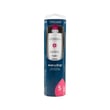
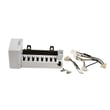
Using the exact model number helps us match the correct Kenmore parts for your refrigerator, such as the refrigerator water filter EDR5RXD1 or the ice maker assembly - refrigerator ice maker by whirlpool 4317943. Small model-number differences can change the correct water filter housing, inlet valve, or door gasket.
- Match the model number from the label first
- Then match the part ID on the part listing (example: EDR5RXD1)
- If you are replacing a water filter, follow the steps in the owner's manual
Last updated: February 2026
What are the most common problems with Kenmore refrigerators?
The most common problems we see on Kenmore refrigerators like model 10659589990 are cooling issues, ice maker and water dispenser problems, water leaks, excess frost, lights not working, and unusual noises. Many of these trace back to airflow restrictions, dirty condenser coils, door seal gaps, or water supply and filter issues (see the owner's manual).
- Not cooling or weak cooling: dirty condenser coils, blocked vents, defrost system trouble, or a failing compressor
- Runs too much: warm room temperature, dirty coils, frequent door openings, or door gaskets not sealing
- Ice maker not making ice: water supply shut off, kinked water line, clogged filter, or ice maker failure
- Water or ice leaking at the dispenser: filter installed incorrectly or clogged, or user technique (not holding the glass under the chute long enough)
- Lights not working: loose/burned-out bulb or doors not fully closed
- Noisy operation: normal operating sounds, or fan-related noise if airflow parts are worn
- Confirm the unit is plugged into a grounded 3-prong outlet; reset the breaker if needed.
- Make sure refrigerator and freezer controls are not set to OFF.
- Clean condenser coils; dirty coils reduce heat transfer and make the compressor work harder.
- Check doors close fully and gaskets seal all the way around.
- If ice or water is acting up, verify the shut-off valve is open and the supply line is not kinked.
| Symptom | Common part to check/replace | Example part for this model |
|---|---|---|
| Bad-tasting water, slow dispense, no ice | Water filter | Refrigerator water filter EDR5RXD1 |
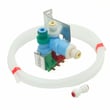
| No ice, weak fill, dispenser issues | Water inlet valve | Refrigerator inlet valve W10408179 |
| Ice maker not producing ice | Ice maker assembly | Ice maker assembly 4317943 |
| Frost buildup, warm temps after a few days | Defrost components | Refrigerator defrost bi-metal WPW10225581 |
These problems often start small (slower ice production, longer run times) but can lead to food temperature swings, frost buildup, and higher energy use. Catching airflow, door seal, and water supply issues early prevents bigger repairs.
Last updated: February 2026
Do they still make 10659589990 refrigerators?
No. Kenmore model 10659589990 is an older side-by-side refrigerator model number, so it is no longer manufactured as a “new” refrigerator. You can still keep this model running by using the parts diagrams and maintenance instructions in the owner's manual and replacing worn components as needed.
Even when a refrigerator model is discontinued, parts support often continues for many years. For the Kenmore 10659589990, that typically means:
- You can still identify parts using the model number and exploded-view diagrams
- Many common wear items remain available (filters, valves, ice maker parts, door hardware)
- Some cosmetic items may be harder to find over time
- Repairs are usually practical when the issue is a serviceable part (not sealed-system failure)
If you are maintaining water, ice, or temperature performance, these are frequent fixes for this style of Kenmore side-by-side:
- Water quality or slow flow: replace the refrigerator water filter EDR5RXD1
- No ice or weak water dispense: check the refrigerator inlet valve W10408179
- Ice maker not cycling or not filling: replace the ice maker assembly - refrigerator ice maker by whirlpool 4317943
- Frost buildup or warm freezer: inspect defrost components such as the refrigerator defrost timer W10822278
| Situation | Typical next step | Why |
|---|---|---|
| Water tastes bad or flow is slow | Replace water filter | Restores flow and filtration performance |
| Ice maker stopped but freezer is cold | Test/replace inlet valve or ice maker | Most common ice failures are water supply or ice maker module |
| Doors not sealing well | Inspect gasket and door alignment | Poor seals cause warm temps and frost |
| Not cooling at all | Diagnose compressor/start components | Sealed-system repairs are more complex |
Knowing the model is discontinued helps set expectations: you will not find a brand-new 10659589990 on the market, but you can still extend its life by replacing high-failure parts (water filter, inlet valve, ice maker, defrost controls) and following the care and safety guidance in the owner's manual.
Last updated: February 2026
How to replace an ice maker in a side by side refrigerator?
For Kenmore model 10659589990, replacing the ice maker is a straightforward swap: shut off power and water, remove the ice bin or bucket, disconnect the harness and fill tube, then mount the new ice maker and restore water and power. Use the owner's manual for your exact ice maker style and access steps.
- Unplug the refrigerator or turn off the circuit breaker.
- Turn off the household water shut-off valve feeding the refrigerator.
- Empty the ice bin or bucket; use warm water to melt stuck ice (never use sharp tools).
- Protect the floor with towels; a small amount of water can spill.
- Have a nut driver/screwdriver ready and keep mounting screws organized.
- Remove the ice storage bin or bucket.
- Some versions use a wire shut-off arm; lift it to the OFF (up) position before removing the bin.
- Access the ice maker (freezer compartment) and remove the cover if present.
- Disconnect the wiring harness from the ice maker.
- Remove mounting screws, then lift the ice maker off its mounting points.
- Install the new ice maker, reusing the mounting points and screws.
- Reconnect the harness, reinstall the cover, then reinstall the bin or bucket.
- Turn water and power back on, then set the ice maker to ON.
Our manual guidance for this style of Kenmore side-by-side is:
| Item | Normal expectation |
|---|---|
| Time to start making ice | Up to 72 hours for full production |
| Normal output | About 7 to 9 batches per 24 hours |
| Max output (some models) | About 10 to 14 batches per 24 hours |
- Confirm the water shut-off valve is fully open.
- Make sure the ice maker is actually ON (wire arm down, or switch set to ON depending on style).
- Check for a jam at the ejector area; clear ice with a plastic utensil.
- If water is not filling the mold, diagnose the water supply side; the refrigerator inlet valve W10408179 is a common failure point.
A correctly installed ice maker and properly seated ice bin or bucket prevents dispenser issues, improves ice production consistency, and helps avoid jams and water flow problems.
Last updated: February 2026