Error Codes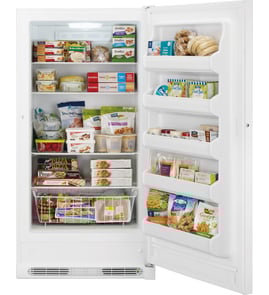






Why is my Whirlpool refrigerator getting frost in the freezer?
Frost in the freezer section usually means warm, moist air is getting inside or the defrost system is not clearing normal ice off the evaporator. On Whirlpool model EV171NYMS05 (upright freezer), the most common causes are a door seal leak, frequent door openings, or a defrost timer issue.
Quick checks we recommend first
- Make sure the door closes fully and is not held open by a bin, shelf, or package.
- Check the gasket for gaps, tears, or areas that feel stiff and won’t seal.
- Look for heavy frost mainly on the back interior panel; that often points to a defrost problem.
- Confirm the freezer is level front-to-back and side-to-side so the door self-closes.
- Reduce door-open time and avoid loading warm, uncovered food.
What usually causes frost (and what to do)
| What you see | Most likely cause | What to do next |
|---|---|---|
| Frost around the door opening | Door not sealing | Clean gasket and cabinet mating surface; warm and reshape gasket if warped |
| Frost only on back wall inside | Defrost system not working | Test/replace defrost components; start with the timer on timer-based models |
| Snowy frost everywhere | Door left ajar or high humidity | Improve closing, limit openings, check room humidity |
Parts that can be involved on EV171NYMS05
If your freezer uses a mechanical defrost system, the defrost timer is a common failure point. If the timer stalls, the evaporator can ice over and airflow drops, which leads to frost and warming.
- Consider inspecting the defrost timer (listed for this model as “Defrost Timer”, part number WP3-81329).
- If you see damaged wiring or loose connections during inspection, use a safe testing approach before replacing parts; our guide how to use a multimeter to test electrical parts video helps with basic checks.
Why it matters
Frost buildup restricts airflow across the evaporator, which makes the compressor run longer, temperatures swing, and food can thaw and refreeze. Fixing the air leak or defrost issue restores normal cooling and efficiency.
Last updated: January 2026
How to reset Whirlpool freezer?
For a Whirlpool EV171NYMS05 upright freezer, the most reliable reset is a power reset: unplug the freezer (or switch the circuit breaker off) for 5 minutes, then restore power and let temperatures stabilize for up to 24 hours. This clears many control and cooling “glitches.”
Recommended reset steps (power reset)
- Turn the temperature control to a mid setting (if it has a dial) before unplugging.
- Unplug the freezer, or turn the dedicated breaker off.
- Wait 5 minutes (this lets the control and compressor protection reset).
- Restore power.
- Set the temperature back to your normal setting.
- Allow 4 to 24 hours for the cabinet temperature to fully stabilize.
If it still is not cooling right after the reset
A “reset” will not fix a failed component. These checks help you decide what to test next:
- Confirm the outlet has power and the cord is firmly seated.
- Listen for the compressor and fan operation after power is restored.
- Check for heavy frost buildup on the back interior panel (defrost system issue).
- Make sure the door closes tightly and the gasket seals all the way around.
- Verify the freezer is not overpacked and vents are not blocked.
Common symptoms and what they usually point to
| Symptom after reset | Most common cause | What to check next |
|---|---|---|
| Runs constantly, warm temps | Air leak or dirty condenser area | Door seal, airflow, room temp |
| Frost wall or ice buildup | Defrost system problem | Defrost timer, heater |
| No interior light, no sound | Power supply issue | Outlet, breaker, wiring |
| Light works, no cooling | Start device or compressor issue | Start components, compressor |
Parts that are often involved (when “resetting” does not help)
If you are troubleshooting beyond a reset, these model-compatible parts are commonly checked or replaced:
- Defrost timer wp3-81329 (controls defrost cycles)
- Heater 8201749 (melts frost off the evaporator during defrost)
- Refrigerator door gasket WP4357142 (prevents warm air leaks that cause frost and long run times)
Why it matters
A proper reset clears temporary control issues and compressor protection lockouts. If temperatures do not recover within 24 hours, the freezer usually has an airflow, defrost, or sealed-system problem that needs diagnosis, not repeated resets.
Last updated: January 2026
What causes an upright freezer to stop freezing?
An upright freezer like Whirlpool EV171NYMS05 usually stops freezing because airflow or heat removal is blocked (overpacked cabinet, dusty condenser area, door not sealing), or because a cooling or defrost component fails (defrost timer, defrost heater, compressor). Start with the simple airflow and door checks first to protect food.
Quick checks we recommend first
- Verify the temperature control is set colder and the freezer is running.
- Make sure the door closes fully and the seal is tight all the way around.
- Look for heavy frost on the back wall or behind the evaporator cover.
- Keep packages from blocking interior vents; do not pack items tight to the back wall.
- Vacuum dust from the lower front grille area and the condenser section.
Common causes and what they look like
| What you notice | Likely cause | What to do next |
|---|---|---|
| Freezer runs but warms up | Poor airflow or dirty condenser area | Clean, improve clearance, recheck temps after 24 hours |
| Frost builds up fast, temps rise | Defrost system problem | Check defrost components such as the defrost timer and heater |
| Moisture, frost near door, temps drift up | Door not sealing | Inspect gasket for gaps, tears, or warping |
| Clicking, then stops, no steady running | Compressor start or compressor issue | Unplug for 5 minutes; if it repeats, schedule service |
Parts that commonly relate to “not freezing” symptoms
If your troubleshooting points to a specific failure, these EV171NYMS05-COMPATIBLE parts are often involved:
- Defrost timer wp3-81329 (controls defrost cycles; failure can cause frost buildup and poor cooling)
- Heater 8201749 (defrost heater; failure can allow ice to choke airflow)
- Refrigerator door gasket WP4357142 (door seal; leaks let warm, moist air in)
- Upright freezer compressor W10309994 (main cooling component; sealed-system repairs typically require a technician)
Why it matters
When airflow across the evaporator is restricted or the freezer cannot shed heat at the condenser, cabinet temperature rises quickly. Fixing a door-seal or defrost issue early prevents heavy frost, long run times, and food spoilage.
Last updated: January 2026