Installation guide
 Owner’s manual
 Error Codes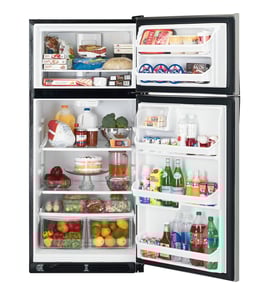



Is a top mount fridge better than a bottom mount?
A Kenmore top-mount refrigerator like model 25370509614 is “better” when you want a typically lower purchase cost, simpler layout, and easy freezer access; a bottom-mount is “better” when you want the fresh-food section at eye level for everyday use. The best choice depends on how you cook and what you reach for most.
Quick comparison: top-mount vs bottom-mount
| Feature | Top-mount (freezer on top) | Bottom-mount (freezer on bottom) |
|---|---|---|
| Most-used items (fresh food) | Lower, you bend more | Higher, less bending |
| Freezer access | Easier, at eye level | Lower, often a drawer |
| Organization | Simple shelves and bins | Often more fresh-food visibility |
| Typical cost and complexity | Often lower and simpler | Often higher and more complex |
When a top-mount is the better fit
We typically recommend a top-mount refrigerator when these points match your needs:
- You use the freezer frequently (frozen meals, bulk items, ice trays)
- You want a straightforward design with fewer features to maintain
- You prefer a lighter door swing and simpler storage layout
- You are replacing an older top-freezer and want a similar fit and feel
- You want easier access to freezer items without crouching
When a bottom-mount is the better fit
A bottom-mount can be the better choice when:
- You cook often and reach into the fresh-food section many times per day
- You want produce, dairy, and leftovers closer to eye level
- You prefer a freezer drawer that can hold larger, stacked items
Why it matters (comfort, efficiency, and installation)
“Better” usually comes down to daily ergonomics and how the refrigerator is installed. For example, proper airflow clearances (typically 3/8 inch at the sides and top, and 1 inch at the back) help cooling performance and reduce run time. We also recommend reviewing leveling and placement guidance in the 25370509614 owner's manual and 25370509614 installation guide so doors close correctly and the unit ventilates as designed.
Last updated: January 2026
Who makes Kenmore refrigerator model 25370509614?
Kenmore model 25370509614 is a Kenmore-branded top-mount refrigerator built on a 253-prefix platform that is commonly associated with Frigidaire/Electrolux manufacturing. For model-specific identification details (including where to find the serial plate), follow the guidance in the 25370509614 owner's manual.
How to confirm the manufacturer on your exact unit
We recommend verifying using the model and serial information on the refrigerator’s serial plate (typically inside the fresh food compartment).
- Locate the serial plate inside the refrigerator compartment
- Record the full model number and serial number exactly as shown
- Match the 253. prefix and the remaining digits to the documentation for your unit
- Use the serial information when ordering parts or scheduling service
- Keep the purchase date with your records for warranty and service history
Why the “253” prefix matters
Kenmore uses different model prefixes to indicate the manufacturing source for a product line. For 253-prefix refrigerators, the platform is widely tied to Frigidaire/Electrolux designs, which is why you may see many compatible parts listed under Frigidaire-sourced components.
| What you see | What it usually indicates | What to do next |
|---|---|---|
| Model starts with 253 | Frigidaire/Electrolux-built platform | Verify on the serial plate and in the manual |
| Parts labeled Frigidaire-compatible | Shared component family | Order by model number to ensure fit |
Why it matters when ordering parts
Knowing the manufacturing platform helps you choose the right replacement parts and troubleshooting steps for your Kenmore refrigerator.
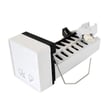
For example, common repairs on this model family often involve cooling airflow or ice production components such as the refrigerator ice maker 241798231 or the refrigerator evaporator fan motor 242077705.
Last updated: January 2026
What are the disadvantages of a top mount fridge?
A Kenmore top-mount refrigerator like model 25370509614 typically costs less and is simple to service, but the main disadvantages are less convenient fresh-food access (more bending), fewer premium organization features, and fewer built-in dispenser options compared with many bottom-freezer designs. See the 25370509614 owner’s manual for your exact feature set.
Common disadvantages (what you’ll notice day to day)
- More bending for fresh food: the refrigerator section is lower, so you reach down more often.
- Less “eye-level” organization: produce drawers and lower shelves can be harder to see and keep sorted.
- Fewer high-end features: many top-mounts skip through-the-door ice/water and advanced controls.
- Freezer access can be less ergonomic: bulky frozen items may be harder to stack and retrieve.
- Door-swing clearance matters: you may need extra space to fully open doors and drawers.
Quick comparison: top-mount vs bottom-freezer
| Feature | Top-mount (like 25370509614) | Bottom-freezer |
|---|---|---|
| Fresh-food access | Lower, more bending | Higher, easier access |
| Freezer access | Higher, easier reach | Lower drawer, easier sorting |
| Typical features | Simpler, fewer extras | More premium options |
| Cost to buy/repair | Often lower | Often higher |
What to check on your specific Kenmore 25370509614
Use these checks to decide if the “disadvantages” apply to your kitchen and habits:
- Measure door swing and clearance needs using the 25370509614 installation guide.
- Confirm whether your unit is configured for an optional ice maker (some versions are).
- Review shelf and drawer layout to see if it fits how you store produce and leftovers.
- Verify recommended room temperature range and ventilation clearances for best cooling performance.
Why it matters
Most “downsides” are about ergonomics and features, not reliability. If you access fresh food many times per day, the lower refrigerator compartment is usually the biggest tradeoff.
Last updated: January 2026
What size is a Kenmore refrigerator model 25370509614?
Kenmore top-mount refrigerator model 25370509614 is a standard full-size top-freezer style; most units in this class are about 30 to 33 inches wide, 65 to 69 inches tall, and 28 to 34 inches deep (depth varies most with handles and door swing). For the exact published dimensions for your unit, use the 25370509614 owner's manual.
How to measure your refrigerator correctly
To avoid fit issues, we recommend measuring the cabinet and also planning for doors, handles, and airflow.
- Width: measure the cabinet at the widest point (not the doors)
- Height: floor to top of cabinet (include hinge cover if it sits higher)
- Depth: measure cabinet depth, then measure again including handles
- Door swing: confirm doors can open fully without hitting walls or cabinets
- Clearance: leave space for ventilation and to pull the refrigerator out for service
Typical size ranges (what most customers see)
| Measurement | Typical range for top-mount refrigerators | Notes |
|---|---|---|
| Width | 30 to 33 in. | Common cabinet cutout widths are built around these sizes |
| Height | 65 to 69 in. | Varies by capacity and hinge design |
| Depth | 28 to 34 in. | Deepest measurement is usually with doors and handles |
Clearance planning checklist
Use these common planning rules, then confirm the exact requirements in the installation guide.
- Leave room behind for the power cord and (if equipped) water line
- Keep enough space above and at the sides for airflow
- Make sure all four corners sit firmly on a level floor
- Plan a path to move the refrigerator in and out without tipping
Why it matters
Correct sizing and clearance prevent poor cooling, door sealing problems, and damage to flooring or cabinets. Proper leveling also helps the doors close and seal consistently.
Last updated: January 2026