Installation guide
 Owner’s manual
 Error Codes

What's the average lifespan of a KitchenAid dishwasher?
A KitchenAid dishwasher typically lasts 10 to 14 years with normal household use. For your KitchenAid KUDS30FXSS4 undercounter dishwasher, consistent cleaning, correct loading, and fixing small issues early are what most often push it toward the high end of that range (or beyond). See the KUDS30FXSS4 owner’s manual for the maintenance routine recommended for your exact model.
What affects lifespan the most
- Water quality and hard water buildup; using rinse aid helps reduce deposits and improves drying
- Filter and sump cleanliness; keeping debris out reduces strain on the wash system
- Drain performance; slow draining can overwork the drain system and leave dirty water behind
- Heat and drying performance; poor heating can lead to longer, less effective cycles
- How often you run it; multiple loads per day shortens service life compared to a few loads per week
Quick maintenance checklist (high impact)
- Use rinse aid regularly for better drying and to help control mineral deposits (especially with hard water).
- Run hot water at the sink before starting a cycle so the dishwasher fills with hotter water.
- Keep spray arms clear of labels, seeds, and broken glass.
- Check the drain path if you notice standing water or a sour odor.
- Avoid overloading; it reduces cleaning and increases wear on racks, wheels, and pump components.
Common “wear items” and what they do
| Part area | What wears out | What you’ll notice |
|---|---|---|
| Drain system | Drain pump, drain hose | Water left in tub, gurgling, slow drain |
| Wash/heat system | Heater, wash motor | Poor drying, cooler water, weak wash |
| Racks | Wheels, adjusters, stops | Rack won’t roll, sags, won’t stay aligned |
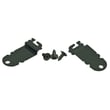
If your racks are binding or not staying aligned, replacing rack hardware like the dishrack adjuster kit (W10712394) - dishwasher rack component by whirlpool W10712394 can prevent extra stress on the door and tub from forcing the rack in and out.
Why it matters
A dishwasher that is maintained tends to wash more efficiently and run fewer repeat cycles. That reduces wear on high-cost components like the sump and motor assembly, and it helps you get the full expected lifespan from the KUDS30FXSS4.
Last updated: February 2026
What is the most common problem with a KitchenAid dishwasher?
The most common issues we see with KitchenAid dishwashers like model KUDS30FXSS4 are poor cleaning (food left on dishes) and drainage problems (standing water). These usually trace back to restricted water flow, a clogged drain path, or a failing pump or heater.
Most common symptoms and what they usually mean
- Dirty dishes after a cycle: spray arms not spinning freely, low water fill, or wash system restriction
- Standing water in the tub: drain hose restriction, disposer/air gap blockage, or a weak drain pump
- Not drying well: heater circuit issue, rinse aid problem, or door not latching consistently
- Leaks at the bottom/front: door seal wear or door alignment issues
- Won’t start or stops mid-cycle: door latch issue, power supply problem, or control fault
Quick checks we recommend first (fast, no parts)
Use the steps in the KUDS30FXSS4 installation guide to confirm the basics that commonly cause “no wash” or “no drain” complaints.
- Verify the dishwasher is getting power (breaker/fuse) and the door closes and latches firmly
- Confirm the water supply valve is fully open
- Start a short cycle; after about 2 minutes, open the door and confirm there is water in the bottom of the tub
- Inspect the drain routing for kinks or a high loop; correct routing prevents backflow and slow draining
- Check for obvious leaks at the water supply connection and drain connection
Parts that commonly solve these problems on KUDS30FXSS4
If the quick checks point to a component failure, these model-compatible parts are common fixes:
| Problem you see | Most likely part area | Example model-compatible part |
|---|---|---|
| Standing water, humming during drain | Drain system | Dishwasher drain pump WPW10348269 |
| Slow drain or water backing up | Drain hose/routing | Dishwasher drain hose 8269144A |
| Poor drying, water not heating | Heating circuit | Dishwasher heater W10703867 |
| No/low fill, weak wash | Water inlet | Dishwasher water inlet valve WPW10327249 |
Why it matters
Poor cleaning and standing water are usually “system” problems, not just detergent. Restoring correct fill, wash circulation, heating, and draining protects the motor, prevents odors, and gets cycle performance back to normal.
Last updated: February 2026
How to fix rubber seal on KitchenAid dishwasher?
On KitchenAid dishwasher model KUDS30FXSS4, fixing the rubber door seal usually means reseating it evenly in the channel around the tub opening, then confirming the door closes without rubbing or gaps. A correctly seated seal stops leaks and reduces door-closing resistance.
Quick fix steps (reseat the seal)
- Turn off power to the dishwasher at the breaker for safety.
- Open the door and inspect the seal for twists, flat spots, tears, or hardened sections.
- Starting at the top center, press the seal firmly into the channel using your fingers, working evenly down both sides.
- Make sure corners are fully seated; corners that pop out are the most common leak point.
- Close and latch the door for several hours so the gasket “sets” into the channel.
- Run a short cycle and check for drips along the bottom and both front corners.
If it still leaks: what to check next
A door seal can be installed correctly and still leak if the door alignment is off.
- Check that the dishwasher is level side-to-side and front-to-back.
- Confirm the door is not contacting screws, brackets, or the countertop.
- Make sure the tub is centered in the cabinet opening so the door doesn’t rub.
- Inspect the lower edge of the door area for debris that prevents full sealing.
Common causes and the best next action
| What you notice | Likely cause | Best next step |
|---|---|---|
| Leak at one front corner | Seal not fully seated in corner | Reseat corner; latch door to set |
| Door feels “tight” closing | Seal twisted or bunched | Remove and reinstall evenly |
| Leak after install, door rubs | Dishwasher not centered/level | Level and re-center dishwasher |
| Seal looks cracked or stiff | Worn gasket material | Replace the seal |
Why it matters
A properly seated rubber seal keeps wash water inside the tub, protects the floor, and helps the latch pull the door fully closed. If the door rubs because the unit is out of level, even a new seal can leak.
For model-specific diagrams and door area details, use the KUDS30FXSS4 owner’s manual and the KUDS30FXSS4 installation guide.
Last updated: February 2026