 Owner’s manual
 Error Codes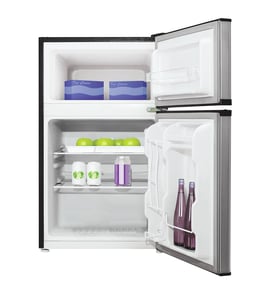

How to tell cubic feet of Kenmore refrigerator by model number?
For Kenmore model 56495499400, the model number by itself usually does not reliably encode the exact cubic-foot capacity. The most accurate way is to look up the capacity in the product specifications in the owner's manual, or calculate it from the usable interior measurements.
- Check the specs: Capacity is typically listed as “Capacity” or “Total volume” in the owner's manual.
- Measure and calculate (good estimate): Measure the main fresh-food compartment’s usable height x width x depth in inches.
- Convert to cubic feet: Divide cubic inches by 1,728.
- Account for real-world space: Subtract space taken by shelves, bins, the compressor hump, and the freezer box (if present).
- Use the model label to confirm you have the right unit: The manual notes the model/serial label is on the upper back area of the refrigerator.
- Empty the compartment enough to measure flat-to-flat.
- Measure usable interior:
- Height (top liner to floor)
- Width (left liner to right liner)
- Depth (back liner to inside front edge, not the door)
- Multiply:
H x W x D = cubic inches - Convert:
cubic inches ÷ 1728 = cubic feet
| What you measure | What it gives you | Best for |
|---|---|---|
| Fresh-food compartment only | Refrigerator section capacity | Compact fridges with a small freezer box |
| Fresh-food + freezer box | Approx. total capacity | Comparing to “total capacity” listings |
Most compact refrigerators fall around 1.7 to 4.5 cubic feet, depending on whether they include a freezer compartment and how much space the cooling components take up.
Capacity affects how much food fits, how you organize shelves and door bins, and whether a replacement shelf, door gasket, or bin needs to match a smaller compact interior.
Last updated: February 2026
What is the average lifespan of a Kenmore 56495499400 refrigerator?
A Kenmore 56495499400 compact refrigerator typically lasts 10 to 15 years. With basic care (good airflow, clean condenser area, and tight door seals), many units reach the upper end of that range before major sealed-system repairs like a compressor become the deciding factor.
- Ventilation and heat: Keeping the refrigerator away from heat sources and allowing airflow helps it run more efficiently.
- Door gasket condition: A leaking door seal forces longer run times and shortens component life.
- Cleaning and odors: Regular cleaning helps prevent corrosion, mold, and lingering smells.
- Temperature habits: Avoid frequent door openings and give temperatures time to stabilize after changes.
- Power quality: Surges and repeated outages can stress the compressor and control components.
Use the care and cleaning guidance in the owner's manual and focus on these practical steps:
- Keep the cabinet level so the door closes fully.
- Wipe spills promptly and clean interior surfaces with mild cleaner.
- Keep the condenser area (if accessible) free of dust and pet hair.
- Check the door gasket for gaps; clean it and ensure it seals all the way around.
- Leave space around the unit for airflow; avoid pushing it tight against walls.
| If your refrigerator is... | Usually makes sense to... |
|---|---|
| Under 8 years old | Repair common wear items first (seals, fan issues, thermostat/control) |
| 8 to 12 years old | Compare repair cost to replacement value and energy use |
| Over 12 years old | Replace if the compressor or sealed system is failing |
Knowing the typical lifespan helps you plan for maintenance and decide when a cooling problem is worth repairing. On compact refrigerators, long run times from poor airflow or a weak door seal are common reasons performance drops earlier than expected.
Last updated: February 2026
Can you still get parts for Kenmore refrigerators?
Yes. You can still get replacement parts for Kenmore refrigerators, including the Kenmore compact refrigerator model 56495499400. The fastest way to match the right parts is to use the model number and the diagrams and part lists shown in the 56495499400 owner's manual.
Because Kenmore made many refrigerator designs over the years, the model number is the key to getting the correct fit.
- Confirm the full model number on the appliance ID label (commonly on the upper back area for compact units)
- Use the model number to match parts by description and diagram location
- Compare the old part to the diagram before ordering (shape, mounting points, wire connectors)
- If the issue is a door not sealing, inspect the gasket and door alignment first
- Unplug the refrigerator before removing panels, testing wiring, or replacing parts
Availability varies by model, but these are the most commonly replaced refrigerator parts:
| Part type | What it fixes | Common symptom |
|---|---|---|
| Door gasket (seal) | Air leaks at the door | Warm temps, sweating, frost |
| Thermostat or temperature control | Poor temperature regulation | Too warm or too cold |
| Start device/relay (compressor start components) | Compressor not starting | Clicking, no cooling |
| Fan motor (if equipped) | Poor airflow | Warm fridge, uneven cooling |
Ordering by brand name alone often leads to the wrong part. Ordering by Kenmore model 56495499400 helps ensure the part matches the exact design, wiring, and mounting used in your compact refrigerator.
If you are chasing a display or control-related issue on other Kenmore refrigerator styles, our error code guides can speed up diagnosis. A good starting point is the Kenmore 106 model refrigerator error codes guide.
Last updated: February 2026
How do I reset my Kenmore refrigerator?
For your Kenmore 56495499400 compact refrigerator, the most reliable reset is a power reset: unplug the refrigerator (or switch the breaker off) for 5 minutes, then restore power and allow up to 24 hours for temperatures to fully stabilize. Use the 56495499400 owner's manual for any model-specific control settings.
- Unplug the refrigerator or turn the circuit breaker off.
- Wait 5 minutes (this lets the control and compressor protection reset).
- Restore power.
- Set the temperature back to your normal setting.
- Keep the door closed as much as possible for the next few hours.
- Check cooling again after 4 to 6 hours; full stabilization can take up to 24 hours.
| Symptom | Reset helps most when | Reset usually will not fix |
|---|---|---|
| Not cooling or warm temps | After a power flicker or control glitch | Sealed system or compressor start problems |
| Lights on, odd behavior | Display or control logic is “stuck” | Broken door switch or wiring issue |
| Frost or moisture issues | After extended door openings | Door gasket not sealing or airflow blockage |
- Confirm the outlet has power and the cord is firmly plugged in.
- Make sure the door closes fully and the gasket is sealing.
- Avoid overpacking; compact refrigerators need clear airflow.
- Verify the temperature control was not set too warm.
- Clean the interior and remove odors that can linger after warm-ups (see how to get rid of refrigerator smells).
A power reset clears many temporary control issues and allows the compressor’s built-in protection to restart normally. After any reset or temperature change, compact refrigerators often need several hours to pull down temperature and up to 24 hours to fully stabilize.
Last updated: February 2026
What are the common problems with Kenmore 56495499400 refrigerators?
Common problems with the Kenmore 56495499400 compact refrigerator include warm temperatures from poor airflow or dirty condenser coils, frost buildup from defrost issues, unusual noises from the fan or compressor area, door sealing problems, and water puddles from a blocked defrost drain or condensation. We use the owner's manual to confirm model-specific operating checks and adjustments.
- Not cooling or weak cooling: dirty condenser coils, blocked vents, failed evaporator fan, or a thermostat/control issue
- Freezer frosts up: defrost heater/thermostat problem or door not sealing
- Noisy operation: fan blade hitting ice, worn fan motor, or the unit not level
- Water inside or under the unit: clogged drain path, excess humidity, or door left ajar
- Door not closing or sealing: hinge alignment, gasket not seating, or cabinet not level
- Confirm temperature settings and give the unit 24 hours after any adjustment.
- Clean the condenser coils (unplug first). Dust buildup is a top cause of warm temps.
- Check airflow: do not pack items against interior vents.
- Listen for the fan: a steady fan sound is normal; clicking, scraping, or silence during a cooling call points to a fan/ice issue.
- Inspect the door seal: close a dollar bill in the door; if it slips easily, the gasket may not be sealing.
This model has a reversible door; if the door was recently swapped, recheck hinge alignment and gasket seating so the door self-closes and seals evenly. The door should sit straight with no gaps along the gasket.
| Issue | What you notice | What to do first |
|---|---|---|
| Door not sealing | Warm spots, condensation | Level the unit; clean gasket; check hinge screws |
| Frost buildup | Ice on back wall/evaporator cover | Verify door closes fully; reduce frequent openings |
| Noise | Rattling or scraping | Ensure unit is level; check for ice contacting fan |
Compact refrigerators rely on tight door sealing and clear airflow; small restrictions (dust on coils, blocked vents, a slightly misaligned door) can quickly cause temperature swings, frost, and extra compressor run time.
Last updated: February 2026





