Installation guide
 Owner’s manual
 Error Codes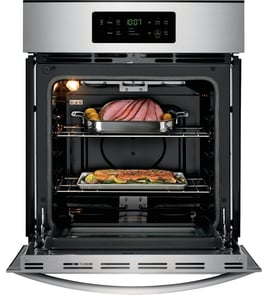




How to find wall oven model number?
For Kenmore wall oven model 79049443411, the model and serial number plate is located along the interior side trim of the oven and is visible when you open the oven door. Use that exact model number when ordering parts or looking up installation requirements.
Where to look on model 79049443411
Check these spots in this order:
- Open the oven door and look along the interior side trim for the serial plate
- Use a flashlight and look on both the left and right interior trim areas
- If the oven is a double wall oven, check the interior side trim for the serial plate location shown in the installation instructions
- Write down the model number, serial number, and any lot number/letter shown on the plate
What to record (so parts match)
When we help you find parts for your Kenmore wall oven, these details prevent ordering the wrong item:
- Model number (example: 79049443411)
- Serial number
- Lot number or letter (if listed)
- Whether it is a single or double wall oven
| What you see on the plate | Why it matters |
|---|---|
| Model number | Identifies the exact design and compatible parts |
| Serial number | Helps confirm production version |
| Lot number/letter | Can narrow down small design changes |
Why it matters
Kenmore wall ovens can look similar across model series, but parts like the control board, wire harness, and temperature sensor can vary by model and production run. Using the serial plate information helps ensure the correct match the first time.
Helpful reference
For the exact serial plate location and installation notes for this model, use the 79049443411 installation guide.
Last updated: January 2026
What is the best brand for electric wall ovens?
For electric wall ovens, the “best” brand is the one that fits your cabinet cutout, electrical supply, and cooking features you will actually use. For a Kenmore wall oven like model 79049443411, we recommend prioritizing correct installation requirements and serviceable parts support over brand name alone; see the 79049443411 installation guide.
How we recommend choosing the best brand
Use these practical checks first; they prevent most fit and performance regrets:
- Fit and installation compatibility: confirm cutout dimensions, required clearances, and that the oven is secured with mounting screws (anti-tip).
- Electrical requirements: plan for a dedicated 120/240V or 120/208V, 60 Hz supply on a separate circuit with proper breaker sizing.
- Cooking performance features: convection, probe support, preheat speed, and temperature stability.
- Serviceability: availability of common repair parts like a temperature sensor, control board, and door lock.
- Error code support: brands with clear diagnostics reduce repair time; use Kenmore 790 manual clean wall oven error codes when troubleshooting.
Brand comparison (what matters most)
| What you care about | What to look for in a brand | Why it helps |
|---|---|---|
| Reliable baking temps | Strong temperature control and calibration options | More consistent results across racks |
| Easier repairs | Common parts availability (sensor, elements, control) | Faster, lower-cost fixes |
| Smooth installation | Clear install specs and anti-tip guidance | Safer install, fewer cabinet issues |
| Diagnostics | Clear fault codes and troubleshooting steps | Less guesswork when it fails |
What “best” means for a Kenmore 79049443411 owner
If you are comparing brands because your current oven is not heating correctly or is throwing codes, it is often more cost-effective to repair first. On this model, common heat and temperature complaints frequently point to components like the oven temperature sensor or heating elements; for example, the range oven temperature sensor 5304504897 is a typical part involved in temperature regulation.
Quick checks before you shop a new oven
- Verify the oven is properly installed and grounded.
- Confirm the oven is not installed stackable or side-by-side (not approved).
- Make sure the unit is secured to the cabinet with mounting screws (anti-tip).
- If temps seem off, use an oven thermometer and compare to the setpoint.
Why it matters
Wall ovens are “built-in systems”; the best brand choice is the one that matches your cabinet and electrical setup and can be supported with parts and diagnostics over time.
Last updated: January 2026
Are all 30 inch wall ovens the same size?
No. “30-inch” wall ovens are grouped by a nominal width, but the exact cabinet cutout width, cutout height, and cutout depth vary by model. For Kenmore model 79049443411, the installation specs show a 30-inch cutout width range and a minimum cutout depth that must be met for the trim to sit flush.
What “30-inch” usually means (and what it does not)
Manufacturers use “30-inch” as a category label, not a guarantee that every oven shares identical dimensions.
Common differences between 30-inch wall ovens include:
- Cutout width range (the opening in the cabinet)
- Cutout height (single vs. double ovens differ a lot)
- Cutout depth (critical for trim fit and convection fan clearance)
- Trim overlap (how much the oven face covers the cutout)
- Electrical junction box location requirements
For the exact requirements for your oven, use the 79049443411 installation guide.
79049443411 cutout sizing: what the install specs show
Based on the installation instructions for this Kenmore wall oven, the 30-inch cutout width is not a single fixed number.
| Installation type | Cutout width (min to max) | Cutout depth (minimum) | Notes |
|---|---|---|---|
| 30-inch single wall oven | 28 1/2 in to 29 in | 23 1/2 in | Depth “G” is critical for proper fit |
| 30-inch double wall oven | 28 1/2 in to 29 in | 23 1/2 in | Not approved for side-by-side or stackable installs |
Why cutout depth matters most
If the cutout depth is too shallow, the decorative trim may not butt against the cabinet, and convection models can develop noise or vibration issues. The install instructions call out the cutout depth dimension as a critical measurement.
Before you buy or swap a “30-inch” wall oven
Use this checklist to avoid fit problems:
- Measure cutout width, height, and depth in three places (top, middle, bottom)
- Confirm the oven is single vs. double (heights are different)
- Verify door clearance in front of the oven when open
- Confirm junction box placement matches the install requirements
- Plan for shims or trim adjustments if your cutout height is oversized
Why it matters
A wall oven that is even slightly mismatched to the cabinet cutout can sit proud, leave gaps around the trim, or require cabinet modification. Matching the cutout specs to the model prevents installation delays and cosmetic issues.
Last updated: January 2026
What is the disadvantage of a wall oven?
A wall oven like the Kenmore 79049443411 typically costs more to buy and install than a freestanding range, and service access can be harder because it is built into cabinetry. You also need a separate cooktop, which can increase total kitchen cost and planning.
Common disadvantages to plan for
- Higher total cost: wall oven plus a cooktop, plus cabinetry work.
- More complex installation: electrical junction box, grounding, and cabinet cutout requirements.
- Harder repairs: built-in placement can make access to wiring, control boards, and fans more time-consuming.
- Cabinet and clearance rules: you must follow required clearances and mounting steps.
- Not flexible for stacking: this model is not approved for stackable or side-by-side installation.
- Tip risk if not secured: anti-tip mounting screws must be installed.
Installation details that affect the “downside”
The installation guide for Kenmore 79049443411 calls out several requirements that can add time and cost, including leaving about 1 1/2 inch clearance at the front, securing the oven with anti-tip mounting screws, and installing the bottom trim for proper operation. See the 79049443411 installation guide.
Quick comparison: wall oven vs range
| Feature | Wall oven | Freestanding range |
|---|---|---|
| Upfront cost | Higher (often) | Lower (often) |
| Installation | Cabinet cutout, junction box, mounting | Typically simpler hookup |
| Cooktop included | No | Yes |
| Service access | More difficult | Easier |
Why it matters
Most wall oven “disadvantages” come from the built-in design: the oven depends on correct cabinet support, clearances, and secure mounting. Planning those details up front helps prevent performance issues and avoids damage to cabinetry.
Last updated: January 2026