Owner’s manual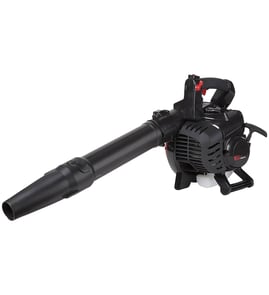




How to find Craftsman leaf blower model number?
Your Craftsman gas leaf blower model number is printed on the product’s model label; for this unit it’s 358.794770 (often shown as 358794770 online). On many blowers, the label is on or near the engine housing, so check the motor casing first.
Check these common label locations (wipe dirt off first so the numbers are readable):
- Side of the engine/motor housing
- Rear of the unit near the handle area
- Near the fuel tank area (around the tank or frame)
- Under or near the air filter cover area
- On the blower housing near the tube connection
For model 358794770, the model number is also shown on the cover of the 358794770 operator’s manual.
Craftsman outdoor power equipment model numbers are often formatted with a prefix and a dot.
| Where you see it | Example for this blower | What it means |
|---|---|---|
| Model label / manual | 358.794770 | Full model format used by Craftsman |
| Parts lookup / online | 358794770 | Same model number without the dot |
We use the model number to match the correct parts diagram and the exact replacement parts (fuel line, air filter, switch kit, tubes). Even small model differences can change the carburetor setup, fuel line routing, or tube fit.
Use the manual and parts list to cross-check what you have:
- Confirm the unit type (blower/vac) and engine size listed in the manual
- Compare your attachments (upper/lower tubes, nozzle, vacuum bag) to the parts list
- Match common service parts by shape and mounting (air filter cover, stop switch)
Last updated: January 2026
What is the best gas-powered leaf blower on the market?
The “best” gas-powered leaf blower depends on how you’ll use it (handheld vs. backpack, blowing vs. vacuuming, yard size). For many homeowners, a strong handheld like the Craftsman 358794770 (rated 215 MPH/470 CFM) is a practical balance of power and portability; for large properties, a backpack blower is usually the top performer.
- Match the style to the job: handheld for quick cleanup; backpack for long runs and big yards
- Compare performance numbers: higher CFM moves more debris; higher MPH helps lift wet or stuck leaves
- Check features you’ll actually use: vacuum capability, tube/nozzle options, easy starting, comfortable grip/harness
- Plan for maintenance: air filter access, fuel line condition, and carburetor serviceability matter long-term
- Use the right fuel mix: most 2-cycle blowers require a specific gas-to-oil ratio
| Type | Best for | Typical strengths | Typical tradeoffs |
|---|---|---|---|
| Handheld gas blower | Driveways, patios, small to medium yards | Lighter, easier to store, lower cost | More arm fatigue, usually less peak output |
| Backpack gas blower | Large yards, heavy leaf season, long sessions | Highest airflow, better comfort over time | Higher cost, more storage space |
This Craftsman model is a 2-cycle gasoline-powered blower rated at 215 MPH / 470 CFM, and it can be used as a blower or a vacuum for dry material (leaves, grass, small twigs). For operating details and specs, use the 358794770 operator’s manual.
Choosing the right blower type and power level saves time and reduces fatigue. It also helps prevent common issues like clogging during vacuum use and poor performance caused by incorrect fuel mix.
Last updated: January 2026
What is better, cfm or mph for a leaf blower?
For the Craftsman gas blower model 358794770, neither CFM nor MPH is “better” by itself; CFM tells us how much air the blower moves, and MPH tells us how fast that air travels. This model is rated 470 CFM and 215 MPH, which is a strong balance for both moving piles and loosening stuck debris (see the 358794770 operator’s manual).
- CFM (cubic feet per minute): moves volume; best for pushing and gathering dry leaves across a wide area.
- MPH (miles per hour): adds force; best for dislodging wet leaves, pine needles, and debris in cracks.
- Best real-world performance: comes from a good balance of both, plus the right nozzle and technique.
| Your cleanup job | Prioritize | Why |
|---|---|---|
| Large driveway, dry leaves | Higher CFM | Moves more material per pass |
| Wet leaves, matted debris | Higher MPH | Breaks debris loose |
| Mulch beds, tight corners | Higher MPH + control | Prevents scattering while still lifting debris |
| General “one blower for everything” | Balanced CFM + MPH | Handles both piling and dislodging |
This Craftsman blower’s 470 CFM helps you build piles quickly, and 215 MPH helps lift stubborn debris. If you want more “punch” at the tip, using the correct nozzle setup matters as much as the numbers.
- Confirm your operating setup and controls in the 358794770 operator’s manual.
- If your airflow feels weak, check the air filter and replace it if dirty (a clogged filter reduces performance); the leaf blower air filter 545146501 is a common maintenance item for this model.
- Make sure tubes and connections are seated and not cracked; air leaks reduce effective CFM and MPH.
CFM and MPH are often marketed like a single “power” number, but they solve different problems. Matching the spec to your debris type helps you finish faster and reduces strain on the 2-cycle engine.
Last updated: January 2026