Installation guide
 Owner’s manual
 Error Codes


How to hard reset a whirlpool dryer?
For a Whirlpool dryer model WGD5800BW0, a “hard reset” is a power reset: disconnect power for a few minutes, then restore power and restart the cycle. This clears many temporary control glitches and addresses a PF (power failure) condition.
Hard reset steps (power reset)
- Turn the dryer OFF.
- Unplug the dryer (or switch the circuit breaker OFF).
- Wait 2 to 5 minutes.
- Restore power (plug back in or turn breaker ON).
- Press and hold START/PAUSE until the drum starts moving.
If the dryer shows PF or won’t restart
The WGD5800BW0 troubleshooting guidance for a PF message is to restart the cycle using the control.
- If the display shows PF, press START/PAUSE to restart.
- If the dryer will not run, confirm the door is fully closed.
- If the dryer still will not start after a reset, check the home power supply (breaker/fuse) and then follow the troubleshooting steps in the WGD5800BW0 owner's manual.
When a reset will not fix it
A reset helps with interrupted cycles and minor electronic glitches. It will not correct a failed component such as a door switch or a drive system problem.
Common no-start causes to check:
- Door not closing or switch not actuating (door switch)
- Start button not being held long enough
- Tripped breaker or blown fuse
- Control detecting a service condition (codes that begin with F)
| Symptom | What to try first | What it points to |
|---|---|---|
| PF on display | Press START/PAUSE | Power interruption |
| Drum never starts | Hold START/PAUSE until drum moves | Start input or door issue |
| Clicking on gas model | Normal operating sound | Gas valve operation |
Why it matters
Resetting the dryer correctly can restore normal operation without replacing parts, and it helps you confirm whether the issue is a simple power interruption or a condition that needs deeper troubleshooting.
Last updated: January 2026
What are the most common issues with WGD5800BW0?
The most common issues we see with the Whirlpool WGD5800BW0 gas dryer are no heat or weak heat, not starting, long dry times from restricted airflow, unusual squealing or thumping noises from drum support parts, and door or sensor-related cycle problems. Use the owner's manual to match symptoms to checks and settings.
Common symptoms and what usually causes them
- Dryer runs but won’t heat: ignition system or gas burner components; also check airflow and lint buildup
- Dryer won’t start: door not fully closed, failed door switch, or a drive system issue
- Takes too long to dry: clogged lint screen, crushed vent, blocked ducting, or restricted outside vent hood
- Squealing, grinding, or thumping: worn drum rollers, idler pulley, or related hardware
- Stops early or dries unevenly: moisture sensor contamination (fabric softener residue) or airflow problems
Parts that commonly fix these problems (when testing confirms failure)
If your troubleshooting points to a worn or failed component, these are frequent replacements for this model:
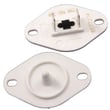
- Dryer door switch WP3406107 (no start when door is closed)
- Dryer gas valve coil kit 279834 (igniter glows but burner won’t stay lit)
- Igniter 279311 (no ignition)
- Dryer drum support roller WPW10314173 (thumping or rumbling)
- Dryer idler pulley W10837240 (squeal, belt slack)
Quick checks we recommend before replacing parts
- Clean the lint screen and confirm strong airflow at the outside vent.
- Verify the cycle and temperature selection (some cycles limit heat).
- Listen for the motor running and the drum turning.
- For heat complaints, check for repeated clicking or short cycling of the flame.
- If the dryer is noisy, rotate the drum by hand (unplugged) to feel for rough rollers.
Symptom-to-part guide (fast reference)
| Symptom | Most likely area | Example part on this model |
|---|---|---|
| Won’t start | Door switch, drive motor | WP3406107, 279787 |
| No heat | Ignition, gas valve coils, sensors | 279311, 279834, WP338906 |
| Loud squeal/thump | Rollers, idler pulley | WPW10314173, W10837240 |
| Long dry times | Venting/ducting, lint screen | W10120998, WPW10293765 |
Why it matters
On a gas dryer like the WGD5800BW0, airflow and ignition work together; a vent restriction can cause long dry times and overheating, while worn drum support parts can damage the drum and belt if ignored.
Last updated: March 2026
What is the capacity of WGD5800BW0?
The Whirlpool WGD5800BW0 gas dryer is a 29-inch wide model, and the installation guide indicates it is designed to align with 3.6 cu. ft. or 3.8 cu. ft. capacity washers for matched height settings. For the exact dryer drum capacity (in cu. ft.), check the specifications section in the WGD5800BW0 owner's manual.
What we can confirm from the installation guide
The installation guide for this Whirlpool dryer provides model-family sizing and setup details that help identify the platform:
- It is shown under 29" wide models with a cabinet width of 29"
- Typical depth shown is about 27 3/4" (varies by door style and venting)
- Height shown is about 43 3/8"
- Leveling legs can be set to match washer heights for 3.6 cu. ft. and 3.8 cu. ft. washers
Where to find the exact capacity (cu. ft.)
Dryer capacity is usually listed as “drum capacity” or “capacity” in the specs section. We recommend checking these spots:
- Specifications or “Product dimensions” section
- Model and serial tag area (then cross-reference in the manual)
- Feature/spec pages that list “drum capacity” explicitly
Quick reference: what the documents show vs. what you are asking
| Item | What it tells you | Where to look |
|---|---|---|
| 29" wide model dimensions | Confirms platform size, not drum volume | WGD5800BW0 installation guide |
| Washer capacity references (3.6/3.8 cu. ft.) | Washer matching height guidance, not dryer capacity | WGD5800BW0 installation guide |
| Dryer drum capacity (cu. ft.) | The capacity you are asking for | WGD5800BW0 owner's manual |
Why it matters
Dryer capacity affects load size, cycle performance, and drying time. If you routinely dry bulky items (comforters, towels), knowing the drum capacity helps you avoid overloading, improve airflow, and reduce wear on the drum support rollers and belt system.
Last updated: January 2026