Installation guide
 Owner’s manual
 Error Codes


What is the average life of a Whirlpool side-by-side refrigerator?
A Whirlpool side-by-side refrigerator like model WRS325FDAM01 typically lasts about 12 years on average, with a common overall range of 10 to 18 years. Consistent maintenance (especially airflow and clean condenser coils) helps you reach the longer end of that range; see the WRS325FDAM01 owner's manual for model-specific care guidance.
Typical lifespan and what changes it
Most side-by-side refrigerators wear based on compressor run time, door use, and heat buildup around the cabinet.
- Clean condenser coils regularly to reduce compressor strain
- Keep doors closed and confirm gaskets seal tightly
- Allow proper ventilation around the refrigerator (side, top, and back clearance)
- Avoid overpacking so air can circulate through shelves and vents
- Keep temperatures stable (frequent big adjustments can increase run time)
Quick maintenance checklist (high impact)
Use this as a simple routine to extend life and reduce “runs all the time” complaints.
| Task | Why it helps | Typical frequency |
|---|---|---|
| Clean condenser area | Lowers heat load, reduces compressor run time | Every 6 to 12 months |
| Check door seal with paper test | Prevents warm air leaks and frost | Every 3 months |
| Verify airflow is not blocked | Prevents warm spots and icing | Monthly |
| Level the refrigerator | Helps doors close consistently | After moving/installation |
What “normal” operation looks like
On WRS325FDAM01, longer run times can be normal because newer, energy-efficient compressors and fans often run longer at lower speeds. Room heat, frequent door openings, and large grocery loads also increase run time.
Why it matters
Knowing the typical 10 to 18 year lifespan helps you decide when a repair (ice maker, water valve, control board) makes sense versus planning for replacement, especially if cooling performance is declining.
Last updated: February 2026
Does the Whirlpool WRS325FDAM01 have an ice maker?
Yes. The Whirlpool WRS325FDAM01 is designed to support an automatic ice maker; you can run it as a standard ice-making refrigerator when it is connected to a household water supply and the ice maker is turned ON (see the WRS325FDAM01 installation guide for water-line setup and ice maker connection details).
How to tell what you have (installed vs. ice maker ready)
We see two common setups on this model family: an ice maker already installed, or an “ice maker kit ready” configuration that needs the ice maker assembly added.
- Look in the freezer for an ice maker module and an ice bin.
- Check for a fill tube and wiring harness near the upper rear freezer wall.
- If the refrigerator is not connected to a water line, keep the ice maker turned OFF to prevent noise and valve cycling.
- If you hear buzzing or clicking from the water valve, that is normal when the valve opens to fill the ice maker.
What you need for ice production
An automatic ice maker needs water, power, and the ice maker switched ON.
| Requirement | What to check | Why it matters |
|---|---|---|
| Water supply | 1/4 in. water line connected; shutoff valve open | No water means no ice |
| Ice maker ON | Wire shutoff arm down or switch set to ON (varies by version) | Ice maker will not cycle when OFF |
| Freezer temp | Typically 0°F to 5°F | Warmer temps slow or stop ice making |
| Bin position | Ice bin seated correctly | Prevents jams and misrouting |
If you need the replacement ice maker assembly
If your ice maker is missing, damaged, or not cycling, the correct replacement for this model is the refrigerator ice maker assembly WPW10300022.
Why it matters
Ice makers are water-valve driven. If the refrigerator is not plumbed in, leaving the ice maker ON can create unnecessary noise and can lead to nuisance symptoms that look like a failure when the real issue is simply “no water connected.”
Last updated: February 2026
Can I use a generic filter in my Whirlpool?
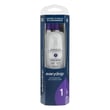
Yes, you can physically install some “generic” water filters in a Whirlpool WRS325FDAM01, but we recommend using the specified replacement filter so filtration performance and flow rate match the refrigerator’s tested requirements. Check the exact filter type and replacement steps in the WRS325FDAM01 owner’s manual.
What the WRS325FDAM01 is designed to use
Your refrigerator’s filtration system is tested to specific conditions (flow, pressure, temperature) and a rated capacity. Using the specified filter helps keep water taste, ice quality, and dispenser flow consistent.
From the documentation: the performance data references a replacement filter P4RFWB (part #W10295370A) and a rated service capacity of 200 gallons.
When a generic filter causes problems
A generic filter is most likely to be an issue when it changes water restriction or doesn’t seal correctly.
- Slow water dispensing or small/hollow ice cubes
- Filter indicator behavior that doesn’t match actual filter life
- Leaks at the filter head or after filter changes
- Off-taste or odor that returns quickly
- Reduced flow when used with reverse osmosis (RO) systems
Water pressure and RO systems (important)
The installation guidance calls out that household water pressure should typically be 30 to 120 psi. If you use an RO system, the refrigerator filter can further reduce pressure; removing the refrigerator filter is sometimes used as a diagnostic step (see the filtration section in the manual).
| Situation | What we recommend | Why it helps |
|---|---|---|
| Normal city water | Use the specified filter type | Maintains tested filtration and flow |
| Low dispenser flow | Verify pressure, then try a known-good specified filter | Separates supply issues from filter restriction |
| RO connected | Confirm RO pressure and sediment filter condition | Prevents pressure drop and weak ice maker fill |
Quick checklist before you decide
- Confirm the filter style/type listed for WRS325FDAM01 in the WRS325FDAM01 owner’s manual.
- After any filter change, flush the system (the manual calls this out after replacement).
- If you see leaking at the connection, stop using that filter and reinstall a properly fitting one.
Why it matters
The water filter is part of the refrigerator’s overall water system. A mismatched filter can reduce dispenser flow, affect ice maker fill, and change filtration results compared to the unit’s certified performance data.
Last updated: February 2026
What is the most common problem with a Whirlpool refrigerator?
The most common Whirlpool refrigerator problem is a cooling complaint (food too warm, freezer not holding temp, or uneven temps). On the Whirlpool WRS325FDAM01, the first fixes we check are airflow and heat removal issues like dirty condenser coils, doors not sealing, and frost buildup that blocks circulation; then we move to fan, defrost, and control-related causes (see the WRS325FDAM01 owner's manual).
Most common symptoms and what they usually point to
- Refrigerator too warm: restricted airflow, dirty condenser coils, door left ajar, or frost blocking the evaporator cover
- Freezer cold but fresh food warm: airflow problem (damper/vents blocked) or evaporator fan issue
- Ice maker not producing or making small/hollow cubes: water supply not fully on, kinked water line, or ice maker switched off
- Noisy operation: normal compressor and fan sound changes, items vibrating on top, or water line noises
- Water leaks/puddles: clogged/iced defrost drain or water line connection issues
Quick checks we recommend first (fast, no parts)
- Confirm the unit is plugged into a grounded 3-prong outlet and cooling is turned on.
- After a move or new install, allow 24 hours for full cooling.
- Make sure doors close fully; re-seat bins and shelves so nothing holds the door open.
- Verify the water shutoff valve is fully open and the supply line is not kinked (ice maker issues).
- Listen for “normal” sounds (buzzing/clicking from the water valve, gurgling during defrost, whirring from fans).
When it’s likely a part issue
If the quick checks do not change anything within a day, these are common next suspects.
| Symptom | Common culprit | Example model-matched part |
|---|---|---|
| Ice maker not making ice | Ice maker assembly | Refrigerator ice maker assembly WPW10300022 |
| No water to dispenser/ice maker | Water inlet valve | Refrigerator water inlet valve WPW10179146 |
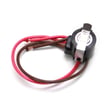
| Frost buildup, warm temps | Defrost system issue | Refrigerator defrost bi-metal thermostat WPW10225581 |
| Intermittent cooling or odd behavior | Control problem | Refrigerator electronic control board WPW10366605 |
Why it matters
Cooling and ice maker complaints often start with airflow, door sealing, or water supply setup. Fixing those basics first prevents unnecessary part replacement and helps the refrigerator run efficiently and quietly.
Last updated: February 2026