Owner’s manual
 Error Codes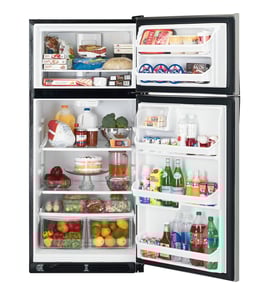




What are the disadvantages of a top mount fridge?
Top-mount refrigerators like Kenmore model 79573269302 typically trade convenience for simplicity: the fresh-food section sits lower (more bending), freezer space can be harder to organize, and many models skip built-in water and ice dispensing features. For layout and airflow details, use the 79573269302 owner's manual.
Common disadvantages (what you notice day to day)
- More bending for fresh food: the refrigerator compartment is below the freezer, so you reach down more often.
- Freezer organization is basic: top freezers often have fewer bins and dividers than some bottom-freezer designs.
- Fewer premium features: many top-mount units do not include an exterior water dispenser or in-door ice.
- Airflow can be easier to block: overpacking can block vents and cause temperature swings.
- Door alignment matters: if doors do not close easily, warm air leaks in and performance drops.
What we recommend to reduce the downsides
Use these practical habits to make a top-mount refrigerator work better:
- Keep frequently used items at waist height by adjusting shelves.
- Leave space around interior vents; do not pack food tightly against vent openings.
- If doors do not self-close smoothly, adjust the front leveling screws so the cabinet tilts slightly back.
- Check door gaskets for gaps and clean them so they seal consistently.
- Group similar foods together to reduce door-open time and improve temperature stability.
Quick comparison: top-mount vs bottom-freezer
| Feature | Top-mount refrigerator | Bottom-freezer refrigerator |
|---|---|---|
| Fresh-food access | Lower, more bending | Higher, easier access |
| Freezer access | Eye level | Lower drawer/pull-out |
| Organization | Often simpler | Often more flexible |
| Typical cost | Often lower | Often higher |
Why it matters
Most cooling complaints in any refrigerator come from airflow and sealing. The manual for this Kenmore model specifically warns that blocked vents can interrupt airflow and lead to temperature and moisture problems, and it also covers door closing and alignment adjustments that help the doors seal properly.
Last updated: January 2026
Is it worth replacing the ice maker on a refrigerator?
Yes, it’s usually worth replacing the ice maker on a Kenmore top-mount refrigerator model 79573269302 when the refrigerator is otherwise cooling well and you rely on ice regularly; an ice maker replacement restores normal ice production without the cost and disruption of replacing the entire refrigerator.
Quick decision checklist
We recommend replacing the ice maker when most of these are true:
- The refrigerator and freezer temperatures are stable and food is staying cold.
- You have water supply connected and turned on.
- The ice maker is the only major problem (no repeated leaks, no cooling failures).
- You use ice often (daily or several times per week).
- The ice maker is physically damaged, jammed repeatedly, or not cycling even after basic checks.
What to check before you buy an ice maker
The manual for this model includes several ice maker basics that can prevent an unnecessary replacement:
- After installation or reconnecting water, allow 12 to 24 hours for ice production to start.
- Make sure the ice maker power switch is set to I (on) once the water line is connected.
- Confirm nothing blocks the feeler arm; when the bin is full, the feeler arm stops production.
- Discard the first few batches of ice after installation to clear the water line.
- If ice sits too long, it can taste stale; dumping old ice often fixes “bad ice” complaints.
For model-specific operating details and safety notes, use the 79573269302 owner's manual.
Cost vs. replacement: a simple comparison
| Option | Best when | Typical outcome |
|---|---|---|
| Replace ice maker assembly | Cooling is good; ice maker is the only failure | Restores ice production and cube harvesting |
| Diagnose water supply/valve first | No ice and no water fill; slow fill; intermittent ice | Fixes root cause without replacing the ice maker |
| Replace refrigerator | Multiple major failures (cooling, sealed system, repeated leaks) | Long-term reset, higher cost |
If you suspect a fill problem (no water entering the ice maker), the refrigerator water inlet valve 5220JA2009D is a common part involved in ice maker water supply.
Why it matters
A built-in ice maker depends on correct freezer temperature, a steady water supply, and a working harvest cycle. Replacing the ice maker makes sense when those basics are already in place; otherwise, you can end up replacing a good ice maker while the real issue is water delivery or temperature control.
Last updated: January 2026
What are the common problems with Kenmore Elite refrigerators?
Common problems we see on Kenmore Elite refrigerators like model 79573269302 include not cooling well, frost or ice buildup, doors not sealing or closing, water or ice maker issues, and unusual noises. Many fixes start with basic maintenance and control settings; use the 79573269302 owner's manual for model-specific checks.
Most common symptoms and what usually causes them
- Not cooling or weak cooling: dirty condenser coils, airflow blocked by food, a failing fan, or a temperature control issue.
- Frost or ice buildup: door left ajar, torn or warped gasket, or a defrost system problem.
- Doors will not close completely: refrigerator not level, bins or shelves out of position, or sticky gaskets.
- Water leaks or puddles: clogged/iced drain path, loose water line connection, or valve issues.
- Ice maker not working: water supply problem, frozen fill tube, or ice maker component failure.
Quick checks we recommend first (safe, no parts required)
- Confirm the refrigerator has had up to 24 hours to cool after plugging in or changing settings.
- Push doors firmly shut and check for packaging or bins preventing closure.
- Clean condenser coils (dirty coils reduce heat transfer and can cause warm temps).
- Inspect door gaskets for gaps, tears, or sticking; clean the gasket and the surface it seals against.
- If you have an ice maker, verify the household water supply valve is fully open and the water line is not kinked.
Parts that commonly relate to these problems on 79573269302
| Symptom | Part to consider | What it affects |
|---|---|---|
| Warm refrigerator temps | Refrigerator sensor 6500JB2001B | Temperature sensing and control response |
| Ice maker not filling | Refrigerator water inlet valve 5220JA2009D | Water flow to ice maker |
| Door not sealing | Refrigerator gasket ADX52752635 | Warm air leaks, frost, poor cooling |
Why it matters
Cooling, frost, and noise complaints often trace back to airflow and sealing. A door that does not close fully can cause longer run times, temperature swings, and ice buildup; the manual’s door and cleaning guidance helps prevent repeat problems.
Last updated: January 2026