Owner’s manual


How do I program a universal remote to my garage door opener?
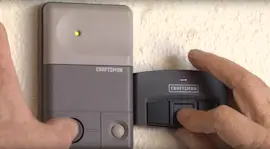
To program a universal remote to your Genie GCG350L garage door opener, put the opener into “learn” mode, then send the remote’s signal within 30 seconds so the opener stores the code. On this model, you confirm programming by pressing the remote button a second time.
Programming steps for Genie GCG350L
- Locate the learn code button and indicator LED on the front of the power head (typically under the force adjustment screws); see the owner's manual.
- Press and release the learn code button.
- Confirm the indicator LED blinks (about twice per second).
- Within 30 seconds, press the button on the universal remote once.
- When the LED stops blinking and stays on, press the remote button again.
- When the LED goes out, the remote is programmed.
If your universal remote has multiple buttons
Many universal remotes can run more than one door. Program each button separately using the same steps above.
| Remote type | What to do | Result |
|---|---|---|
| Single-button remote | Program once using the steps above | Controls 1 door |
| 2 or 3-button remote | Repeat programming steps for each button | Controls multiple doors |
Clear old remotes (when a remote is lost or you want a fresh start)
If you need to erase all stored remotes from the opener’s memory:
- Press and hold the learn code button for about 10 seconds.
- Release when the indicator LED goes out.
- Reprogram the remotes you still want to use.
Why it matters
The GCG350L uses Genie INTELLICODE rolling-code security, which changes the access code each time the remote is used. That improves security, but it also means you must use the learn button process to pair any new universal remote.
Last updated: February 2026
What's the average lifespan of a Genie garage door opener?
A Genie garage door opener like model GCG350L typically lasts 10 to 15 years. With normal residential use and basic upkeep (tight hardware, aligned safety sensors, and a balanced door), many openers run longer; heavy use and poor door balance shorten life.
Typical lifespan by what wears out first
Most “opener failures” are really wear, adjustment, or safety-sensor issues rather than a dead motor.
- Drive system wear (chain, sprockets, rail wear) increases noise and vibration
- Safety sensor (Safe-T-Beam®) problems cause no-close or reversal symptoms
- Wiring and wall control issues can stop operation from the button
- Door balance problems overload the opener and shorten motor/gear life
- Power interruptions or surges can stress electronics
Maintenance that extends life (and prevents nuisance problems)
We recommend these habits for the GCG350L and similar AC chain drive openers:
- Test the contact reverse using a flat 2x4 on the floor; the door should reverse on contact
- Keep the Safe-T-Beam® sensors aligned and the beam path clear
- Check that the door is properly balanced; a heavy or fast-moving door needs service
- Inspect visible wiring for staples through wire, pinches, or breaks
- Confirm the opener is plugged into a working outlet (a lamp test is a quick check)
For model-specific safety checks and wiring/terminal details, follow the steps in the owner's manual.
Quick “replace vs. repair” guide
| If you notice this | Most likely cause | What to do first |
|---|---|---|
| Door will not close, lights blink | Safe-T-Beam® misalignment/obstruction | Align sensors, clear beam path, check LEDs |
| Runs from remote but not wall button | Wall control lock switch, wiring, terminal connection | Check lock switch, inspect wires and terminal connections |
| Door reverses on the 2x4 test | Contact reverse needs correction | Recheck settings and safety steps in the manual |
| Loud operation, jerky travel | Chain/rail wear or door out of balance | Check door balance; inspect drive components |
Why it matters
A garage door opener is a safety device as much as a convenience feature. Keeping the reversing system and Safe-T-Beam® working correctly helps prevent injury and reduces strain that shortens the opener’s service life.
Last updated: February 2026
How do I know which garage door opener is compatible?
For a Genie GCG350L AC chain drive garage door opener, compatibility is mainly about matching the control technology and programming method. Start by confirming your opener’s model number and then use the programming and safety-system details in the GCG350L owner's manual to choose a remote, wall control, or accessory that will reliably pair and operate the door.
What “compatible” means for the GCG350L
Most compatibility questions come down to whether the accessory can communicate with your opener’s receiver and safety system.
- Remote/control type: Genie systems commonly use Intellicode style rolling-code remotes (the code changes each use for security).
- Programming method: Compatible remotes must support the same learn/program steps used by the opener.
- Safety sensors: The opener must work with its Safe-T-Beam style photo-eye safety system; the door should not close if the beam is blocked.
- Door type and hardware: Lightweight doors (steel, aluminum, fiberglass, glass) often need added bracing so the opener can operate safely.
- Power and mounting basics: The opener needs a 120V grounded outlet within reach and proper header/support mounting.
Quick compatibility checklist (before you buy anything)
Use this list to avoid pairing problems and unsafe operation:
- Verify the opener is Genie model GCG350L on the motor unit label.
- Confirm whether your current remote is Intellicode (rolling-code) style.
- Check that the wall control you want supports vacation/lock and light functions if you use them.
- Inspect the Safe-T-Beam sensors: aligned, LEDs normal, wiring intact.
- Make sure the garage door is balanced and moves freely before adding accessories.
Common accessory types and what to match
| Accessory you’re adding | What must match | What to check first |
|---|---|---|
| Remote control | Radio/rolling-code system | Existing remote type and programming steps |
| Wall button/console | Wiring and feature set | Lock/vacation switch, light control |
| Safety sensor parts | Sensor system type | LED status, alignment, wire condition |
| Smart add-on controller | Opener compatibility list | Whether it supports Genie rolling-code systems |
Why it matters
Using a mismatched remote or control can cause pairing failures, intermittent operation, or unsafe closing behavior. The manual’s safety guidance also matters: we recommend monthly reversal testing using a 2x4 laid flat to confirm the opener reverses on contact.
Last updated: February 2026
What would cause a Genie garage door opener to stop working?
A Genie GCG350L garage door opener usually stops working because it is not getting power, the wall control is locked out, the Safe-T-Beam® safety sensors are blocked or misaligned, or a wiring connection is loose or damaged. We use the checks below to pinpoint the exact cause quickly.
Quick checks we do first (fastest fixes)
- Confirm the opener has power; plug a lamp into the same outlet to verify the outlet works.
- Check the home breaker or fuse for the garage circuit.
- Check the wall console lock switch; if it is on, the wall control may not run the opener.
- Look at the Safe-T-Beam® LEDs; misalignment or an obstruction can stop normal operation.
- Inspect visible low-voltage wires for staples through wiring, pinched sections, or cuts.
- Make sure the emergency release is engaged; a disengaged carriage prevents door movement.
Use the Safe-T-Beam® LEDs to narrow it down
The GCG350L uses the Safe-T-Beam® system to prevent closing on people or objects. If the sensors are blocked, misaligned, or have wiring issues, the opener may not run normally.
| What you see at the sensors | What it usually means | What we do |
|---|---|---|
| Both LEDs steady (normal) | Sensors are aligned and powered | Move to power, wall control, or wiring checks |
| LEDs off | Powerhead not powered or wiring issue | Check outlet, breaker/fuse, then wiring connections |
| Blinking pattern | Beam blocked, misaligned, interference, or sensor fault | Clear obstruction, realign sensors, inspect wiring |
For the exact LED meanings and the model’s troubleshooting chart, follow the GCG350L owner's manual.
Wiring and control checks (common on “dead” openers)
- Verify wall control wires are firmly connected at the powerhead terminals.
- Check that limit switch wires are on the correct terminals (OPEN and CLOSE leads).
- Look for obvious shorts or broken insulation along the wire run.
If you need to test wiring or electrical parts safely, use a meter and follow how to use a multimeter to test electrical parts video.
Why it matters
A garage door opener can appear “broken” when the real issue is a safety sensor condition or a simple power interruption. Fixing the root cause also helps keep the door’s contact-reverse safety feature working correctly.
Last updated: February 2026