Installation guide
 Owner’s manual
 Error Codes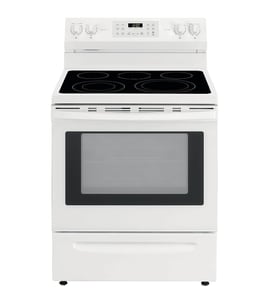


How old is my KitchenAid KDRS505XSS00 oven?
Your KitchenAid KDRS505XSS00 range’s age is determined by its serial number on the model/serial/rating plate. On this model, the plate is located behind the control panel, and the serial number encodes the manufacturing date (year and month). Use the decoding guidance in the KDRS505XSS00 installation guide to locate the plate, then match the serial format to KitchenAid date-code charts.
The installation instructions for this 30-inch double oven dual-fuel range show the model/serial/rating plates behind the control panel.
- Turn the range off and let all surfaces cool.
- For safer access, shut off power at the breaker before reaching behind panels.
- Look behind the control panel area for a rating plate that lists model and serial.
- Write down the full serial number exactly as shown.
- Keep the number with your records for parts matching and service history.
KitchenAid serial formats vary by production era, but the date is typically encoded in the first several characters.
- Identify the first 2 to 4 characters of the serial number.
- Look for a year code (often a letter or digit) and a month code (often the next character).
- If your serial begins with letters, treat the first letter as the year code and the second as the month code (common format).
- If your serial begins with digits, treat the early digits as the date code (common format).
- Once decoded, your range age is simply the time from the manufacture month/year to today.
| What you have | What it tells you | What to do next |
|---|---|---|
| Model number (KDRS505XSS00) | Exact product version | Use it to match diagrams and parts |
| Serial number | Manufacture month and year | Decode the first characters using a KitchenAid date-code chart |
| Rating plate location | Where to find both numbers | Check behind the control panel |
Knowing the manufacture date helps us match the correct parts and revisions for your dual-fuel range (for example, ignition components, gas valves, or oven heating parts). It also helps explain age-related issues like weak ignition, worn door hardware, or uneven baking.
Last updated: February 2026
Is KitchenAid considered high-end?
Yes. KitchenAid is widely considered a premium, high-end brand in mainstream appliances, and the KitchenAid KDRS505XSS00 dual-fuel range with double oven fits that “pro-style” tier with performance-focused cooking features and upscale design.
High-end typically refers to stronger build quality, better cooking performance, and more refined fit and finish than entry-level models.
Common high-end traits you’ll see in this category:
- More precise burner control and consistent oven temperatures
- Heavier-duty knobs, grates, and door hardware
- Pro-style layout and larger overall footprint
- More serviceable design with replaceable components
- Higher parts cost for premium components (controls, valves, door parts)
We recommend using a mix of performance, ownership cost, and installation requirements.
| What to check | What you’ll typically see on premium ranges | Why it matters |
|---|---|---|
| Installation clearances | Tighter, more specific cabinet and wall clearances | Helps prevent heat damage and improves safety |
| Electrical and gas requirements | More demanding hookups (dual-fuel) | Impacts install complexity and cost |
| Parts and serviceability | More specialized components | Repairs can be more involved but parts are replaceable |
| Fit and finish | Stainless surfaces, heavier doors, robust grates | Better durability and feel |
For model-specific installation and clearance details, use the installation guide.
Higher-end ranges often use more specialized gas and control components. For this model, examples include:
- Range surface burner valve WPW10206288 (burner control and flame regulation)
- Range surface burner igniter switch assembly WPW10204718 (spark ignition switching)
- Door latch W10883049 (door locking and secure closure)
Knowing KitchenAid is “high-end” helps set expectations: you usually get better cooking performance and sturdier construction, but installation requirements and replacement parts (like burner valves, igniters, and door hardware) can be more specialized.
Last updated: February 2026
What is the life expectancy of a KitchenAid oven?
A KitchenAid oven typically lasts 15 years. For your KitchenAid KDRS505XSS00 dual-fuel range with double oven, regular cleaning, correct installation clearances, and prompt replacement of wear parts (like elements and door hardware) help it reach that lifespan; heavy daily use can shorten it.
Most full-size ranges and built-in ovens fall into a similar service-life window when they are installed correctly and maintained.
| Appliance type | Typical life expectancy |
|---|---|
| Gas oven/range | 15 years |
| Electric oven/range | 15 years |
| Dual-fuel range (gas cooktop, electric ovens) | 15 years |
These are the most common causes of early failure in a dual-fuel range like the KDRS505XSS00.
- Overheating from blocked vents or poor airflow around the range
- Power issues (loose connections, repeated breaker trips, surges)
- Running self-clean too often (high heat stresses door latches, wiring, and controls)
- Slamming or forcing oven doors (wears hinges, receivers, and glass mounts)
- Ignoring weak heating symptoms (a struggling element can overwork controls)
We recommend these practical habits for long-term reliability.
- Keep burner heads and caps seated correctly so flames burn clean and stable
- Wipe spills promptly; baked-on spills hold heat and can damage finishes and door seals
- Use cookware that matches burner size to reduce excess heat on the cooktop
- If baking gets uneven or preheat times climb, test and replace the bake element early
- Follow the cabinet clearance and heat limits in the installation guide
If symptoms show up, these model-matched parts are often involved:
- Weak or uneven baking: range bake element W11662148
- Door not closing or sealing well: door latch W10883049
- Burner won’t light or keeps clicking: range surface burner igniter switch assembly WPW10204718
A range that is heating correctly and venting properly runs cooler at the controls and wiring. That reduces heat stress, prevents repeat repairs, and is the difference between replacing a major control at year 8 versus getting a full 15-year service life.
Last updated: February 2026