Installation guide
 Owner’s manual
 Error Codes
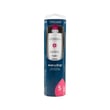


Where to find model number on Kenmore side by side refrigerator?
On Kenmore side-by-side refrigerator model 10654573300, we find the model number on the model and serial number label inside the refrigerator compartment, typically on an inside wall. Open the fresh food door and look along the interior side walls for the tag; confirm the exact location in the 10654573300 owner's manual.
Quick steps to locate the tag
- Open the fresh food (refrigerator) door.
- Look on the inside wall of the refrigerator compartment (not the freezer).
- Check the side walls first; then check near the crisper area and upper interior walls.
- Use a flashlight; the label is often small and can blend into the liner.
- Write down the full model number and serial number exactly as shown.
What the label is used for (and why it matters)
The model and serial number label is the fastest way to match the correct Kenmore parts and diagrams for your exact build. We use it to ensure items like an ice maker assembly, water inlet valve, or door gasket match your refrigerator’s configuration.
Model number vs. serial number
| Item | What it tells us | When you need it |
|---|---|---|
| Model number (example: 10654573300) | The exact refrigerator design and parts list | Ordering parts, looking up diagrams, checking fit |
| Serial number | Production details for your specific unit | Service history, warranty and service calls |
Tips if the label is hard to read
- Wipe the area gently with a damp cloth and dry it; avoid abrasive cleaners.
- Take a close-up photo and zoom in to read faded characters.
- Copy the number carefully; one wrong digit can pull the wrong parts list.
Last updated: February 2026
What's the average lifespan of a Kenmore refrigerator?
Most Kenmore refrigerators average 10 to 15 years of service life; a well-maintained Kenmore 10654573300 side-by-side can often reach the upper end of that range when basic care (cleaning, good door sealing, and stable temperatures) is kept up.
Typical lifespan and what to expect
For household refrigerators like this Kenmore side-by-side, lifespan is mainly driven by compressor run time, airflow across the condenser, and how well the doors seal.
- Average range: 10 to 15 years
- Common “life extenders”: clean condenser area, tight door gaskets, correct leveling
- Common “life shorteners”: clogged coils, frequent warm air leaks, repeated power interruptions
| Condition | What you’ll notice | Likely impact on lifespan |
|---|---|---|
| Coils and airflow kept clean | Quieter running, steadier temps | Longer life |
| Door gaskets sealing well | Less frost, less compressor cycling | Longer life |
| Poor maintenance or heavy use | Warm temps, more running time | Shorter life |
Maintenance that most improves longevity
We recommend following the care steps in the 10654573300 owner's manual. These are the highest-value habits for extending refrigerator life.
- Clean the refrigerator and door gaskets regularly (sticky or dirty gaskets can make doors harder to open and can leak air)
- Keep the unit level so doors close consistently
- Maintain proper food loading so vents are not blocked
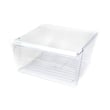
- Replace failed wear items promptly (lights, bins, door-cam components)
- Address cooling or defrost symptoms early (frost buildup, warming, unusual noises)
Why it matters
A refrigerator that runs longer to hold temperature puts more stress on the sealed system (compressor and refrigerant tubing). Simple upkeep reduces run time, helps prevent temperature swings, and typically delays major repairs.
Last updated: February 2026
How to clean condenser coils on Kenmore refrigerator?
For Kenmore refrigerator model 10654573300, we clean the condenser by removing the base grille, vacuuming the coil area with a soft brush, reinstalling the grille, then restoring power. In most homes, routine condenser cleaning is not needed; dusty or pet-heavy homes need it every 2 to 3 months (see the 10654573300 owner's manual).
Steps to clean the condenser coils
- Unplug the refrigerator (or disconnect power at the breaker).
- Pull the refrigerator forward enough to work safely.
- Remove the base grille (it snaps or screws off depending on the trim style).
- Vacuum:
- the base grille
- the open area behind the grille
- the front surface of the condenser coil
- Reinstall the base grille.
- Plug the refrigerator back in.
How often should we clean the coils?
The manual guidance for this Kenmore side-by-side is straightforward:
- Normal home conditions: no routine condenser cleaning needed
- Greasy or dusty environment: clean every 2 to 3 months
- Significant pet traffic: clean every 2 to 3 months
| Home condition | Recommended coil cleaning interval |
|---|---|
| Typical household | As needed (no routine schedule) |
| Dusty, greasy, or pets | Every 2 to 3 months |
Tips that prevent damage and improve results
- Use a vacuum with a soft brush; stiff bristles can bend fins.
- Keep the nozzle slightly off the coil surface; let suction do the work.
- Clean the base grille itself; a clogged grille restricts airflow.
- Avoid spraying cleaners or water into the coil area.
- Make sure the grille is fully seated when you reinstall it (airflow matters).
Why it matters
Dirty condenser coils reduce heat transfer, which makes the compressor run longer and can lead to warmer temperatures and higher energy use. Keeping airflow clear at the base grille helps the refrigerator cool efficiently.
Last updated: February 2026
How to tell cubic feet of Kenmore refrigerator by model number?
For Kenmore model 10654573300, the most accurate way to get cubic feet is to read the model and serial label inside the fresh food compartment and then confirm the listed capacity in the 10654573300 owner's manual. Model numbers can hint at size, but the label and manual give the exact spec.
Fast ways to find the cubic feet
- Check the rating plate: Look on the inside wall of the refrigerator compartment (near the top side walls or behind crisper drawers on many side-by-sides).
- Use the manual specs section: Capacity is typically listed with other dimensions and electrical requirements.
- Compare by product type: Most Kenmore side-by-side refrigerators of this era are commonly in the 20 to 26 cu. ft. range.
- Measure as a backup: If the label is missing, you can estimate interior volume by measuring usable interior space (less accurate).
Where to look inside the refrigerator
Common label locations on Kenmore side-by-side units like 10654573300:
- Left interior wall of the fresh food section
- Right interior wall near the top shelf area
- Behind or above the crisper pans
- Near the ceiling light housing area
Estimating cubic feet (when you cannot read the label)
If you need a quick estimate, measure the usable interior (not the outside cabinet):
| What to measure | How | Notes |
|---|---|---|
| Width | Inside wall to inside wall | Exclude door bins |
| Height | Floor to ceiling inside | Exclude air ducts if possible |
| Depth | Back wall to front edge | Exclude shelves thickness |
Then multiply W x H x D (in inches) and divide by 1,728 to get cubic feet.
Why it matters
Cubic feet helps you match the right refrigerator size for your kitchen and compare models accurately. It also helps when planning airflow clearance and installation space; the installation guide covers ventilation clearances and placement basics.
Last updated: February 2026
What are the most common problems with Kenmore refrigerators?
The most common problems we see on Kenmore refrigerators like model 10654573300 are cooling issues, water leaks, ice maker and dispenser failures, and unusual noises. These usually trace back to airflow problems (dirty coils or a failed fan), defrost system trouble, or water supply components.
Most common symptoms and what usually causes them
- Not cooling or warm temperatures: blocked airflow, dirty condenser coils, evaporator fan issue, or defrost frost buildup
- Freezer cold but fresh food warm: restricted air circulation between compartments, evaporator fan problem, iced-over evaporator
- Water leaking or puddles: clogged defrost drain, loose water line, or a leaking inlet valve
- Ice maker not making ice: water supply issue, inlet valve problem, or ice maker assembly failure
- Strange noises: normal operating sounds, fan noise, or water valve buzzing during ice maker fill
Quick checks we recommend first (before replacing parts)
- Confirm airflow: do not block vents; allow space around food packages (see 10654573300 owner's manual).
- Listen for fan operation: you should typically hear air movement when the unit is running.
- Check for frost buildup: heavy frost on the freezer back wall points to a defrost problem.
- Inspect for leaks: look under the unit and behind the toe grille area for water.
- Verify water supply (if you have ice and water): make sure the shutoff valve is fully open and the line is not kinked.
Parts that commonly solve these problems on 10654573300
| Problem area | What fails most often | Example part for this model |
|---|---|---|
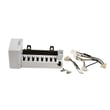
| Ice maker not working | Ice maker module or assembly | Ice maker assembly 4317943 |
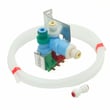
| No water to dispenser or ice maker | Water inlet valve | Refrigerator inlet valve W10408179 |
| Frost buildup, warm temps | Defrost control components | Refrigerator defrost bi-metal WPW10225581 and refrigerator heater WP2323198 |
Noises: what is normal on this model
Kenmore side-by-side refrigerators commonly make operational sounds such as buzzing when the ice maker fills, sizzling during defrost, gurgling as refrigerant moves, and fan or compressor sounds as speeds adjust. The “Normal Sounds” section in the 10654573300 owner's manual helps you match the sound to the cause.
Why it matters
Most “big” refrigerator complaints are caused by simple airflow, defrost, or water supply issues. Catching them early helps prevent food spoilage, recurring ice buildup, and water damage around the refrigerator.
Last updated: February 2026
Who made Kenmore 10654573300?
Kenmore model 10654573300 was manufactured for Sears by Whirlpool. The “106” prefix in the model number is the key identifier that ties this refrigerator to Whirlpool-built Kenmore units; we use that prefix when matching parts, diagrams, and service information.
How to confirm it on your refrigerator
Use these quick checks to verify you are working with the correct Kenmore model and manufacturer family:
- Match the full model number exactly: 10654573300 (not a partial).
- Check the model and serial tag inside the fresh food section (often on a side wall).
- Use the “106” prefix when looking up Kenmore refrigerator error codes and troubleshooting.
- Follow the wiring and door removal steps exactly as shown in the 10654573300 owner's manual.
- If you are installing the unit or re-hanging doors, follow the 10654573300 installation guide to avoid alignment and sealing issues.
Why the manufacturer matters for parts and repairs
Kenmore is a brand name; different manufacturers built different Kenmore model series. Knowing Whirlpool built the 106-series helps us select the right style of components (ice maker, inlet valve, defrost parts) and the correct repair procedures.
Common Whirlpool-built (106-series) part examples for this model
| System | What you might replace | Example part for 10654573300 |
|---|---|---|
| Ice maker | Ice maker assembly | Ice maker assembly - refrigerator ice maker by whirlpool 4317943 |
| Water/ice supply | Water inlet valve | Refrigerator inlet valve W10408179 |
| Defrost | Defrost heater | Refrigerator heater WP2323198 |
Related help for Kenmore 106 refrigerators
If your display is showing a fault or you are troubleshooting cooling or ice issues, use a Kenmore 106-specific reference so the code meanings match your platform: Kenmore 106 model refrigerator error codes.
Why it matters
The same symptom (no ice, warm freezer, water not dispensing) can point to different parts depending on who built the Kenmore unit. Using the Whirlpool-built 106-series identification keeps troubleshooting accurate and prevents ordering the wrong part.
Last updated: February 2026
Why is there water leaking from the bottom in my Kenmore refrigerator?
Water leaking from the bottom of your Kenmore 10654573300 side-by-side refrigerator usually comes from a clogged or frozen defrost drain that overflows during defrost, or from a slow leak in the water supply system for the ice maker or dispenser. Use the 10654573300 owner's manual for safe access points and component locations.
Quick checks (5 minutes)
- Look for ice or a water sheet on the freezer floor; this points to a frozen defrost drain.
- Check the drain pan area; some water is normal after defrost, overflow is not.
- Inspect the dispenser area; the removable tray can overflow and mimic a “bottom leak.”
- Pull the unit forward and look for drips at the lower rear water line connection.
- If the leak appears after filter changes, flush several gallons to purge air.
Clear a clogged or frozen defrost drain
- Unplug the refrigerator.
- Remove freezer items and access the rear interior panel area.
- Melt ice at the drain trough using warm water (turkey baster) or a hair dryer on low.
- Flush warm water through the drain until it runs freely into the drain pan.
If the leak is from the water system
Common sources are the household supply line, compression fittings, or the inlet valve feeding the ice maker and dispenser.
- Tighten fittings only enough to stop seepage (do not overtighten).
- Replace a valve that drips from the valve body or will not shut off cleanly.
| Where you see water | Most likely cause | What to do next |
|---|---|---|
| Ice on freezer floor, puddle at front | Defrost drain frozen/clogged | Thaw and flush the drain |
| Drips behind unit | Supply line or valve seep | Inspect fittings, replace valve |
| Water only near dispenser | Spillover or air in lines | Empty tray, flush system |
Why it matters
During normal defrost, water should run into the drain pan. When the drain is restricted, water backs up, freezes, and eventually spills onto the floor.
If you confirm the valve is leaking, replace it with the exact refrigerator inlet valve W10408179.
Last updated: February 2026