Owner’s manual
 Error Codes


How can I tell how many cubic feet my Kenmore refrigerator is?
Your Kenmore side-by-side refrigerator model 25359683992 capacity (cubic feet) is found in the model’s specifications, not in the basic use and care sections. The most reliable way is to check the specs section in the owner's manual or calculate it by measuring the interior space.
Fast ways to find cubic feet
- Check the rating plate inside the fresh food compartment (often on a side wall or near the crisper area); it may list capacity.
- Look up the specifications in the owner's manual for model 25359683992.
- Measure the usable interior (ignore door bins and rounded corners) and calculate volume.
- If you are comparing sizes, use total capacity (fresh food + freezer), not just one compartment.
How to calculate cubic feet (quick math)
- Measure the inside of the refrigerator compartment in inches:
- Height (H)
- Width (W)
- Depth (D)
- Multiply: H × W × D = cubic inches
- Convert to cubic feet: cubic inches ÷ 1,728
Example calculation
| Measurement | Inches |
|---|---|
| Height | 60 |
| Width | 20 |
| Depth | 18 |
| Total cubic inches | 21,600 |
| Cubic feet (÷ 1,728) | 12.5 |
Repeat for the freezer side and add the two results for an estimated total capacity.
Why it matters
Cubic feet helps us match the right refrigerator size for your kitchen and storage needs, and it is useful when comparing models or planning shelf and bin organization.
Last updated: February 2026
What are the most common issues with 25359683992?
The most common issues we see with the Kenmore 25359683992 side-by-side refrigerator involve cooling performance, ice and water dispensing, and defrost-related frost buildup. Many problems trace back to airflow (fans and ducts), water supply components, or a failed defrost control; use the owner's manual for model-specific operating checks.
Common symptoms and what they usually point to
- Not cooling or warm temperatures: dirty condenser area, weak evaporator airflow, thermostat/control issues
- Freezer cold but fresh food warm: restricted air ducting, evaporator fan problems, door not sealing
- Ice maker not making ice: low water supply, inlet valve issue, ice maker mold problems
- Water dispenser slow or no water: clogged filter, frozen water tube, inlet valve issue
- Frost buildup on back freezer wall: defrost system problem (timer/control, heater circuit), blocked drain
- Water leaking inside or under unit: clogged/iced drain tube, cracked water line, overfilled drain pan
Quick checks we recommend first
- Confirm controls are set correctly and doors close fully.
- Listen for the evaporator fan running when the freezer door switch is pressed.
- Check for heavy frost on the freezer rear panel (defrost clue).
- If water flow is weak, replace the filter and purge air from the line.
- Inspect for ice or debris blocking the drain opening.
Parts that commonly solve these problems (when symptoms match)
| Symptom | Common part to inspect/replace | Example from this model’s parts list |
|---|---|---|
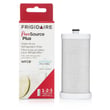
| Slow/no water, bad taste/odor | Water filter | Genuine Kenmore refrigerator water filter WFCB |
| No ice, no water fill | Water inlet valve | Refrigerator water inlet valve 218859701 |
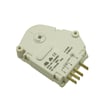
| Frost buildup, warm temps | Defrost control/timer | Crosley refrigerator defrost timer 215846602 |
| Leaking from freezer area | Drain system | Refrigerator drain tube 241957901 |
Why it matters
Cooling, ice maker, and leak complaints often share the same root causes: restricted airflow, a defrost failure that blocks air passages with ice, or a water supply restriction. Catching the pattern early prevents food spoilage and water damage.
Last updated: March 2026
What does er if mean on a Kenmore refrigerator?
On a Kenmore refrigerator, ER IF typically points to an ice maker fan (ice room fan) airflow problem. On model 25359683992, this usually means the fan is blocked by ice, the fan is failing, or the wiring/control is not sensing proper fan operation.
What to check first (fast, no parts)
- Unplug the refrigerator for safety.
- Open the freezer and inspect the ice bin area for frost or ice buildup that could block airflow.
- Remove the ice storage bin and shake it to loosen cubes; do not use sharp tools to break ice.
- Make sure the freezer door closes fully and the ice bin seats correctly.
- Restore power and listen for the fan running near the ice maker area.
Common causes and likely fixes
| What’s happening | What it means | What usually fixes it |
|---|---|---|
| Heavy frost/ice around ice maker area | Air cannot move across the ice room | Defrost the buildup; improve door sealing and usage habits |
| Fan noise is abnormal or fan is silent | Fan motor or blade issue | Inspect fan area; replace damaged fan blade if needed |
| Ice clumps and dispenser jams | Ice melts and refreezes, restricting movement and airflow | Empty bin, dry it, and reset; keep freezer temp steady |
| Water flow is restricted | Filter restriction can contribute to poor ice performance | Replace the water filter on schedule |
Parts that often relate to ice and airflow symptoms
If you find physical damage or persistent ice-related issues, these model-compatible parts are commonly involved:
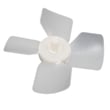
- Refrigerator evaporator fan blade 5308000010 (if the blade is cracked, rubbing, or stripped)
- Genuine Kenmore refrigerator water filter WFCB (replace about every 6 months or 200 gallons)
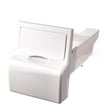
- Refrigerator ice container 241734001 (if the bin is damaged and causing jams)
Why it matters
When the ice fan cannot move air correctly, the ice maker area can warm up or frost over. That leads to slow ice production, clumping, dispenser jams, and repeated error codes.
Where to confirm model-specific steps
For your Kenmore 25359683992, we recommend following the diagnostic and access steps in the owner's manual.
Last updated: February 2026