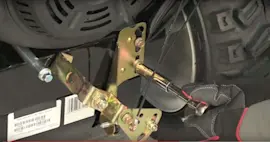
Owner’s manual
 View engine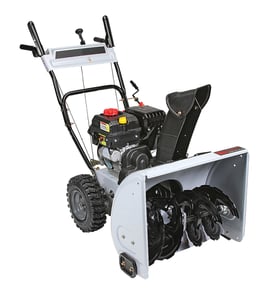



Can I use 5W30 instead of SAE 30 in my snowblower?
Yes, you can use 5W30 in your Craftsman snow thrower model 247887000; in fact, the owner’s manual lists SAE 5W30 as the specified engine oil for this model. SAE 30 is typically used only in warmer temperatures, while 5W30 is better for cold-weather starting.
What the oil chart means for model 247887000
Our manual for this Craftsman snowblower shows these temperature-based recommendations:
- Above 32°F: SAE 30W
- 0°F to 32°F: SAE 5W30 (or SAE 10W)
- Below 0°F: SAE 0W30 (synthetic)
For the exact wording and maintenance steps, use the 247887000 owner’s manual.
Quick decision guide
Use this as a practical rule of thumb for typical snow season use:
- If you run the snowblower mostly below freezing, 5W30 is the right choice.
- If you run it mostly above freezing, SAE 30 can be acceptable, but it is not ideal for cold starts.
- If you already added 5W30, you do not need to drain it just because it is not SAE 30.
Why it matters
Oil viscosity affects both starting and engine protection. Thicker oil (like SAE 30) can make cold starts harder, while multi-viscosity oil (like 5W30) flows better in winter conditions, helping reduce wear during startup.
Oil type comparison
| Oil type | Best for | Tradeoff |
|---|---|---|
| SAE 30 | Warmer operation (above 32°F) | Harder starting in cold weather |
| SAE 5W30 | Winter operation (0°F to 32°F) | May increase oil consumption above 32°F |
| SAE 0W30 (synthetic) | Extreme cold (below 0°F) | Higher cost |
Last updated: January 2026
What is the typical lifespan of a gas snowblower?
A typical gas snowblower often lasts about 10 to 15 years with consistent maintenance and proper storage. For the Craftsman 247887000 two-stage snow thrower, following the seasonal service steps in the 247887000 owner's manual is one of the best ways to maximize lifespan.
What most affects lifespan on the Craftsman 247887000
The biggest drivers are fuel care, oil changes, belt condition, and wear items that protect the housing.
- Use fresh, clean unleaded fuel and avoid leaving old fuel in the tank during storage
- Check engine oil before use; change oil on schedule
- Inspect V-belts for cracking or glazing and replace when worn
- Keep skid shoes and the shave plate adjusted to reduce housing wear
- Clear packed snow safely (use the clean-out tool, not your hands)
Maintenance milestones to plan for
These are common intervals that help a gas snowblower reach the upper end of its lifespan.
| Task | Typical interval | What it helps prevent |
|---|---|---|
| Check engine oil level | Every use | Low-oil engine damage |
| Change engine oil | After first few hours, then about every 25 hours | Premature engine wear |
| Inspect belts | About every 25 hours | Loss of drive or auger performance |
| Check/replace spark plug | Inspect seasonally; replace as needed | Hard starting, misfires |
| Off-season fuel prep | End of season | Carburetor varnish, no-start issues |
Signs it may be nearing end-of-life (or needs major service)
A snowblower can still be worth repairing, but these symptoms often mean higher-cost work is coming:
- Repeated hard-starting even after fresh fuel and a new spark plug
- Persistent belt slipping or frequent belt failures
- Excessive vibration that returns after tightening fasteners
- Poor snow discharge even with correct auger engagement and chute clear
- Drive system struggles to propel consistently under load
Why it matters
A snowblower that is maintained on schedule usually costs less over time and is more reliable during heavy snowfall. Simple upkeep (oil, fuel, belts, and wear-item adjustments) often adds years of dependable winter performance.
Last updated: January 2026
Is a 2 stage or 3 stage snowblower better?
For Craftsman model 247887000, you have a 22-inch two-stage snow thrower; for most homeowners, a 2-stage design is the better all-around choice for typical driveway snow. A 3-stage can clear dense, end-of-driveway plow piles faster, but it’s usually heavier and costs more.
How 2-stage and 3-stage designs differ
A 2-stage machine uses an auger to pull snow in and an impeller to throw it. A 3-stage adds an “accelerator” intake to help feed snow into the impeller faster.
- 2-stage: Great for most storms, mixed snow types, and standard driveways
- 3-stage: Best when you regularly face deep, wet, compacted snow and plow berms
- Tradeoffs: 3-stage units are typically heavier, more expensive, and can be more complex to maintain
- Real-world result: “Better” depends on snow depth, snow density, and how quickly you need to clear
Quick comparison
| Feature | 2-stage (like 247887000) | 3-stage |
|---|---|---|
| Intake system | Auger + impeller | Auger + accelerator + impeller |
| Best for | Most residential clearing | Frequent heavy, dense, end-of-driveway piles |
| Typical downsides | Can slow down in very dense berms | Higher cost, more weight |
Getting the best performance from Craftsman 247887000
You can’t convert a 2-stage to a 3-stage because the stage design is built into the auger housing and drive system. If you want stronger performance from this specific model, focus on setup and maintenance.
- Set skid shoes correctly for pavement vs. uneven surfaces
- Run at full throttle when throwing snow (per operating guidance)
- Clear clogs safely using the chute clean-out tool, not your hands
- Check belts and cable adjustments if the auger hesitates or the drive slips
For model-specific operating and adjustment steps, use the 247887000 owner’s manual.
Why it matters
Choosing the right stage affects clearing speed, how well you handle heavy plow piles, and how much effort it takes to maneuver the machine. A well-maintained 2-stage like Craftsman 247887000 is a reliable match for most winter conditions.
Last updated: January 2026