
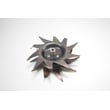
What are the common problems with mantis Tillers?
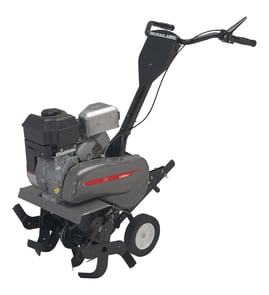
Common problems we see on the Mantis SV-5C-2 front-tine tiller include tines that spin weakly or stop under load, hard starting or stalling, and poor tilling performance in compacted soil. Most issues trace back to fuel/ignition, drive/clutch wear, or tine/gearbox binding.
Most common symptoms (and what they usually mean)
- Tines turn slowly or stop in soil: clutch/drive wear, engine not reaching full RPM, or tine/gearbox drag
- Starts then dies: stale fuel, clogged carburetor passages, restricted fuel cap vent, or dirty air filter
- Hard starting: fouled spark plug, weak ignition, or old fuel
- Excessive vibration: bent tines, loose fasteners, or debris wrapped around the tine shaft
- Poor tilling in hard ground: shallow passes, dull/bent tines, or trying to cut too deep too fast
Quick checks we recommend first
- Fuel: Drain old fuel and refill with fresh, properly mixed fuel (for 2-cycle versions) or fresh gas (for 4-cycle versions).
- Air filter: Clean or replace if dirty or oil-soaked.
- Spark plug: Inspect, clean/replace if fouled; confirm the plug wire fits tightly.
- Tines: Remove wrapped roots/string; check for bends and confirm the tine bolts are tight.
- Throttle and choke: Verify full throttle travel and correct choke use during starting.
Symptom-to-fix guide
| Symptom | Most likely cause | Best next step |
|---|---|---|
| Tines slow under load | Engine not at full RPM | Clean air filter, verify throttle linkage, tune carburetor |
| Tines stop but engine runs | Clutch/drive wear | Inspect clutch drum/shoes and drive components |
| Engine bogs in hard soil | Cutting too deep | Make shallow passes; let the tines do the work |
| Vibrates or hops | Tines damaged or unbalanced | Inspect/replace bent tines; tighten hardware |
Why it matters
A tiller that cannot maintain tine speed usually is not “too weak”; it is losing power (fuel/air/ignition) or losing drive (clutch/gearbox). Fixing the root cause prevents premature wear and makes the SV-5C-2 easier to control.
Parts and diagrams
We recommend matching your exact SV-5C-2 configuration to the diagrams before ordering; you can also search by model number on Sears PartsDirect to find the correct Mantis tiller/cultivator parts.
Last updated: February 2026
What is better, forward or reverse tiller?
For most homeowners, a forward-rotating (standard) tiller is the better choice for routine garden prep, mixing compost, and maintaining already-worked soil. A reverse-rotating design bites harder and is better for breaking new ground or compacted soil, but it costs more and takes more effort to manage.
Forward vs. reverse: what “better” means in real use
Forward and reverse describe tine rotation relative to the wheels.
- Forward-rotating tines pull the tiller forward; they are easier to maneuver in tight beds.
- Reverse-rotating tines dig downward and backward against the direction of travel; they break soil more aggressively.
- For a front-tine tiller like the Mantis SV-5C-2, forward rotation is the most common setup and is typically best for lighter-duty work.
Quick comparison
| Feature | Forward-rotating tines | Reverse-rotating tines |
|---|---|---|
| Best for | Established gardens, weeding, mixing amendments | New ground, hard/compacted soil, deeper primary tilling |
| Control/effort | More maneuverable; can “walk” around beds | More stable bite; can feel heavier to steer |
| Soil finish | Good for blending and cultivating | More aggressive breakup; can leave larger clods in very hard soil |
| Cost/weight (typical) | Lower, lighter | Higher, heavier |
How we recommend choosing
Use these decision points to match the tool to the job:
- Choose forward rotation if you mostly maintain beds, work in softer soil, or need easy turning.
- Choose reverse rotation if you routinely hit hardpan, heavy clay, or you are converting lawn to garden.
- If you only need aggressive digging once, consider renting a heavier rear-tine unit for that first pass, then maintain with a lighter tiller.
- For best results with either style, till in multiple shallow passes instead of one deep pass.
Why it matters
Tine rotation changes how the machine transfers power into the ground. Forward rotation favors maneuverability and speed in already-loose soil; reverse rotation favors traction and soil breakup when conditions fight back.
Parts and model matching
When you are comparing options or ordering maintenance items (tines, belts, wheels, throttle parts), match parts to the exact model number SV-5C-2 to avoid fit issues. We recommend starting with the model parts list, or searching by model on Sears PartsDirect.
Last updated: February 2026
What is the horsepower rating of a 5 foot tiller?
A “5-foot tiller” typically does not have its own horsepower rating; it is usually a tractor PTO-driven rotary tiller, and the key spec is the tractor’s PTO horsepower. For average soil, plan on about 25 PTO HP for a 5-foot tiller, with heavier conditions pushing higher.
Quick sizing rule (what to use)
A practical rule we use for rotary tillers is about 5 PTO horsepower per foot of tiller width in average conditions.
- 5 ft tiller in worked, loamy soil: ~25 PTO HP
- 5 ft tiller in heavier clay: ~30 to 40+ PTO HP
- 5 ft tiller in virgin ground, deep passes, or fast ground speed: often 40+ PTO HP
PTO HP vs engine HP (why the numbers vary)
When people say “horsepower,” they may mean different ratings. PTO horsepower is the most useful for matching a tractor to a tiller.
| Rating type | What it represents | What to use for a 5-ft tiller? |
|---|---|---|
| Engine HP | Power at the engine crankshaft | Not the best match by itself |
| PTO HP | Power available at the PTO shaft | Use this |
| Drawbar HP | Pulling power at the wheels | Secondary for tillers |
What changes the horsepower requirement
These factors increase the PTO HP you need for a 5-foot tiller:
- Hard, dry clay or rocky soil
- First-time tilling (unbroken ground)
- Deeper tilling depth
- Higher travel speed
- Wider bite per pass (not overlapping)
- Heavier tiller weight and more aggressive tine design
Why it matters
If PTO HP is too low, the tiller bogs down, leaves clods, and can overstress driveline components (slip clutch, shear bolt, gearbox). If PTO HP is adequate, you get consistent tine speed and cleaner soil finish.
Note for Mantis SV-5C-2 owners
Your Mantis SV-5C-2 is a front-tine tiller/cultivator and is not a 5-foot PTO implement. If you are shopping parts or confirming your exact model before ordering, use Sears PartsDirect to search by model number.
Last updated: February 2026