Owner’s manual
 Error Codes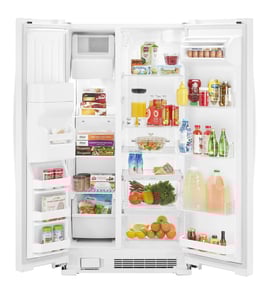



Is the GSS22JETABB garage ready?
GE GSS22JETABB is not considered “garage ready” for cold spaces; the installation guidance calls out that you should not install the refrigerator where temperatures can drop below 60°F (16°C) because it may not run often enough to maintain safe food temperatures. For best performance, keep it in a climate-controlled area and follow the owner's manual.
What “garage ready” means (and why it matters)
A “garage ready” refrigerator is designed to keep stable temperatures even when the surrounding air gets very cold or very hot. If a standard refrigerator sits in a cold garage, it can run less often, which can lead to warmer fresh-food temperatures and inconsistent ice production.
Recommended placement for GE GSS22JETABB
Use these placement rules to avoid temperature and airflow problems:
- Avoid locations that can drop below 60°F (16°C)
- Leave clearance for airflow: 1/8 inch on the sides, 1 inch on top, and 1 inch at the back
- Plan for door swing; about 3/4 inch clearance helps with a 90° opening
- Install on a solid, level floor so the cabinet does not wobble
- Adjust the rollers so doors close easily and the refrigerator sits firmly
Quick decision guide
| Garage condition | Good fit for GSS22JETABB? | What to do |
|---|---|---|
| Heated or stays above 60°F year-round | Yes | Install with proper clearances and leveling |
| Drops below 60°F in winter | No | Move indoors or keep the space reliably heated |
| Very hot garage (often above typical room temps) | Risky | Improve ventilation and monitor temperatures closely |
Why it matters for food safety and performance
When the refrigerator does not run often enough, the fresh-food section can drift warmer than your set temperature. That can shorten food life, reduce ice maker performance, and make temperature control inconsistent.
Last updated: February 2026
What is the most common problem with a GE refrigerator?
The most common GE refrigerator complaint is not cooling properly (fresh food warm, freezer not cold enough, or temperatures that swing). On the GE GSS22JETABB, the quickest wins are confirming the controls are set correctly, the doors seal tightly, and the unit has had a full 24 hours to stabilize after changes; see the owner's manual.
Most common symptoms and what they usually point to
- Not cooling or weak cooling: door left ajar, controls set too warm, airflow blocked, dirty condenser area, or a fan issue
- Long run times: frequent door openings, hot room temperature, large warm food load (often normal)
- Strange noises: modern compressor and pressure equalization sounds can be normal
- Ice maker issues: freezer not at 15°F (-9°C) or below, low water pressure, or a clogged filter
- Door not closing: gasket sticking/folding, bins or packages preventing closure
Quick checks we recommend first (5 to 10 minutes)
- Make sure nothing is holding the doors open and the doors close fully
- Verify temperature controls are not set to 0 (off) and adjust to a normal setting
- Allow 24 hours after plugging in or changing settings for temperatures to stabilize
- Listen for normal operating sounds (hum, whoosh, clicks) before assuming a failure
- If ice is slow or hollow, confirm freezer temperature is cold enough and check for water flow restrictions
Common causes vs. likely parts (when checks do not fix it)
| Symptom | Common cause | Part that often relates (if needed) |
|---|---|---|
| Fresh food warm, freezer OK | Evaporator airflow problem | Evaporator motor WR60X10185 |
| Temps fluctuate or read wrong | Sensor out of range | Refrigerator temperature sensor WR55X10025 |
| Frost buildup, warming over time | Defrost control issue | Thermostat WR50X10068 |
| No interior light | Burned-out bulb (power still present even if controls are off) | Refrigerator light bulb 40A15 |
Why it matters
A refrigerator that is not cooling can spoil food quickly, and door-seal or airflow problems also force the compressor to run longer than necessary. Catching the simple causes first (controls, doors, airflow, stabilization time) prevents unnecessary part replacement.
Last updated: February 2026
Are GE side by side refrigerators good?
GE side-by-side refrigerators like model GSS22JETABB are a solid, practical choice for everyday use: they typically offer dependable cooling, easy access to both fresh food and freezer sections, and convenient features like an ice maker and dispenser. Long-term performance depends most on maintenance, airflow, and door seal condition (see the owner's manual).
What “good” usually means for a side-by-side refrigerator
A side-by-side is a good fit when you want consistent temperatures and quick access to frozen foods without bending as much as a bottom-freezer design.
Common strengths:
- Steady cooling when vents are kept clear and doors seal tightly
- Narrow door swing compared with many French-door models
- Easy organization with shelves and door bins on both sides
- Built-in ice and water convenience on many versions
Common tradeoffs:
- Freezer is narrower; wide pizza boxes and large platters can be harder to fit
- Ice makers can be noisy during harvest cycles
- Door gaskets and dispenser parts wear over time
What to check on your GE GSS22JETABB if performance is not great
If you are judging “good” based on noise, slow ice production, or temperature swings, these checks usually pinpoint the cause.
- Confirm the temperature settings are correct and stable
- Make sure interior vents are not blocked by food packages
- Listen for the evaporator fan; a failing fan can cause warm spots
- Inspect door gaskets for gaps, tears, or areas that do not grip the cabinet
- If the unit is warm, check for condenser airflow issues and dust buildup
Parts that commonly affect cooling and ice performance
| Symptom | Common area | Example part for this model |
|---|---|---|
| Warm fridge or uneven temps | Temperature sensing | Refrigerator temperature sensor WR55X10025 |
| Warm freezer, weak airflow | Evaporator fan system | Evaporator motor WR60X10185 |
| Frost buildup, warming cycles | Defrost control components | Thermostat WR50X10068 |
Why it matters
A side-by-side can seem “bad” even when the sealed system is fine; most complaints trace back to airflow restrictions, door sealing, or a fan/sensor issue. Keeping temperatures stable protects food quality and reduces compressor run time.
Last updated: February 2026
Why is my GE side by side freezer freezing up?
Freezer “freezing up” on your GE GSS22JETABB usually means frost or ice is building up because warm, moist air is getting into the freezer or the unit is not defrosting efficiently. The fastest fixes are checking door sealing and reducing long or frequent door openings; then inspect the defrost and airflow components.
Most common causes (and what to check first)
- Door left open or opened too often: moisture enters and freezes on cold surfaces.
- Package holding the door open: even a small gap can cause heavy frost.
- Door gasket not sealing: look for rips, gaps, or areas that do not contact the cabinet.
- Airflow blocked: items pushed against vents can cause cold spots and frost.
- Defrost system issue: frost returns quickly after you clear it, or the evaporator area ices over.
Quick troubleshooting steps
- Inspect the door seal: close a sheet of paper in several spots; it should drag when you pull.
- Look for obstructions: make sure shelves, bins, and food packages are not preventing full closure.
- Confirm temperature settings: set the freezer control one step warmer or colder only as needed; give it 24 hours to stabilize after changes.
- Defrost and observe: if you manually defrost and heavy frost returns within days, focus on gasket, door closure, and defrost parts.
- Unplug before service: follow safety guidance in the owner's manual.
Parts that commonly solve freezer frost and ice buildup
If the freezer is icing up because the defrost cycle is not ending correctly or temperatures are being read inaccurately, these model-matched parts are common fixes:
| Symptom you notice | What it often points to | Model-matched part to consider |
|---|---|---|
| Frost blankets the back wall, airflow gets weak | Defrost control components | Thermostat WR50X10068 |
| Temps swing, freezer overcools or undercools | Sensor reading issue | Refrigerator temperature sensor WR55X10025 |
| Frost plus poor circulation, warm spots, noisy fan | Evaporator fan problem | Evaporator motor WR60X10185 |
| Door does not seal, frost near door edges | Gasket leak | Refrigerator door gasket WR24X10302 |
Why it matters
Frost buildup restricts airflow across the evaporator coils, which makes the freezer run longer, can warm the fresh food section, and can lead to ice jams around vents and the icemaker area.
Last updated: February 2026