
What stapler is best for cabinet assembly?
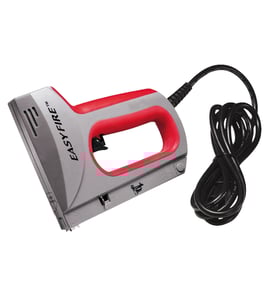
For cabinet assembly, we recommend a narrow crown stapler (typically 18-gauge) because it gives strong holding power with a smaller, cleaner staple footprint for plywood backs, face frames, and drawer parts. Your Craftsman model 351183080 is a 1/2-inch crown stapler, which is commonly used for light-to-medium fastening tasks.
What to use for common cabinet tasks
- Cabinet backs and casebacks (thin plywood): 18-gauge narrow crown stapler
- Drawer boxes (thin stock): 18-gauge narrow crown stapler; consider glue plus staples
- Face frames and trim returns: 18-gauge brad nailer often leaves a smaller hole than staples
- Toe-kick skins and light panels: narrow crown staples work well
- Heavy structural joints: screws or pocket-hole joinery (staples are not structural fasteners)
Staple size and crown: quick guide
| Cabinet task | Typical fastener type | Typical length range |
|---|---|---|
| 1/4 in. back panel to cabinet | Narrow crown staple | 1/2 to 1 in. |
| Drawer bottom (thin plywood) | Narrow crown staple | 1/2 to 3/4 in. |
| Face frame to cabinet box | Brad nails or screws | 1-1/4 to 2 in. |
| Temporary clamping while glue cures | Narrow crown staple | 1/2 to 1 in. |
How to choose the “best” stapler for your shop
- Pick 18-gauge narrow crown for most cabinetry and furniture assembly.
- Choose a tool that can drive staples cleanly into hardwood and plywood without crushing the surface.
- Look for depth-of-drive adjustment so staples sit flush without overdriving.
- Use the shortest staple that still bites securely into the second piece.
- Plan on test shots on scrap to dial in depth and avoid blowout.
Why it matters
Cabinet parts are often thin and visible; narrow crown staples reduce splitting and surface damage while still giving good holding power, especially when paired with wood glue.
For more DIY help with tool and repair basics, see are diy appliance repairs safe.
Last updated: February 2026
What size staples does a Craftsman stapler use?
For the Craftsman 351183080 1/2" crown stapler, use 1/2-inch crown staples in the leg length range the tool is designed for (most commonly 1/4 inch to 9/16 inch legs). Using the correct crown and leg length prevents jams and helps the driver blade set staples consistently.
Staple size basics (what matters most)
- Crown width: This model is a 1/2-inch crown stapler; the crown must match.
- Leg length: Choose based on material thickness; longer legs hold better but can blow through thin stock.
- Wire gauge: Use the gauge specified for the stapler’s staple family; mismatched gauge can cause feeding issues.
- Collation style: Use the staple strip style the magazine is built for (wrong collation can misfeed).
- Material: Galvanized or stainless staples resist rust for outdoor or damp locations.
Quick leg-length selection guide
Use this as a practical starting point for a 1/2-inch crown stapler:
| What you’re fastening | Typical staple leg length | Notes |
|---|---|---|
| Fabric, thin underlayment | 1/4" to 5/16" | Reduces blow-through and surface damage |
| 1/4" to 3/8" plywood, light trim | 3/8" to 1/2" | Good general-purpose range |
| Thicker wood-to-wood fastening | 1/2" to 9/16" | Better holding power; avoid on thin stock |
If staples are jamming or not setting flush
- Confirm you’re using 1/2-inch crown staples (not narrow crown).
- Try a shorter leg length if staples are curling or blowing out the side.
- Check for bent staples and reload with a fresh strip.
- Clean the magazine channel and nose area; debris causes misfeeds.
- Verify air pressure (pneumatic) or battery/drive setting (cordless) is appropriate for the material.
Why it matters
Staple crown and leg length directly affect feed reliability, holding strength, and surface finish. Matching the fastener to the Craftsman 351183080 and your material thickness is the fastest way to prevent jams and get consistent drive depth.
For general DIY safety and prep before troubleshooting, review are diy appliance repairs safe.
Last updated: February 2026
Does Craftsman make a cordless stapler?
Yes. Craftsman makes cordless staplers, including V20 battery-powered narrow crown staplers that are designed to drive staples consistently without an air hose or cord.
What to know before you buy
Cordless staplers vary by staple gauge and crown size, so matching the tool to your fasteners and material is the key.
- Staple type: narrow crown vs. wide crown
- Gauge: commonly 18-gauge for narrow crown staplers
- Material use: trim, upholstery, light framing, sheathing (tool-dependent)
- Depth control: tool-free depth adjustment is common on newer cordless models
- Power source: battery platform compatibility (for example, V20)
Cordless vs. corded vs. pneumatic (quick comparison)
| Type | Best for | Tradeoffs |
|---|---|---|
| Cordless (battery) | Quick jobs, punch-list work, portability | Heavier tool, battery runtime limits |
| Corded electric | Consistent power without batteries | Needs an outlet, cord management |
| Pneumatic (air) | High-volume stapling, lighter hand tool | Requires compressor, hose, fittings |
How this relates to your Craftsman 351183080
Your Craftsman model 351183080 is a 1/2-inch crown stapler. If you are considering a cordless replacement, confirm the cordless model supports 1/2-inch crown staples (many cordless staplers are narrow crown, which is typically smaller).
Why it matters
Using the wrong crown size or gauge can cause frequent jams, poor staple set depth, and weak holding power. Matching staple specs to the tool protects your workpiece and helps the stapler feed smoothly.
For help identifying the exact model number on your tool before ordering parts or choosing a replacement, use how to find your appliance model number (and what it means for parts).
Last updated: February 2026
What are the different parts of a stapler?
Most staplers, including powered models like the Craftsman 351183080 1/2" crown stapler, are built around the same core assemblies: a handle and trigger, a magazine that feeds staples, and a nose/driver area that drives the staple into the material. Knowing the names helps with loading and jam checks.
Common stapler parts (what you can identify)
- Handle/grip: Where you hold the tool; often contains the main housing and controls.
- Trigger: Activates the firing cycle.
- Safety contact (contact tip): Helps prevent firing unless the nose is pressed to the work.
- Magazine (staple rail): Holds the staple strip and guides it forward.
- Pusher and spring: Applies tension to advance staples in the magazine.
- Nose/driver channel: The front area where the driver pushes the staple out.
- Housing/body: The frame that supports internal components.
Quick reference table
| Part | What it does | What you notice when it has an issue |
|---|---|---|
| Magazine | Stores and guides staples | Staples do not feed, frequent jams |
| Pusher/spring | Keeps staples moving forward | Misfeeds, double-feeds, weak advance |
| Nose/driver channel | Aligns and drives staples | Bent staples, staples not fully set |
| Safety contact | Prevents unintended firing | Won’t fire unless pressed firmly |
Why it matters
When a stapler jams or misfires, the problem is usually in the magazine feed path, the pusher tension, or the nose/driver area. Using the correct part names makes it easier to inspect the right spot first.
Basic checks tied to these parts
- Disconnect power before opening the magazine or inspecting the nose.
- Remove the staple strip; clear any bent staples from the magazine.
- Check that the pusher slides smoothly and returns with firm spring tension.
- Look into the nose opening for debris; clear it carefully.
- Confirm you are using the correct crown and leg length staples for the tool and material.
For general safety practices before DIY repair work, use are diy appliance repairs safe.
Last updated: February 2026
How to load an old Craftsman staple gun?
To load a Craftsman power stapler like model 351183080, open the staple magazine, place a stick of staples into the track with the legs facing down toward the nose, then close and latch the magazine so the spring pusher can feed staples forward.
Safe loading steps (works for most older Craftsman staplers)
- Disconnect power before loading (unplug the cord, or remove the battery if your version is cordless).
- Point the tool away from you and keep your finger off the trigger.
- Open the magazine using the release latch or by pulling back the spring-loaded pusher until it locks.
- Load one stick of staples into the magazine channel (crown up, legs down toward the nose).
- Close the magazine fully; if there is a pusher rod, release it and guide it forward against the staples.
Choose staples that fit your stapler
Older power staplers are sensitive to staple size and style. Use staples that match the tool’s required:
- Crown width (narrow crown vs. wider crown)
- Leg length (shorter for thin materials, longer for thicker materials)
- Wire gauge (heavier wire for tougher fastening)
If you are unsure what your 351183080 takes, match the staple packaging to the markings on the stapler body or magazine, or bring a sample staple to compare.
If it will not feed after loading
- Confirm the magazine is fully latched; a half-latched magazine will not advance staples.
- Remove the staples and reload them flat in the track (no tilted strip).
- Clear a jam at the nose area before reloading.
- Clean dust and debris from the magazine channel; buildup causes misfeeds.
Quick checks
| What to check | What “correct” looks like | Result |
|---|---|---|
| Staple orientation | Legs down toward the nose | Reduces jams |
| Magazine latch | Clicked fully closed | Enables feeding |
| Pusher tension | Pusher rests firmly on staples | Consistent advance |
Why it matters
Correct loading prevents misfeeds and jams that can damage the driver path and slow down fastening, especially on older tools like the Craftsman 351183080.
For general DIY safety practices while working on tools, see are diy appliance repairs safe.
Last updated: February 2026