Installation guide
 Owner’s manual
 Error Codes


How many cubic feet is a Kenmore Elite he3 washer?
A Kenmore Elite HE3 washer is a front-load washer; most HE3 models are about 3.8 cu. ft. capacity. The Kenmore washer model 11029132413 is a top-load washplate design, so it is not an HE3; use the 11029132413 owner's manual to confirm your washer’s exact capacity.
Make sure you are matching the right washer family
“HE3” is a Kenmore Elite front-load family name; capacity varies by the exact model number.
- If your washer has a front door, it can be an HE3 style.
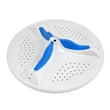
- If your washer loads from the top and uses a low-profile washplate, it is not an HE3.
- Always use the full model number from the ID tag to match specs.
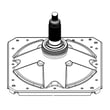
- For model 11029132413, the parts list includes a washplate, which confirms it is a top-load design.
Where to find the capacity for your exact model
Check these places in order:
- Specifications section in the 11029132413 owner's manual
- Model and serial tag (commonly under the lid or along the lid opening)
- Product literature that came with the washer
- If you are installing in a tight space, use the 11029132413 installation guide for fit and clearance details
Quick comparison (so you do not mix up specs)
| Washer type | How it loads | Typical capacity |
|---|---|---|
| Kenmore Elite HE3 | Front-load door | 3.5 to 4.0 cu. ft. |
| Kenmore 11029132413 | Top-load with washplate | Varies by model; confirm in manual |
Why it matters
Capacity affects load size, cycle performance, and detergent dosing (especially with HE detergent); using the correct capacity also helps you choose the right replacement parts and accessories.
Last updated: January 2026
How to reset a Kenmore 11029132413 washer?
To reset a Kenmore 11029132413 washer, we recommend doing a simple power reset: unplug the washer (or switch off the breaker) for about 1 minute, then restore power and restart the cycle by pressing and holding Start/Pause/Unlock Lid for up to 3 seconds. See the 11029132413 owner's manual for model-specific control steps.
Quick reset steps (power reset)
- Press Start/Pause/Unlock Lid once to pause the cycle.
- Wait for the tub to stop moving; the lid may stay locked for several minutes during spin.
- Unplug the washer (or turn the breaker off) for 60 seconds.
- Plug it back in (or turn the breaker on).
- Select a cycle, then press and hold Start/Pause/Unlock Lid for up to 3 seconds to start.
If an error code is showing
Many F-type system errors clear and retry the same way:
- Touch Start/Pause/Unlock Lid once to clear the code.
- Touch and hold Start/Pause/Unlock Lid again (up to 3 seconds) to restart.
- If the code returns, check for simple causes first (lid not fully closed, load too tight, oversudsing).
Common “looks like it needs a reset” causes
| What you notice | What to check first | What to do |
|---|---|---|
| Washer won’t start | Lid not closed or lid locked | Close lid; press and hold Start/Pause/Unlock Lid |
| Stops mid-cycle | Suds control pause | Reduce detergent; use HE detergent only |
| Won’t fill | Water supply issue | Confirm both faucets are fully on |
| Lid won’t unlock | Items on lid or high-speed spin | Remove items from lid; wait for movement to stop |
Why it matters
A power reset clears temporary control glitches and lets the washer reinitialize lid lock, load sensing, and cycle logic. If the washer repeatedly needs resets, focus on the underlying trigger (lid lock, drain, fill, or oversudsing) instead of resetting every time.
Last updated: January 2026
How to unclog drain hose on Kenmore washer?
On Kenmore washer model 11029132413, a clogged drain hose is usually cleared by correcting the hose setup first, then flushing the hose and checking for a blockage at the drain pump. Start by unplugging the washer and disconnecting the drain hose from the home drain.
Safety and prep
- Unplug the washer (or switch off the breaker).
- Turn off both water faucets.
- Have towels, a shallow pan, and a bucket ready.
- Expect water to spill when you remove the hose.
- If the washer is full of water, bail out as much as possible before moving it.
Step-by-step: clear the clog
- Pull the washer forward enough to access the rear.
- Remove the drain hose from the standpipe or laundry tub.
- Inspect the hose end for lint, coins, or a sock; remove debris by hand.
- Flush the hose in a bucket using hot water; a hot water plus vinegar soak helps loosen sludge.
- If the clog is stubborn, gently work a flexible drain brush or a straightened plastic zip tie into the hose (avoid sharp tools that can puncture it).
- Reinstall the hose using the correct setup from the 11029132413 installation guide.
Check the installation (this fixes many “clog” symptoms)
The installation instructions for this washer call out key drain-hose limits that affect draining:
- Keep about 4.5 in. (114 mm) of hose inside the standpipe.
- Do not force excess hose down into the standpipe.
- Do not tape over the drain opening.
- Keep the drain hose end below 96 in. (2.4 m) above the floor.
Quick setup checklist
| Item to verify | Target for this washer | What happens if it’s wrong |
|---|---|---|
| Hose insertion depth | ~4.5 in. into standpipe | Long drain, siphoning, slow drain |
| Standpipe height | Hose end below 96 in. | Drain pump struggles, long drain |
| Drain opening | Not taped/sealed | Poor airflow, slow drain |
When the hose is clear but it still won’t drain
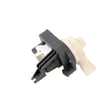
If the hose flushes clean and the washer still drains slowly, the blockage is often at the pump inlet or the pump itself. A common replacement for this model is the washer drain pump W10876600.
Symptoms that point to the pump
- Hums but drains slowly or not at all
- Drains sometimes, then stops mid-cycle
- Repeated long-drain behavior after hose is cleared
Why it matters
A restricted drain hose or incorrect standpipe setup can trigger long-drain conditions, leave water in the tub, and strain the drain pump over time.
Last updated: January 2026