Installation guide
 Owner’s manual
 Error Codes

What are the main 5 parts of a refrigerator?
The five main parts that make a refrigerator cool are the compressor, condenser, expansion device, evaporator, and a temperature-sensing control (often a thermistor). In a GE GFE28HSHFSS bottom-mount refrigerator, these work together with fans and door seals to keep temperatures stable.
The “core cooling system” (the main 5)
These are the parts that move heat out of the refrigerator:
- Compressor: pumps refrigerant through the sealed system
- Condenser: releases heat to the room (often through condenser coils)
- Expansion device: drops refrigerant pressure so it can get cold
- Evaporator: absorbs heat inside the refrigerator/freezer
- Thermistor or temperature sensor: tells the control board when to run cooling
If you are troubleshooting temperature swings, a common sensor used for temperature feedback is the refrigerator temperature sensor WR55X10025.
Other “major” parts people often include
These are not always counted in the “main 5,” but they are critical to performance and common repairs:
- Evaporator fan: circulates cold air through the compartments
- Defrost system: prevents frost buildup on the evaporator
- Door gasket: keeps warm, humid air from leaking in
Quick reference table
| Part | What it does | Common symptom when it fails |
|---|---|---|
| Compressor | Moves refrigerant | Warm fridge/freezer, little or no cooling |
| Condenser | Dumps heat | Poor cooling, long run times |
| Expansion device | Lowers pressure | Weak cooling, uneven temps |
| Evaporator | Absorbs heat | Warm temps, frost patterns |
| Thermistor/sensor | Controls cycling | Temps too warm/cold, erratic operation |
Why it matters
Knowing the “main 5” helps you separate sealed-system cooling problems (compressor, coils, refrigerant path) from airflow and control problems (fans, sensors, gaskets). Airflow and sensor issues are often more straightforward to diagnose and repair.
For model-specific component locations and service access steps, use the installation guide.
Last updated: February 2026
What is the most common problem with a GE refrigerator?
The most common issue we see with GE refrigerators like model GFE28HSHFSS is poor cooling (fresh food too warm, freezer not holding temperature). In most cases, the cause is restricted airflow, a failing evaporator fan, or a temperature-sensing or defrost problem that prevents steady, even cooling.
Quick checks that fix many cooling complaints
- Make sure air vents inside the refrigerator and freezer are not blocked by food packages.
- Set temperatures to typical targets: 37°F fresh food and 0°F freezer.
- Clean dust from the condenser area (dirty coils make the compressor run longer and cool worse).
- Confirm the doors close fully and the gasket seals all the way around.
- Listen for the evaporator fan: it should run when the unit is cooling (often heard from the freezer area).
Common causes and the parts that often solve them
If basic checks do not restore normal temperatures, these are frequent culprits on bottom-mount designs:
| Symptom | Likely cause | What to check next |
|---|---|---|
| Fridge warm, freezer cold | Weak/no airflow to fresh food | Evaporator fan operation and ice buildup |
| Frost/ice buildup, warming over time | Defrost system issue | Defrost heater, defrost thermostat, airflow |
| Temps swing up and down | Sensor or control issue | Temperature sensor readings, control response |
| Ice maker/dispenser issues plus cooling complaints | Water/ice system restriction or related faults | Filter condition, inlet valve function |
Model-matched parts that are commonly involved in these repairs include the refrigerator evaporator fan motor WR60X26866, the refrigerator temperature sensor WR55X10025, the refrigerator defrost heater WR51X10132, and the refrigerator defrost bi-metal thermostat WR50X10108.
Why it matters
When cooling is weak, the compressor and fans tend to run longer, food safety becomes a concern, and frost buildup can worsen airflow problems. Catching a fan, sensor, or defrost issue early usually prevents bigger performance problems.
Where to confirm model-specific settings and diagnostics
For the exact control settings, diagnostic steps, and any model-specific notes for GFE28HSHFSS, use the owner's manual.
Last updated: February 2026
Can I replace fridge parts myself?
Yes, for your GE GFE28HSHFSS bottom-mount refrigerator, we recommend DIY replacement only for straightforward, non-sealed-system parts (filters, lights, some gaskets, some ice maker components). For electrical, wiring, or water-tank and dispenser tear-down work, follow the installation guide and use a qualified technician when the procedure calls for it.
Good DIY jobs vs. technician jobs
Many repairs are very DIY-friendly, but some steps in GE procedures include electrical-shock warnings and call for qualified service.
- Good DIY: replacing the water filter, cleaning, basic adjustments, simple drawer/bin swaps
- Good DIY with care: replacing an LED module, replacing an ice maker assembly, replacing a door gasket
- Technician recommended: control board diagnosis, wiring repairs, sealed-system work (compressor, refrigerant valve, evaporator)
- Technician required: any repair where you cannot safely disconnect power and water, or where water lines must be opened inside the door
Safety steps we use before any repair
The installation documentation for this style of GE bottom-freezer dispenser refrigerator emphasizes disconnecting power before service and reinstalling all parts and panels before operating.
- Unplug the refrigerator (or switch off the breaker)
- Shut off the water supply if you will touch any water line, valve, or filter housing
- Pull the unit out carefully and protect the floor with towels if water lines are being disconnected
- Take photos of wire connectors and tube routing before you remove anything
- Reinstall all covers, screws, and grounding connections before restoring power
Parts that are commonly DIY-replaced on this model
If your symptoms match, these are examples of parts we often see customers replace successfully:
| Symptom | Common DIY part to check | Example part for GFE28HSHFSS |
|---|---|---|
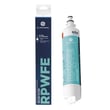
| Bad taste, slow water flow | Water filter | GE refrigerator water filter RPWFE |
| No ice or weak ice production | Ice maker assembly | Refrigerator ice maker assembly WR30X28731 |
| Lights out or flickering | LED light assembly | Refrigerator led light assembly WR55X11132 |
| Door not sealing, frost, warm spots | Freezer door gasket | Refrigerator freezer door gasket WR14X36194 |
Why it matters
Choosing the right DIY level prevents repeat failures and protects the refrigerator’s electronics and water system. A simple part swap (like a filter or gasket) is usually low risk; a misrouted wire or leaking tube inside a dispenser door can create bigger problems.
Last updated: February 2026
How to order GE appliance parts?
You can order replacement parts for your GE GFE28HSHFSS bottom-mount refrigerator by matching your model number and the part you need, then selecting the correct part from the parts list for this model. For diagrams, part locations, and model-specific details, use the GFE28HSHFSS owner's manual.
How we recommend ordering parts (fast and accurate)
- Confirm the full model number: GFE28HSHFSS.
- Identify the symptom (no cooling, no ice, leaking, lights out) and the system involved.
- Use the parts list to match the exact part name and part ID.
- Compare your original part to the listing (connectors, mounting points, and wire count).
- Order the part and keep the packaging until the repair is complete.
Common parts customers order for this model
If you are troubleshooting a specific issue, these are frequently replaced items for the GFE28HSHFSS:
- Water and ice issues: GE refrigerator water filter RPWFE, refrigerator water inlet valve WR57X10098
- Cooling and airflow issues: refrigerator evaporator fan motor WR60X26866, refrigerator temperature sensor WR55X10025
- Defrost and frost buildup issues: refrigerator defrost heater WR51X10132, refrigerator defrost bi-metal thermostat WR50X10108
Quick “symptom to part” guide
| Symptom | What to check first | Common matching part for this model |
|---|---|---|
| Warm fridge or freezer | Airflow, fan noise, frost pattern | Evaporator fan motor (WR60X26866) |
| No ice or slow ice | Filter, water supply, valve | Water filter (RPWFE) or inlet valve (WR57X10098) |
| Frost buildup, poor cooling | Defrost system components | Defrost heater (WR51X10132) or bi-metal (WR50X10108) |
| Lights out or flickering | LED module and connections | LED light assembly (WR55X11132) |
Why it matters
Ordering by model number plus exact part ID helps prevent fit and wiring mismatches, especially on GE refrigerators where similar-looking parts can vary by revision.
Last updated: February 2026