Owner’s manual
 Error Codes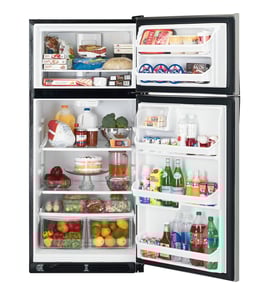


How to tell cubic feet of Kenmore refrigerator by model number?
You typically cannot determine the exact cubic-foot capacity from the Kenmore model number alone. For Kenmore model 25361662100, the most reliable way is to check the capacity listed on the model’s rating label or in the 25361662100 owner's manual.
Best ways to find the cubic feet (most accurate first)
- Check the owner’s manual: Look for “capacity,” “total capacity,” or “cubic feet.”
- Find the rating label: It’s commonly inside the fresh food compartment on a side wall or near the crisper area.
- Measure and estimate (backup method): Use interior measurements to estimate volume if the label is missing.
- Compare by style: Most top-mount (top-freezer) refrigerators are commonly in the mid-size range.
Quick estimate method (when you can’t find the label)
If you need a rough estimate, measure the usable interior (not the outside cabinet):
- Width (inches)
- Depth (inches)
- Height (inches)
Then estimate:
- Cubic feet = (Width × Depth × Height) ÷ 1728
Typical capacity ranges (helpful for sanity-checking)
| Refrigerator type | Common total capacity range |
|---|---|
| Top-mount (top-freezer) | ~14 to 22 cu. ft. |
| Compact top-freezer | ~10 to 14 cu. ft. |
| Large top-freezer | ~20 to 24 cu. ft. |
Why it matters
Knowing cubic feet helps us match the right replacement parts and accessories (like shelves, bins, and door racks) and it also helps when comparing energy use and storage needs across refrigerator models.
Last updated: January 2026
How to adjust the height of a Kenmore refrigerator?
To adjust the height (level) on your Kenmore refrigerator model 25361662100, remove the toe grille and turn the front roller/leveling adjustments with a flat-blade screwdriver or 3/8-inch socket. Raise the front slightly so the doors close freely and the cabinet slopes about 1/4 to 1/2 inch from front to back.
Step-by-step leveling for model 25361662100
- Unplug the refrigerator or switch off power at the breaker for safety.
- Pull the unit forward enough to access the bottom front.
- Remove the toe grille (kick plate) at the bottom front.
- Use a flat-blade screwdriver or a 3/8-inch socket wrench to turn the front roller adjustments.
- Raise the front until the doors close on their own when opened about halfway.
- Level side-to-side so all four corners rest firmly on the floor.
For the exact access points and illustrations, follow the 25361662100 owner's manual.
What “correctly leveled” looks like
| Check | What you want | Why it matters |
|---|---|---|
| Front-to-back | Front slightly higher (about 1/4 to 1/2 inch) | Helps doors close and seal properly |
| Side-to-side | Cabinet level | Prevents door swing and uneven shelf alignment |
| Floor contact | All four corners solid | Reduces vibration and noise |
Common issues after adjusting height
- Doors still pop open: Raise the front a little more and recheck the door seal.
- Refrigerator rocks: Re-level side-to-side; confirm the floor is solid and flat.
- Toe grille won’t fit back on: Lower the front slightly, then reinstall the grille.
- Noisy operation after moving: Make sure the cabinet is stable and not touching the wall.
Why it matters
Proper leveling helps the door gaskets seal, keeps temperatures stable in the freezer and fresh food sections, and reduces wear on hinges and handles over time.
Last updated: January 2026
What are the common problems with Kenmore Elite refrigerators?
Common issues that stop a Kenmore Elite refrigerator from cooling or running correctly include compressor problems, ice maker or water-supply issues, and control or defrost-system failures. For your Kenmore model 25361662100, we recommend using the troubleshooting steps and “Before you call” checks in the 25361662100 owner's manual first.
Most common problem areas (and what you’ll notice)
- Compressor or start components: clicking, humming with no cooling, or the unit won’t start.
- Defrost system problems: frost buildup on the freezer back wall, warm refrigerator section, weak airflow.
- Evaporator fan airflow issues: freezer may be cold but fresh food warms, or you hear unusual fan noise.
- Ice maker and water supply issues: no ice, slow ice production, leaks near the back or under the unit.
- Control settings or power supply problems: temperature control set to OFF, tripped breaker, blown fuse.
Quick checks we use before replacing parts
- Confirm the refrigerator is plugged into a grounded outlet (no extension cord or adapter).
- Verify the temperature control is not set to OFF; allow 24 hours after changes for temperatures to stabilize.
- If it just stopped, wait about 20 minutes in case it is in a normal defrost cycle.
- Check for blocked vents and overpacked shelves that restrict airflow.
- If you have an ice maker, confirm the water valve is open and the fill tube is not frozen.
Parts that commonly relate to these symptoms on model 25361662100
| Symptom | Likely system | Example part you may need |
|---|---|---|
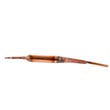
| Frost buildup, warming fridge | Defrost system | Refrigerator defrost bi-metal thermostat 5303918202 or refrigerator defrost heater 5303918203 |
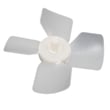
| Noisy or weak airflow | Evaporator fan area | Refrigerator evaporator fan blade 5308000010 |
Why it matters
Catching airflow and defrost problems early helps prevent warm-food conditions and reduces strain on the sealed system (compressor, evaporator, condenser), which is typically the most expensive category of repair.
Last updated: January 2026
What does code er if mean on Kenmore Elite fridge?
On Kenmore model 25361662100 (top-mount), “ER IF” is not a normal operating code. When it appears, it almost always means the display is showing a misread/partial message or the control is seeing an intermittent electrical issue (power, wiring, or control). Use the 25361662100 owner's manual to confirm the correct display messages and control operation.
What to do first (safe, quick checks)
- Unplug the refrigerator for 5 minutes, then plug it back in to clear a temporary control glitch.
- Confirm the outlet is grounded and supplying steady power (avoid extension cords).
- Make sure the temperature controls are set normally (not between settings).
- Check that the doors fully close and the door switch is not stuck.
- If the message returns, write down exactly what the display shows (including any flashing lights) and when it happens.
Common causes when a strange code keeps coming back
| What you observe | Most likely issue | What we recommend |
|---|---|---|
| Code appears after a flicker/outage | Power interruption affecting the control | Reset power; verify outlet and cord fit tightly |
| Display characters look incomplete or scrambled | Display/control board glitch | Reset; if recurring, plan for control diagnosis |
| Cooling is weak plus heavy frost on freezer back wall | Defrost system problem restricting airflow | Inspect for frost pattern; check defrost components |
| Code appears when opening/closing door | Door switch or wiring connection issue | Inspect switch action; check harness connections |
Parts that may be involved (when symptoms match)
If you also have heavy frost buildup and poor cooling, the defrost system is a common place to focus. A failed defrost thermostat can prevent proper defrosting and lead to airflow problems.
- Consider the refrigerator defrost bi-metal thermostat 5303918202 if testing shows it is open when cold or not switching correctly.
- If the refrigerator is not defrosting at all, the defrost heater and wiring should also be checked.
Why it matters
A recurring error-style message usually means the refrigerator is not reliably sensing temperature, door status, or defrost operation. Catching it early helps prevent warm temperatures, frost buildup, and food spoilage.
Last updated: January 2026