Owner’s manual
 Error Codes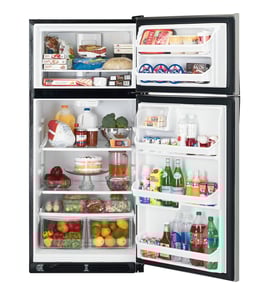



Which is better top mount or bottom mount freezer?
For a Kenmore 25368982801 top-mount refrigerator, a top-mount freezer is usually the better pick for lower purchase cost and strong energy efficiency, while a bottom-mount freezer is usually better for everyday convenience because fresh-food items sit closer to eye level. Use your cooking habits and kitchen layout to decide; our 25368982801 owner's manual covers operation and setup details.
Quick comparison: top-mount vs bottom-mount
- Top-mount freezer (freezer on top)
- Typically lower upfront cost
- Often very efficient for the size
- Freezer items are easiest to reach
- Bottom-mount freezer (freezer on bottom)
- Fresh-food section is easiest to reach (less bending)
- Better for households that use the refrigerator section most
- Freezer access can mean more bending (unless it is a pull-out drawer design)
What we recommend choosing based on
- You use the freezer a lot: top-mount usually feels more convenient.
- You use fresh food most: bottom-mount usually feels more convenient.
- You want the simplest, most budget-friendly layout: top-mount.
- You have mobility or back concerns: bottom-mount can reduce bending for daily items.
- You want fewer “door open” moments: either style works, but organizing shelves and bins matters more than freezer position.
Why it matters
Freezer position changes how often you bend, how quickly you can grab frequently used items, and how you organize airflow around shelves and door bins. That day-to-day ergonomics usually matters more than small differences in energy use.
Helpful decision table
| If you care most about... | Usually better choice | Why |
|---|---|---|
| Lower upfront cost | Top-mount | Simpler design, often priced lower |
| Easy access to fresh food | Bottom-mount | Refrigerator section sits higher |
| Easy access to frozen food | Top-mount | Freezer is at eye/chest level |
| Simple organization | Top-mount | Traditional shelf and bin layout |
Last updated: January 2026
How much top clearance does a fridge need?
For the Kenmore top-mount refrigerator model 25368982801, we recommend 3/8 inch of clearance at the top (and sides) for proper airflow and easier installation; allow 1 inch at the back. These clearances match the installation guidance in the 25368982801 owner's manual.
Recommended clearances for model 25368982801
Use these minimum gaps around the cabinet (not the door handles):
- Top: 3/8 inch
- Sides: 3/8 inch
- Back: 1 inch
- Keep vents and airflow paths clear of cabinets, trim, and stored items.
| Location | Minimum clearance | What it helps with |
|---|---|---|
| Top | 3/8 in. | Heat release and steady cooling |
| Sides | 3/8 in. | Air circulation and easier fit |
| Back | 1 in. | Room for airflow plus electrical and (if equipped) water line |
Tips to avoid clearance-related cooling problems
Even with the right top clearance, a tight install can still cause warm temps if airflow is blocked.
- Make sure the refrigerator is not pushed hard against the wall.
- Confirm the cabinet opening is square so the case is not twisted.
- Leave space so the power cord is not pinched.
- If your unit has an ice maker, route the water line so it does not kink behind the refrigerator.
- After moving the refrigerator, recheck door closing and gasket contact.
Why it matters
Top clearance is part of the airflow path that lets the condenser system shed heat. When the space above the refrigerator is too tight, the unit can run longer, struggle to hold temperature, and waste energy.
Last updated: January 2026
What are the dimensions of a Kenmore refrigerator model 25368982801?
Kenmore top-mount refrigerator model 25368982801 measures 32 in. wide, 68 1/4 in. high, and 29 5/8 in. deep (cabinet depth without handles). For installation planning, confirm whether you need cabinet-only depth or depth including handles in the 25368982801 owner's manual.
Dimensions at a glance
| Measurement | Size |
|---|---|
| Width | 32 in. |
| Height | 68 1/4 in. |
| Depth (without handles) | 29 5/8 in. |
How we recommend measuring for a perfect fit
Even with published specs, measuring your space prevents surprises.
- Measure the opening width at the front and back (walls are not always square)
- Measure height to the lowest overhead cabinet or soffit
- Measure depth to the front edge of counters, then add room for door swing
- Check doorway and hallway clearance for delivery
- Plan ventilation space above and behind the refrigerator
Why it matters
Refrigerator depth is the most common fit issue. The cabinet depth can fit an alcove, but handles and door swing can affect walkway clearance and whether drawers and shelves can slide out fully.
Installation tip
If the refrigerator is tight in the opening, leveling the front rollers or leveling screws helps the doors self-close and improves sealing. The leveling procedure and clearance guidance are covered in the 25368982801 owner's manual.
Last updated: January 2026