Error Codes



What is the most common problem with whirlpool refrigerators?
The most common Whirlpool refrigerator problem is a cooling complaint (too warm, uneven temps, or food freezing), usually caused by restricted airflow, dirty condenser coils, or a failing fan or temperature sensor. On the WRFF3236RZ00, start by checking airflow and fan operation first.
- Fresh food section too warm but freezer seems OK
- Freezer too warm and ice cream is soft
- Temperature swings (OK one day, warm the next)
- Frost buildup on the back wall or in the freezer
- Loud fan noise, rattling, or no fan sound at all
- Water pooling inside or under the refrigerator
- Confirm settings: Set refrigerator to 37°F and freezer to 0°F; wait 24 hours for stabilization.
- Clean condenser coils: Dust buildup reduces heat removal and causes warm temps.
- Check vents: Do not block return vents with food packages.
- Listen for the evaporator fan: If the fan is noisy or not running, cooling will suffer.
- Look for door seal gaps: Warm air leaks cause frost and temperature problems.
If basic checks point to a component issue, these model-matched parts are common fixes:
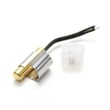
- Temperature sensing issues: refrigerator thermistor W10316760
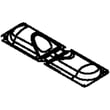
- Poor airflow between compartments: refrigerator electronic damper WPW10594329
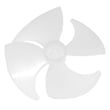
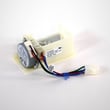
- Evaporator fan problems (noise, no airflow): refrigerator evaporator motor W11024089 and refrigerator evaporator fan blade WP2169142
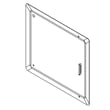
- Door not sealing: Whirlpool refrigerator door gasket (gray) W10443320 or Whirlpool refrigerator door gasket, right (gray) W10830162
| Symptom | Most likely area | Common next step |
|---|---|---|
| Fridge warm, freezer OK | Damper or airflow | Inspect damper movement and vent blockage |
| Both sections warm | Condenser coils, fans, compressor system | Clean coils; verify fans run |
| Frost buildup, warm temps | Defrost/drain/air leak | Check door seal and drain path |
| Fan noise | Evaporator fan blade/motor | Inspect blade for ice contact; replace worn parts |
Cooling problems usually get worse over time; running warm can spoil food, and running too cold can freeze produce. Catching airflow, fan, or sensor issues early helps the WRFF3236RZ00 hold steady temperatures and reduces strain on the compressor.
For model-specific troubleshooting steps and fault displays, use our Whirlpool refrigerator error codes guide.
Last updated: February 2026
Does WRFF3236RZ00 have an ice maker?
Yes. The Whirlpool WRFF3236RZ00 bottom-mount refrigerator is designed to use an ice maker in the freezer section; if your unit is not making ice, we focus on power, temperature, and the ice maker circuit before replacing parts.
- Check that the ice maker is switched ON (some versions use a rocker switch).
- Make sure the freezer is cold enough; best ice production happens around 0°F.
- Verify the door is closing fully so the ice maker can run a complete cycle.
- Look for a blocked fill area or frozen clumps in the ice bin.
- If the ice maker is installed but inactive, inspect the wiring connection at the ice maker.
| Symptom | Most likely cause | What we check first |
|---|---|---|
| No ice, freezer still cold | Ice maker not turned on or door not sensing closed | Door switch operation |
| Ice is small or hollow | Freezer temp too warm or water supply issue | Freezer temp and water flow |
| Ice maker cycles but no fill | Water delivery problem | Fill tube and supply line |
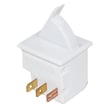
If the refrigerator light stays on when the door is shut, or the unit thinks the door is open, the ice maker can pause. A failed door switch is a common, straightforward fix; see the refrigerator door switch W11396033.
An ice maker depends on three basics: a cold freezer, a closed-door signal, and reliable water fill. Confirming those items first prevents unnecessary part replacement and gets ice production back faster.
Last updated: February 2026
Is a top mount or bottom mount fridge better?
A bottom-mount refrigerator like the Whirlpool WRFF3236RZ00 is better when you want everyday fresh-food items at eye level and more organized freezer storage; a top-mount is often the better pick when you want the simplest layout and typically lower purchase cost.
| Feature | Top-mount refrigerator | Bottom-mount refrigerator (like WRFF3236RZ00) |
|---|---|---|
| Fresh-food access | You bend more | More at eye level |
| Freezer access | Easy reach | You bend more |
| Organization | Usually simpler | Often more drawers/baskets |
| Typical efficiency | Often very good | Varies by design/features |
| Repair access | Generally straightforward | Similar, but more drawer hardware |
- You use the refrigerator section more than the freezer.
- You want better visibility of fresh foods to reduce waste.
- You prefer pull-out freezer drawers and baskets for organization.
- You frequently store heavier items (milk, produce) and want less bending.
- You want a layout that makes it easier to keep foods separated.
- You want a simpler, more traditional layout.
- You want fewer drawers and moving parts in the freezer area.
- You want a model style that often comes in at a lower upfront cost.
- You do not mind bending to reach fresh-food shelves.
“Better” depends on how you shop and cook. Most households open the fresh-food doors far more than the freezer, so bottom-mount designs can feel more convenient day to day. If you are focused on simplicity and value, top-mount designs can be a strong fit.
If you are comparing styles because of performance concerns (warm temps, icing, or odd behavior), checking for stored error codes and common symptom patterns can save time.
- Use our guide: Whirlpool refrigerator error codes
Last updated: February 2026
What are the disadvantages of a bottom freezer refrigerator?
Bottom-freezer refrigerators like the Whirlpool WRFF3236RZ00 keep fresh food at eye level, but the tradeoffs are higher purchase cost, more bending to access frozen items, and drawer-style freezers that can feel less organized. They can also be more sensitive to drain and defrost-related icing.
- More bending and lifting: you reach down for frozen foods, and heavy items can be awkward to pull from deep drawers.
- Freezer organization can be harder: stacked bins and deep baskets can hide items unless you use dividers.
- Upfront cost is often higher: bottom-mount designs typically cost more than comparable top-freezer models.
- Freezer access is less convenient: if you use the freezer constantly, the lower position can be a nuisance.
- Icing and water issues can be more noticeable: when a drain path ices up, you may see frost buildup or water where it should not be.
Many complaints come down to a few serviceable systems rather than the layout itself.
| Symptom | Common cause | What we check first |
|---|---|---|
| Water pooling inside or under the unit | Defrost drain restriction or ice | Clear drain, check for recurring icing; see how to get rid of refrigerator puddles |
| Warm fridge, freezer OK (or uneven temps) | Airflow control or fan issue | Damper operation, evaporator fan, frost pattern; consider refrigerator electronic damper WPW10594329 |
| Temps swing, food freezes in fridge | Sensor/control feedback issue | Thermistor placement/reading; consider refrigerator thermistor W10316760 |
| Frosty freezer, poor sealing | Door gasket not sealing | Inspect gasket, warm and reshape, check door alignment; see how to fix a fridge door seal |
Knowing these disadvantages helps you decide whether a bottom-mount fits your habits (fresh-food heavy vs. freezer heavy) and helps you troubleshoot correctly. For example, “bottom freezer problems” are often airflow, sealing, or defrost-drain issues that can be fixed with the right diagnosis.
Last updated: February 2026