Owner’s manual
 Error Codes


How do I tell what model Kenmore fridge I have?
Your Kenmore refrigerator’s model number is printed on the appliance’s rating label. On Kenmore bottom-mount models like 59669313011, you’ll typically find that label inside the fresh food compartment, inside the freezer, or behind the lower kickplate. Use the exact model number to match the correct parts and diagrams.
Where to look for the model number label
Check these common locations first (look for a sticker or metal plate with numbers and letters):
- Inside the refrigerator compartment on a side wall
- Inside the refrigerator compartment behind or near the crisper drawers
- Inside the freezer compartment on a side wall
- Along the door frame when the door is open
- Behind the lower toe grille or kickplate area
What the label usually shows
The rating label normally includes more than just the model number. Here is what to copy down:
| Label item | What to record | Why it matters |
|---|---|---|
| Model number | Full model (example: 59669313011) | Ensures exact-fit parts and diagrams |
| Serial number | Full serial | Helps identify production run details |
| Electrical info | Volts/amps/Hz | Useful for safe troubleshooting |
Tips to avoid ordering the wrong part
Once you find the label, match characters exactly.
- Write the model number exactly as shown (no missing digits)
- Use the full model number, not just “596” or “Kenmore bottom-mount”
- If the label is worn, take a clear photo and zoom in
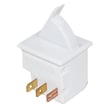
- Use the model number to confirm parts like the refrigerator electronic control board WPW10503278 or refrigerator door switch W11396033
Why it matters
Kenmore model numbers can look similar, but small differences change the correct door gasket, control board, LED light, or ice maker kit. Using the exact model number keeps your repair accurate and prevents returns.
For more model-specific identification and service info, use the owner's manual.
Last updated: February 2026
What's the average lifespan of a Kenmore refrigerator?
Most Kenmore refrigerators average 10 to 15 years of service life; with consistent care and timely repairs, many units reach the upper end of that range. For your Kenmore 59669313011 bottom-mount refrigerator, following the cleaning and care guidance in the owner's manual helps maximize lifespan.
Typical lifespan range (what to expect)
In normal household use, these are realistic expectations for a Kenmore refrigerator:
- 10 to 15 years is the typical average lifespan
- 15+ years is common when the sealed system stays healthy and maintenance is consistent
- Lifespan shortens when the unit runs hot (dirty condenser area), has air leaks (bad gaskets), or has chronic icing and airflow problems
| Lifespan range | What it usually indicates | What to do now |
|---|---|---|
| 0 to 7 years | Early failure or heavy use conditions | Focus on airflow, cleaning, and correct temps |
| 8 to 15 years | Normal service life | Keep up with preventive maintenance |
| 15 to 20 years | Well-maintained unit | Address small issues quickly to avoid major failures |
Maintenance that extends refrigerator life
These actions reduce compressor run time, prevent moisture issues, and help avoid expensive breakdowns:
- Keep door openings brief and make sure doors fully close (reduces humidity and frost load)
- Clean sticky or dirty door gaskets with mild soap and warm water; rinse and dry (helps prevent air leaks)
- After adding a large load of food, allow several hours for temperatures to stabilize
- If temperatures drift, adjust controls gradually and recheck after about 24 hours
- Replace failed interior lighting promptly so you can spot spills and airflow blockages (see refrigerator led light W11602886 if your light is out)
Why it matters
A refrigerator that seals well and breathes properly runs fewer hours per day. That reduces wear on high-cost components like the compressor and control board, and it also helps prevent moisture buildup and temperature swings.
When a repair is worth it (quick rule)
- Worth repairing: door seal issues, fan noise, lighting, minor electrical issues
- Consider replacement: repeated sealed-system failures or multiple major parts needed at once
Last updated: February 2026
How to tell if a Kenmore refrigerator compressor is bad?
On Kenmore model 59669313011, a bad compressor usually shows up as poor or no cooling even though the refrigerator has power, often paired with unusual clicking or repeated start attempts. Before condemning the compressor, we confirm the outlet, controls, airflow, and start components using the checks in the owner's manual.
Quick symptoms that point toward a compressor problem
- Refrigerator and freezer are warm after allowing a full 24 hours of run time after setup
- Unit runs “all the time” but temperatures do not recover (common complaint in the manual troubleshooting section)
- Repeated clicking every few minutes (often the start device trying and failing)
- Compressor is very hot to the touch after trying to run (use caution)
- No normal operating sounds at all (no compressor or fan activity)
Rule out the common look-alikes first (fast checks)
These issues can mimic a bad compressor and are quicker to verify:
- Power and controls: verify the outlet works and the refrigerator control is turned on
- New installation: allow 24 hours for the refrigerator to cool completely
- Door left open or frequent openings: warm air load can make the unit run longer
- Airflow blockage: make sure vents are not blocked by food packages
- Dirty or sticky door gaskets: clean with mild soap and warm water; dry fully
What to test next (what a technician typically checks)
If the basics above check out, compressor diagnosis usually includes electrical and sealed-system checks:
- Start relay/overload function and wiring connections
- Compressor winding continuity and shorts to ground
- Running amperage compared to typical compressor draw
- Evidence of sealed-system restriction or refrigerant loss (cooling pattern issues)
Parts that are commonly involved with “compressor won’t start” complaints
| What you notice | Common suspect | Example part for this model |
|---|---|---|
| Clicking, then silence | Start device/relay | Combination W10873801 |
| No cooling plus control issues | Main control | Refrigerator electronic control board WPW10503278 |
| Compressor runs but cooling is weak | Sealed-system issue | Compressor service is typically required |
Why it matters
Replacing a compressor is a major repair; confirming power, controls, door sealing, and start components first prevents unnecessary sealed-system work and gets you back to stable refrigerator temperatures faster.
Last updated: February 2026
Why is the bottom of my Kenmore refrigerator leaking water?
Water at the bottom of your Kenmore 59669313011 bottom-mount refrigerator is typically defrost water backing up from a clogged drain and spilling into the cabinet, or a slow leak from the ice maker or water supply line that runs down and pools underneath. Confirm access points in the 59669313011 owner's manual.
Most common causes to check first
- Clogged or frozen defrost drain: Meltwater cannot reach the drain pan and overflows.
- Drain pan shifted: Defrost water drips but misses the pan.
- Ice maker or water line seepage: A small drip travels along tubing and collects at the base.
- Door not sealing well: Extra humidity creates more frost and more defrost water.
Quick checks (10 to 15 minutes)
- Unplug the refrigerator; pull it out and look for water trails at the rear and center.
- Check the freezer floor and back wall for a sheet of ice (strong drain-clog sign).
- Inspect the drain pan position under the unit; reseat it if it is off-center.
- If connected to water, shut off the household water supply for 12 to 24 hours and see if the leak stops.
Symptom-to-cause guide
| What you see | Most likely cause | What to do next |
|---|---|---|
| Water under crisper area | Defrost drain clogged | Clear ice and flush drain with hot water |
| Puddle after defrost | Drain pan shifted | Reposition pan; recheck after 1 day |
| Water near back with ice maker | Water line seep | Inspect fittings and tubing for drips |
Parts that can help when the drain is the issue
A blocked drain often involves the drain tube path; this model-matched part is commonly used when the drain outlet needs repair or extension:
Why it matters
Leaks can damage flooring and also signal a defrost drainage problem that leads to ice buildup and reduced cooling.
Last updated: February 2026
How many cubic feet is my Kenmore refrigerator by model number?
Your Kenmore bottom-mount refrigerator model 59669313011 has its exact cubic-foot capacity listed in the specifications section of the owner's manual. The most reliable on-appliance confirmation is the model and serial rating label inside the fresh-food compartment.
How to find the exact capacity for model 59669313011
Use these methods in order; they are the fastest and most accurate:
- Check the specifications pages in the owner's manual for model 59669313011.
- Look for the model and serial rating label (typically on an interior side wall in the refrigerator section).
- If the label is hard to read, clean it gently and take a clear photo to zoom in.
- Compare your model format to the manual cover list (it shows the 596.6931% series), then match your full model number.
What “cubic feet” means (and why it can be confusing)
Cubic feet is the refrigerator’s total interior storage volume. It is not the same as usable shelf space because bins, shelves, the ice maker, and air channels reduce what you can practically store.
Typical capacity range (for context)
Most Kenmore bottom-mount refrigerators in this style commonly fall in this range:
| Refrigerator type | Typical total capacity range |
|---|---|
| Bottom-mount (standard depth) | About 18 to 25 cu. ft. |
| Bottom-mount (counter depth) | About 18 to 22 cu. ft. |
Why it matters
Knowing the correct cubic-foot capacity helps when you are comparing replacement shelves and bins, planning kitchen fit, and setting expectations for cooling recovery after loading groceries (larger cavities often take longer to stabilize).
Last updated: February 2026