Owner’s manual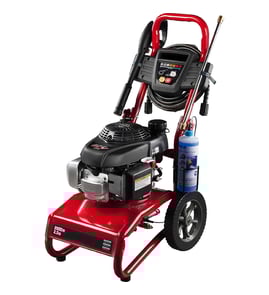





Are pressure washers 2 stroke or 4?
The Craftsman pressure washer model 580751651 uses a 4-stroke gasoline engine, so it runs on straight gasoline in the fuel tank and engine oil in the crankcase (no gas/oil premix). For the exact oil type, capacity, and service intervals, follow the 580751651 owner's manual.
Most homeowner gas pressure washers like the 580751651 are 4-stroke. Use these quick checks:
- Oil fill/dipstick present on the engine (4-stroke)
- Separate oil changes listed in maintenance steps (4-stroke)
- No mention of fuel mix ratios like 50:1 or 40:1 (4-stroke)
- Runs at a governed constant speed during operation (common on 4-stroke pressure washers)
- Spark arrestor and muffler guard service described as routine maintenance (common on 4-stroke engines)
Use this as a safe, practical baseline for the Craftsman 580751651:
| Item | 4-stroke pressure washer (like 580751651) | 2-stroke pressure washer |
|---|---|---|
| Fuel in tank | Gasoline only | Gasoline mixed with 2-cycle oil |
| Engine lubrication | Separate crankcase oil | Oil carried in the fuel mix |
| Routine service | Check oil level, change oil, service spark arrestor | Mix fuel correctly, service spark plug and air filter |
Using premixed fuel in a 4-stroke engine can foul the spark plug and cause heavy smoke; running straight gas in a 2-stroke engine can quickly damage the engine. Correct fuel and oil practices also help the engine maintain proper governed speed and protect the pump.
If your engine runs poorly after a fuel mistake or maintenance issue, use these guides to narrow it down:
Last updated: January 2026
Can you put 87 gas in a pressure washer?
Yes. For the Craftsman pressure washer model 580751651, we recommend using regular unleaded gasoline, which is typically 87 octane. Use clean, fresh fuel and follow the refueling and storage steps in the 580751651 owner's manual to help prevent hard starting and fuel-system problems.
- Use regular unleaded gasoline (commonly 87 octane).
- If unleaded is not available, regular leaded gasoline can be used.
- Avoid storing alcohol-blended fuels (ethanol or methanol blends) for long periods; they can attract moisture and cause fuel separation during storage.
- Do not keep gasoline from one season to the next.
- Replace a rusty gas can; rust and dirt in fuel cause running problems.
- Shut the engine off and let it cool for at least 2 minutes before refueling.
- Refuel outdoors, away from sparks, flames, and smoking.
- Clean around the fuel cap before removing it.
- Fill with room for expansion; do not overfill.
| Topic | Best practice | What it prevents |
|---|---|---|
| Octane | Regular unleaded (typically 87) | Poor performance from incorrect fuel |
| Fuel freshness | Buy small amounts, use promptly | Gum and varnish deposits |
| Storage over 30 days | Empty the fuel system before storage | Carburetor and fuel-system damage |
Using the correct gasoline and handling it properly helps your pressure washer start easier, run smoother under load, and reduces carburetor issues caused by stale fuel or moisture contamination.
For storage and fuel-system prep, follow the steps in the 580751651 owner's manual.
Last updated: January 2026
What kind of oil does a Craftsman 3000 psi pressure washer take?
For the Craftsman pressure washer model 580751651, use SAE 30 weight engine oil; the engine oil capacity is 20 oz. This is the correct oil type for normal operating temperatures and routine maintenance on this gas pressure washer (check the maintenance section in the 580751651 owner's manual).
Use the table below as your quick reference when changing oil.
| Spec | What to use |
|---|---|
| Oil type | SAE 30 weight engine oil |
| Oil capacity | 20 oz |
| Gasoline capacity | 1 U.S. gallon |
A clean oil change helps protect the crankshaft, piston rings, and governor components from wear.
- Run the engine briefly to warm the oil (warm oil drains faster)
- Shut off the engine and let it cool enough to handle safely
- Place an oil pan under the engine
- Drain through the drain plug if equipped; if not, drain through the oil fill tube by carefully tilting the unit
- Refill with 20 oz of SAE 30 and recheck the level on the dipstick (do not overfill)
Using the correct viscosity (SAE 30) helps the engine maintain proper lubrication film strength under load, which is especially important on a pressure washer where the engine can run at steady high RPM while driving the pump.
If you are troubleshooting performance issues after maintenance, these guides help narrow down common causes:
Last updated: January 2026