Owner’s manual
 Error Codes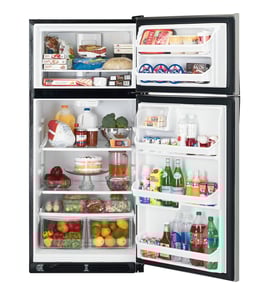

How to tell cubic feet of Kenmore refrigerator by model number?
For Kenmore model 36370242000, the model number alone usually does not state the exact cubic-foot capacity. The most reliable way is to look up the capacity in the product specs section of the owner's manual, or calculate it by measuring the usable interior space and converting cubic inches to cubic feet.
Fast ways to find capacity
- Check the specs in the manual: Look for “capacity” or “cubic feet” under specifications in the owner's manual.
- Look for a rating/spec label: Many top-mount refrigerators have a label inside the fresh food section (side wall, ceiling, or near the crisper area) that may list capacity.
- Measure and calculate: Use interior measurements to estimate cubic feet (best when the manual does not list it clearly).
How to calculate cubic feet (interior)
- Measure the usable interior of each compartment in inches:
- Fresh food: height x width x depth
- Freezer: height x width x depth
- Convert each compartment to cubic feet:
- Cubic feet = (H x W x D) / 1728
- Add fresh food + freezer results for total capacity.
Measurement tips (so your estimate is realistic)
- Measure inside wall to inside wall, not the outside cabinet.
- Use the average depth if shelves or ducts reduce space in some areas.
- Exclude obvious non-storage areas (large air ducts, light housings, thick door bins) if you want a “usable space” estimate.
Typical capacity range (for context)
Most Kenmore top-mount refrigerators like the 36370242000 fall into a common range; use this to sanity-check your math.
| Refrigerator style | Typical total capacity |
|---|---|
| Top-mount (top freezer) | ~14 to 22 cu. ft. |
Why it matters
Capacity helps you compare replacement models, choose the right storage accessories, and understand airflow needs (overpacking can reduce cooling performance and contribute to frost or temperature swings).
Last updated: February 2026
What is the upper part of a fridge called?
On a Kenmore top-mount refrigerator like model 36370242000, the upper compartment is typically called the freezer compartment (or simply the freezer). It’s the section designed to keep foods frozen and, on some models, it also supports an ice maker.
What you’ll usually find in the upper (freezer) section
- Freezer shelves or a wire rack
- Freezer door bins
- Temperature control (on some top-mount designs)
- Air vents that help move cold air to the fresh food section
- Optional ice maker components (if equipped)
Freezer vs. refrigerator: quick comparison
| Compartment | Typical temperature range | Main purpose |
|---|---|---|
| Freezer (upper on top-mount) | 0°F to 5°F | Long-term frozen storage, ice making |
| Fresh food section (lower) | 34°F to 40°F | Everyday refrigerated foods |
Why it matters
Knowing the correct compartment name helps when you’re using the owner's manual for temperature settings, airflow guidance, and troubleshooting issues like warm freezer temps, frost buildup, or poor cooling in the refrigerator section.
Related parts you might see referenced for freezer issues
If you’re diagnosing cooling or frost problems, these parts commonly come up in top-mount refrigerator repairs:
- Refrigerator defrost bi-metal thermostat WR50X10010 (helps control defrost cycling)
- Refrigerator defrost heater WR51X465 (melts frost off the evaporator)
- Refrigerator defrost timer WR9X520 (controls when defrost runs on many mechanical-timer models)
Last updated: February 2026
Can I run my Kenmore refrigerator without a water filter?
Yes. Your Kenmore top-mount refrigerator model 36370242000 will still cool normally without a water filter; the only impact is on the water system (dispenser and ice maker). If your setup requires a bypass, use the method shown in the owner's manual to prevent leaks and restore proper water flow.
What changes when the filter is removed
Running without a filter mainly affects water quality and the water circuit.
- Water and ice can taste or smell worse because they are not being filtered
- Sediment can collect in the water valve and ice maker over time
- Water flow can be reduced if the filter housing needs a bypass plug
- You may see dripping or leaks at the filter head if it is not sealed correctly
Quick checks to avoid leaks or low water flow
Before you leave the filter out long-term, we recommend these basics:
- Confirm whether your refrigerator uses a filter cartridge, an inline filter, or no filter at all
- Make sure the filter head is fully seated and not cracked
- Flush the water line after any change (dispense several cups of water)
- Check the supply shutoff valve is fully open
- Inspect for slow fill or no fill at the ice maker
Parts that commonly relate to water flow issues
| Symptom | Common cause | Related part on this model page |
|---|---|---|
| No water to ice maker/dispenser | Inlet valve not opening | Refrigerator water valve WR57X10033 |
| Ice maker fill tube freezing or leaking | Tube misrouted, cracked, or icing | Refrigerator ice maker fill tube WR17X1948 |
Why it matters
A missing or bypassed filter does not harm the sealed cooling system, but it can shorten the life of water-system components by letting minerals and debris reach the inlet valve and ice maker. If you prefer to run unfiltered, keeping the water line clean and leak-free becomes more important.
For filter selection and replacement tips, use our guide: how to replace the water filter in a Kenmore refrigerator.
Last updated: February 2026
What are the disadvantages of a top mount fridge?
Top-mount refrigerators like the Kenmore 36370242000 are reliable and space-efficient, but the main tradeoffs are convenience and organization: fresh-food items sit lower (more bending), freezer access is higher, and features like in-door ice and water are less common on this style.
Common disadvantages (what you’ll notice day to day)
- More bending for fresh food: the refrigerator compartment is below the freezer, so you reach down more often.
- Less “eye-level” organization: produce drawers and lower shelves can be harder to see and keep sorted.
- Fewer premium features: top-mount designs often have fewer options for in-door dispensers and advanced controls.
- Freezer ergonomics: the freezer is at shoulder height for many people, which can be awkward for heavy items.
- Door-swing clearance: in tighter kitchens, the door swing can feel more intrusive than some bottom-freezer layouts.
Quick comparison: top-mount vs bottom-freezer
| Feature | Top-mount (like 36370242000) | Bottom-freezer |
|---|---|---|
| Fresh-food access | Lower, more bending | Higher, easier access |
| Freezer access | Higher, easier for quick grabs | Lower, often a pull-out drawer |
| Organization | Typically simpler | Often more bins/drawers |
| Cost/complexity | Typically lower | Often higher |
When a “disadvantage” becomes a repair or parts issue
Sometimes the layout is fine, but performance issues make it feel inconvenient. If you’re dealing with warm temps, frost buildup, or water/ice problems, check the troubleshooting and maintenance steps in the owner's manual.
Here are common parts that affect day-to-day usability on this model:
- If the door does not seal well (temperature swings, moisture), a worn gasket can be the cause; see refrigerator freezer door gasket WR24X445.
- If the ice maker is slow or not filling, the water supply components matter; see refrigerator water valve WR57X10033 and refrigerator ice maker fill tube WR17X1948.
- If you see heavy frost or poor cooling, the defrost system is a common area to inspect; see refrigerator defrost bi-metal thermostat WR50X10010 and refrigerator defrost timer WR9X520.
Why it matters
Choosing a refrigerator style is mostly about ergonomics. If you access fresh food many times a day, a bottom-freezer layout can feel easier; if you want a simpler, proven design with straightforward maintenance, a top-mount is often a strong fit.
Last updated: February 2026
What are the most common problems with Kenmore refrigerators?
The most common issues we see on Kenmore refrigerators like model 36370242000 are cooling problems, water leaks, ice maker or dispenser troubles, frost buildup, and unusual noises. Many of these trace back to airflow restrictions, defrost-system failures, door seal gaps, or a starting/cooling component beginning to fail; use the 36370242000 owner's manual for model-specific checks.
Most common symptoms and what usually causes them
- Not cooling or warm temperatures: dirty condenser coils, failed start device, weak compressor, or evaporator fan/airflow problems.
- Freezer cold but fridge warm: blocked air vents, iced-over evaporator (defrost issue), or a fan problem.
- Water leaking or puddles: clogged defrost drain, cracked water line, or a leaking inlet valve.
- Excessive frost: door left ajar, torn gasket, or a failed defrost heater/thermostat/timer.
- Noisy operation: fan blade hitting ice, worn fan motor mounts, or compressor start components buzzing/clicking.
- Ice maker not filling or slow fill: restricted water supply, frozen fill tube, or a valve problem.
Quick checks we recommend first (no parts required)
- Confirm temps: 0°F in the freezer and 37°F in the fresh food section.
- Make sure vents are not blocked by food packages.
- Clean condenser coils and verify the condenser fan (if equipped) runs when the compressor runs.
- Check door closing and gasket contact all the way around.
- Look for frost on the freezer back panel (a strong clue of a defrost problem).
- If you have an ice maker, confirm the shutoff arm is down and the fill tube is not frozen.
Common fixes and parts that often solve them
| Symptom | Likely system | Example part for 36370242000 |
|---|---|---|
| Clicking, won’t start cooling | Compressor start circuit | Relay ptc WR07X10055 |
| Frost buildup, warm fridge | Defrost system | Refrigerator defrost heater WR51X465 or refrigerator defrost bi-metal thermostat WR50X10010 |
| No water to ice maker/dispenser | Water supply/valve | Refrigerator water valve WR57X10033 |
| Interior light won’t work | Light circuit | Light switch WR23X37285 or 40A15/22 40A15 |
Why it matters
Catching airflow, defrost, and start-component problems early helps prevent food spoilage and reduces strain on the compressor (one of the most expensive repairs on a refrigerator).
Last updated: February 2026