Owner’s manual
 Error Codes



What is the advantage of a bottom mount fridge?
A bottom-mount design on the KitchenAid KRFC704FPS00 puts the fresh-food refrigerator section at eye level and the freezer in a lower drawer, so you reach for everyday items with less bending. This layout also supports wide, easy-to-organize fresh-food storage.
Key advantages you’ll notice day to day
- Fresh food at eye level: easier to see and grab milk, produce, and leftovers.
- Less bending: you typically access the refrigerator more than the freezer.
- Wider refrigerator space: French door bottom-mount designs often make it easier to store platters and large containers.
- Better organization: freezer drawers help separate frozen foods into tiers/baskets.
- Convenient feature access: on this model family, items like in-door ice and filtration features are designed for quick reach (see the KRFC704FPS00 user guide).
Bottom-mount vs top-freezer: quick comparison
| Feature | Bottom-mount (like KRFC704FPS00) | Top-freezer |
|---|---|---|
| Most-used section height | Refrigerator at eye level | Freezer at eye level |
| Bending for daily items | Less | More |
| Freezer access | Pull-out drawer(s) | Swing door |
| Organization style | Drawer tiers/bins | Shelves/bins |
Why it matters
Most households open the refrigerator far more often than the freezer. With a bottom-mount refrigerator, the foods you use every day stay in your natural line of sight, which can reduce “door-open time,” improve organization, and make meal prep more efficient.
Last updated: January 2026
What is the most common problem with a KitchenAid refrigerator?
Temperature inconsistency and ice maker or water system issues are the most common problems we see on KitchenAid refrigerators like model KRFC704FPS00. In practice, these show up as warm fresh-food temps, soft ice or no ice, slow water dispensing, or water leaks around the filter and supply line (see the KRFC704FPS00 user guide).
Most common issues (and what they usually look like)
- Temperature not holding steady: food spoils faster, fridge section warms, freezer seems OK.
- Ice maker problems: no ice, small or hollow cubes, clumping in the bin.
- Water leaks or drips: puddles under the front, dripping at the dispenser, or leaking at the filter area.
- Door sealing issues: condensation, frost, or the door not closing firmly.
- Odors: lingering smells even after cleaning.
Quick checks we recommend first
- Confirm controls are set to the recommended temperatures in the KRFC704FPS00 user guide.
- Make sure doors close fully and the refrigerator is level.
- If ice or water is slow, replace the water filter and flush the system.
- Check the water line behind the refrigerator for kinks and confirm household water pressure is adequate.
- Clean condenser area and ensure airflow around the cabinet.
Parts that commonly solve these symptoms (when replacement is needed)
If troubleshooting points to a worn or failed component, these model-compatible parts are commonly involved:
| Symptom | Commonly related part | Example from this model’s parts |
|---|---|---|
| Odors in fresh-food section | Air filter | Refrigerator air filter W10311524 |
| No ice or irregular ice | Ice maker assembly | Refrigerator ice maker assembly W10908391 |
| Condensation or poor sealing | Door gasket | Refrigerator door gasket (gray) W10917313 |
Why it matters
These issues can raise food-safety risk, increase energy use (longer compressor run time), and cause secondary damage like frost buildup or water damage. Catching the early signs usually prevents a bigger repair later.
Last updated: January 2026
Why is my KitchenAid refrigerator leaking at the bottom?
On KitchenAid model KRFC704FPS00, a leak at the bottom is most often caused by a clogged or frozen defrost drain (defrost water overflows) or a water-supply leak (filter not seated, tubing connection, or valve area). Use the KRFC704FPS00 user guide to follow safe access steps and confirm the filter installation procedure.
Quick checks we recommend first
- Confirm the liquid is water (it dries) and not a slick residue.
- Note when the puddle appears: after dispensing water, after ice maker activity, or after a defrost cycle.
- Check for water or ice under the crisper area and along the freezer drawer rails.
- Inspect the water filter compartment (lower left in the fresh food section on this model) for fresh drips.
- Make sure the refrigerator is level so water drains to the pan correctly.
Most common causes and what to do
1) Defrost drain clogged or frozen
Defrost meltwater should flow through a drain to the evaporator pan. If the drain is blocked, water can back up and leak out.
- Unplug the refrigerator.
- Look for ice buildup in the bottom interior areas.
- Flush the drain with warm water and clear debris.
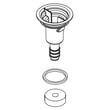
- If the drain hardware is damaged or missing, inspect the refrigerator drain funnel W10503218.
2) Water filter not seated or filter door area dripping
If the filter is not fully locked, water can leak inside the compartment and run down.
- Remove and reinstall the filter; confirm it locks with the correct quarter-turn.
- After reinstalling, dispense water and watch for drips.
- Replace the filter if the seals look damaged; use the refrigerator cartridge wrap assembly EDR2RXD1.
3) Water line or valve area leak behind the refrigerator
A slow drip behind the unit can travel forward and show up as a front puddle.
- Check the household supply line for kinks or loose fittings.
- Look for water trails on the back panel and floor.
Symptom-to-cause guide
| What you notice | Most likely cause | Where to look |
|---|---|---|
| Puddle after defrost, ice in bottom areas | Clogged or frozen defrost drain | Drain path and evaporator pan area |
| Drips right after changing filter | Filter not seated | Filter compartment |
| Water behind fridge then front puddle | Supply line or connection leak | Back of cabinet and shutoff valve |
Why it matters
Stopping the leak quickly helps prevent floor damage and reduces the chance of ice buildup that can affect cooling performance and door sealing.
Last updated: January 2026