Owner’s manual
 Error Codes



Is side-by-side better than a French door?
A side-by-side is “better” than a French door when you want easy access to both fresh and frozen foods at eye level and you prefer narrower door swing clearance. For Whirlpool model GSS26C4XXY00, the best choice depends on your kitchen space and how you store groceries.
Quick comparison
| Feature | Side-by-side | French door |
|---|---|---|
| Fresh-food access | Good, but shelves are narrower | Excellent, wide shelves for platters |
| Freezer access | Easy, vertical storage | Often a bottom drawer (deeper reach) |
| Door swing clearance | Typically needs less side clearance | Often needs more clearance for wide doors |
| Best for | Balanced fresh/frozen use | Fresh-food heavy households |
Choose a side-by-side if you
- Store frozen foods often and want them at eye level
- Prefer tall, narrow freezer organization (bins, pizza boxes, bags)
- Have a tighter aisle and want narrower doors
- Use the in-door ice and water frequently and want quick access
Choose a French door if you
- Keep lots of fresh ingredients and want wide refrigerator shelves
- Store wide items (party trays, sheet pans, large leftovers)
- Want more flexible refrigerator space for meal prep
- Prefer a bottom freezer drawer for bulk frozen storage
Why it matters
Side-by-side and French door layouts change how cold air circulates, how you organize food, and how often doors stay open. Picking the layout that matches your habits helps reduce temperature swings, improves food freshness, and can cut down on ice maker and dispenser issues.
Helpful resources for Whirlpool refrigerators
- For care, features, and storage tips specific to your unit, use the GSS26C4XXY00 owner’s manual.
- If you rely on the dispenser, follow best practices in how to prevent water dispenser and ice maker problems.
Last updated: January 2026
How many cubic feet is the Whirlpool refrigerator model GSS26C4XXY00?
The Whirlpool side-by-side refrigerator model GSS26C4XXY00 is typically listed at about 25.3 cubic feet total capacity, with about 9.9 cubic feet in the freezer. For the exact capacity breakdown for your unit, check the GSS26C4XXY00 owner's manual.
Capacity breakdown (what the numbers mean)
Refrigerator capacity is usually shown as total cubic feet, then split between the fresh food and freezer compartments.
- Total capacity: overall usable space (fresh food + freezer)
- Freezer capacity: space behind the freezer door
- Fresh food capacity: total minus freezer (varies by configuration)
- Shelves and bins: affect usable space but not the rated cubic feet
Quick reference table
| Measurement | Typical value for GSS26C4XXY00 listings | What it represents |
|---|---|---|
| Total capacity | 25.3 cu. ft. | Fresh food + freezer |
| Freezer capacity | 9.9 cu. ft. | Freezer compartment |
| Fresh food capacity (calculated) | 15.4 cu. ft. | Total minus freezer |
Why it matters
Knowing the cubic feet helps when comparing side-by-side refrigerator sizes, planning kitchen space, and choosing storage accessories like shelves, drawers, and door bins that match how you use the fresh food and freezer sections.
Last updated: January 2026
How to force defrost on Whirlpool side-by-side refrigerator?
On the Whirlpool GSS26C4XXY00 side-by-side refrigerator, “force defrost” is typically done through the control’s service/diagnostic mode (not by unplugging). Once started, a forced defrost cycle commonly runs about 20 minutes and then returns to normal cooling.
Before you start (important)
- Move perishable food to a cooler if the freezer has heavy frost buildup.
- Keep towels handy; melting frost can drip.
- Do not chip ice with sharp tools; you can puncture the evaporator.
- If you smell burning or see smoke, stop and unplug the refrigerator.
How forced defrost usually works on Whirlpool side-by-sides
Because the exact key sequence can vary by control style and revision, we recommend using the model’s procedure in the GSS26C4XXY00 owner's manual.
Most Whirlpool electronic-control side-by-sides follow this general pattern:
- Enter diagnostics/service mode using a specific button combination.
- Navigate to a “defrost” or “forced defrost” test.
- Start the test; the defrost heater energizes and the evaporator begins warming.
- The unit exits the test automatically (often around 20 minutes) or when you cancel it.
What to check if forced defrost will not run
If the refrigerator will not enter forced defrost, or it starts but frost returns quickly, these are the most common causes:
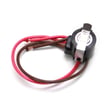
- Failed defrost thermostat/bi-metal such as Refrigerator defrost bi-metal WPW10225581
- Control problem (defrost not being commanded)
- Evaporator fan issue (poor airflow can mimic a defrost problem)
- Door not sealing well (warm air intrusion)
- Drain restriction causing ice buildup after defrost
Quick results guide
| What you observe | What it usually means | What to do next |
|---|---|---|
| Frost melts and airflow improves | Defrost heater circuit likely works | Monitor for repeat icing; check door seal and usage |
| No melting after 10 to 15 minutes | Defrost system fault | Check defrost bi-metal, wiring, and control diagnostics |
| Heavy frost returns in days | Defrost not occurring in normal operation | Focus on defrost controls/sensors and airflow |
Why it matters
Forced defrost is a fast way to confirm whether the defrost system can melt evaporator frost. If frost keeps building, the freezer can lose airflow, temperatures rise, and the refrigerator section may warm even though the compressor runs.
Last updated: January 2026
How wide is a 24.5 cu ft refrigerator?
A 24.5 cu. ft. refrigerator is typically in the 36-inch class. For Whirlpool model GSS26C4XXY00 (side-by-side), plan on about 35 5/8 inches cabinet width and about 36 inches overall width with handles; confirm your exact configuration in the GSS26C4XXY00 owner's manual.
What width number should I use for fit?
Use the measurement that matches your situation (opening size vs. door clearance).
- Use cabinet width to judge the box fit between cabinets.
- Use overall width (with handles) to avoid handle interference.
- Add space for door swing so doors open fully.
- Leave room for airflow clearance at the sides and top.
- Measure the opening in multiple spots (front and back) to catch out-of-square walls.
Quick reference: common width measurements
| Measurement type | What it includes | What to use it for |
|---|---|---|
| Cabinet width | Refrigerator box only | Will it physically fit in the cutout? |
| Overall width | Handles and protrusions | Will handles hit cabinets or walls? |
| Clearance width | Extra space around unit | Ventilation and door swing |
Why widths vary at the same capacity
Capacity (24.5 cu. ft.) does not lock in a single exterior width; design choices change the outside dimensions.
- Side-by-side vs. French door layouts
- Insulation thickness and liner design
- Standard-depth vs. counter-depth cabinet design
- Handle style and hinge geometry
Why it matters
If you size only to “36 inches,” the refrigerator can still bind on handles or fail to ventilate properly. Using the cabinet width plus the right clearances helps prevent fit issues and cooling performance problems.
Last updated: January 2026