Owner’s manual



How do I reset my Samsung dryer?
To reset your Samsung dryer model DVE54R7600C, we recommend a simple power reset: turn the dryer off, cut power at the breaker (or unplug it) for about 5 minutes, then restore power and start a cycle. This clears many temporary control glitches and some information codes.
- Press Power to turn the dryer off.
- Unplug the dryer or switch OFF the dryer circuit breaker.
- Wait 5 minutes.
- Restore power.
- Press Power, select a cycle, then press and hold Start/Pause (Hold to Start).
- If an information code returns, address the cause (not just the symptom).
Some codes clear after a reset, but they usually come back if the underlying issue remains.
| What you see | What it usually means | What to check first |
|---|---|---|
| dC | Door is open or not sensed as closed | Close door firmly; check for laundry caught in the door |
| FC | Power supply frequency issue | Reset power; if it returns, have the outlet/supply checked |
For a full list of Samsung dryer codes and fixes, use Samsung dryer error codes.
A reset will not correct a failed component or airflow restriction. If the dryer still will not run or heat after resetting, these are common next checks:
- Lint screen and exhaust vent for blockage (restricted airflow can trigger overheating issues)
- House breaker (a tripped breaker can leave the dryer with partial power)
- Door latch and door switch operation
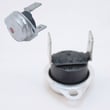
- Overheat protection parts (thermal cut-off, high-limit thermostat)
- Moisture/temperature sensing problems
If you suspect a temperature-sensing issue, the dryer thermistor DC32-00007A is one of the components used to monitor temperature.
Resetting is a fast first step, but repeated codes or shutdowns point to a condition the dryer is detecting (door not closed, power issue, overheating, or a sensor problem). Fixing the root cause prevents repeat failures and helps drying performance.
For model-specific operating details and button functions, follow the DVE54R7600C owner's manual.
Last updated: February 2026
How to find part number for Samsung dryer?
For your Samsung DVE54R7600C dryer, the fastest way to get the correct part number is to first confirm the model number from the appliance ID label, then use that exact model to match the part in the parts list and diagrams. The DVE54R7600C owner's manual also helps you identify key components.
On most Samsung front-load dryers (including DVE54R7600C), the model and serial tag is typically located:
- On the front frame behind the dryer door (open the door and check the cabinet opening)
- Sometimes on the back panel as a secondary label
- Occasionally on the side of the cabinet near the door opening
Use this process to avoid ordering the wrong Samsung dryer part:
- Write down the full model number exactly as shown (DVE54R7600C)
- If present, note the serial number too (helps with production revisions)
- Identify the part by function and location (for example: lint filter area, blower housing, door switch)
- Match the part in the model-specific diagrams and confirm the manufacturer part number
- Compare the part description to what you see on the dryer before ordering
These are frequent part lookups for this model family:
| Symptom or task | Part type to check | Example part from our list |
|---|---|---|
| Dryer will not start when door closes | Door switch | Dryer Door Switch DC64-00828B |
| Dryer takes too long to dry | Lint screen, blower wheel, venting | Dryer Lint Screen DC97-16742A |
| Overheating or shuts off | High-limit thermostat, thermal cut-off | Dryer High-limit Thermostat DC47-00018A |
| No heat or heat cuts out | Thermal cut-off thermostat/fuse | Dryer Thermal Cut-off Thermostat DC47-00016A |
Samsung dryers often have multiple similar-looking versions of thermostats, fuses, and sensors. Using the exact model number (DVE54R7600C) and confirming the part description prevents mismatches, repeat repairs, and drying performance problems.
Last updated: February 2026
How to tell if Samsung dryer thermal fuse is bad?
On the Samsung DVE54R7600C dryer, a bad (blown) thermal fuse commonly shows up as a dryer that will not run or runs with no heat. The reliable way to confirm is a continuity test with a multimeter; a good fuse reads closed (continuity), a blown fuse reads open (no continuity). See the DVE54R7600C user manual for safety and access guidance.
- Dryer will not start even though the door is shut and power is on
- Drum tumbles but there is no heat (clothes stay damp)
- Cycle stops early after overheating
- Burning smell or very hot cabinet (often tied to restricted venting)
- Lint buildup around the lint filter area or exhaust duct
- Unplug the dryer (electric shock hazard).
- Access the fuse location (typically on or near the heater housing or blower housing, depending on design).
- Pull the wires off the fuse terminals (note their positions).
- Set a multimeter to continuity or ohms.
- Touch a probe to each terminal:
- Good fuse: continuity (beep or near 0 ohms)
- Bad fuse: no continuity (OL or very high resistance)
A thermal fuse usually blows because the dryer overheated. If you replace the fuse without fixing airflow, it can blow again.
| What to check | What we look for | Why it matters |
|---|---|---|
| Lint filter and housing | Lint film, blockage | Reduces airflow and raises heat |
| Exhaust duct and outside hood | Kinks, crushed duct, lint clog | Most common overheating cause |
| Temperature controls | Out-of-range readings | Can cause overheating |
- Dryer thermal cut-off fuse, 320-degree f DC47-00015A
- Dryer high-limit thermostat DC47-00018A
- Dryer thermistor DC32-00007A
The thermal fuse is a one-time safety device; when it opens, it prevents unsafe overheating. Restoring safe airflow (lint filter, exhaust duct, outside hood) helps the dryer heat correctly and protects the heater and motor.
Last updated: February 2026
How to tell if a Samsung dryer heating element is bad?
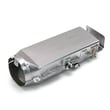
On our Samsung DVE54R7600C dryer, a bad heating element typically shows up as little to no heat, long dry times, or an “HC” high-temperature heating check code caused by airflow problems that overheat the heater area. Confirm the element with a visual inspection and a multimeter continuity test.
- Clean the lint filter and run a timed dry cycle.
- Check airflow: weak exhaust at the outside vent often causes overheating and heat shutdowns.
- Watch for information codes; “HC” points to a high-temperature condition and “tC/tC5” points to thermistor resistance issues.
- If the drum tumbles but clothes stay cold, move to electrical tests.
- Unplug the dryer (electric shock hazard) and let it cool.
- Access the heater terminals (follow the disassembly steps in the DVE54R7600C owner’s manual).
- Set the meter to ohms (Ω) or continuity.
- Test terminal-to-terminal:
- Good element: continuity and a steady resistance reading (not OL/infinite).
- Bad element: OL/infinite resistance (open heater) or visibly broken coil.
- Test each terminal to the metal heater housing:
- Good element: no continuity to ground.
- Bad element: continuity to ground (shorted heater).
If the element tests good, these parts commonly stop heat on Samsung dryers:
| Symptom | More likely cause | Example part for this model |
|---|---|---|
| Dryer overheats, may show HC | Restricted venting, high-limit thermostat opening | Dryer high-limit thermostat DC47-00018A |
| No heat after overheating event | Thermal cut-off opened | Dryer thermal cut-off thermostat DC47-00016A |
| tC or tC5 code, heat cycles oddly | Temperature sensing issue | Dryer thermistor DC32-00007A |
A failed heating element prevents proper drying, but airflow restrictions can also trigger high-temperature protection and damage heat-related components. Verifying the heater with a meter helps you replace the right part the first time.
Last updated: February 2026
What does E3 mean on a Samsung dryer?
On the Samsung DVE54R7600C dryer, an E3 code means the dryer is detecting an overload or out-of-balance load. Reducing the load size and redistributing items typically clears the code and helps the drum tumble normally; see the DVE54R7600C user manual for load-size guidance.
- Press Power to stop the cycle.
- Open the door and remove some items (heavy loads trigger overload sensing).
- Untangle and redistribute items so weight is even.
- For bulky items (blankets, comforters), dry one item at a time.
- Restart on a Sensor Dry cycle and monitor tumbling.
| Common cause | What you’ll notice | What to do |
|---|---|---|
| Too many items | Drum struggles to start or slows | Remove 25% to 50% of the load |
| One heavy item | Thumping, load clumps to one side | Add a few similar items or dry single-item |
| Mixed fabrics/weights | Some items wet, some dry | Sort by fabric weight and re-run |
| Drag from airflow restriction | Longer dry times, hotter cabinet | Clean lint filter and check venting |
An E3 that returns with small, balanced loads usually points to a tumbling or airflow problem that makes the dryer work harder than normal.
- Confirm the drum turns freely by hand (with power off).
- Check for excessive lint buildup around the lint filter area.
- If you hear squealing or grinding, inspect wear items such as the Samsung dryer drum belt 6602-001655 and drum support rollers.
Running overloaded can reduce drying performance, increase cycle time, and add strain to the drive system (belt, motor, rollers). Keeping loads small and balanced helps the dryer dry evenly and protects key parts.
Last updated: February 2026
What is the average lifespan of a Samsung dryer?
A Samsung dryer typically lasts 10 to 15 years. For your Samsung DVE54R7600C, consistent airflow maintenance (lint filter and venting), avoiding overloads, and addressing heat or error-code issues early are the biggest factors that keep it running closer to the 15-year end of that range.
- Vent restriction (long dry times, overheating, extra wear on the heater and motor)
- Lint filter habits (clean every load; wash the screen film buildup periodically)
- Load size (small to medium loads reduce belt and roller stress)
- Heat management (overheating can trip safety thermostats and fuses)
- Power quality (power issues can trigger information codes and stress electronics)
- Clean the lint filter every load.
- Check airflow at the outside vent hood; it should be strong and steady.
- Clean the vent duct at least yearly (more often with long ducts or heavy use).
- Keep the dryer level to reduce vibration and drum support wear.
- Use cycle settings appropriately; Sensor Dry can extend time based on load moisture (normal behavior).
| Symptom | Likely wear area | Typical next step |
|---|---|---|
| Squealing, thumping | Drum support rollers, belt | Inspect drum support and belt condition |
| Long dry times | Venting, lint buildup, heat control | Verify airflow, then check heat components |
| No heat or overheating | Thermostats, thermal cut-off, thermistor | Test components and correct vent restriction |
If you’re troubleshooting heat or code-related problems on this model, use the DVE54R7600C owner’s manual for the checkpoints and information code table, and reference our Samsung dryer error codes guide for quick code lookups.
Most dryers fail early from overheating and restricted airflow, not from “age” alone. Keeping airflow strong reduces cycling stress on the heater circuit, thermostats, and motor, which directly extends service life.
Last updated: February 2026