Installation guide
 Owner’s manual
 Error Codes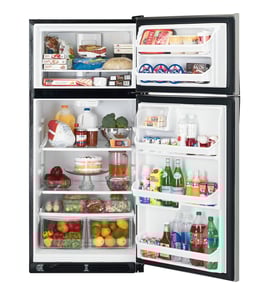

What is the upper part of a fridge called?
On the Kenmore 25361702400 top-mount refrigerator, the upper section is the freezer compartment. It’s the coldest area of the appliance, designed to keep foods frozen and, on some models, it also houses the automatic ice maker and freezer light.
What you’ll typically find in the upper (freezer) compartment
Depending on how your 25361702400 is equipped, the upper section commonly includes:
- Freezer shelves or door bins for frozen foods
- Cold air circulation paths (vents) that help freeze food evenly
- An ice maker area (if installed) and an ice bin
- A freezer light and light shield (on some models)
- Defrost-related components working behind the freezer’s rear panel
For model-specific layout and feature details, use the 25361702400 owner's manual.
Why the name matters (freezer vs. refrigerator section)
Knowing the correct compartment name helps when you’re troubleshooting temperature problems or ordering parts. For example, “freezer cold but refrigerator warm” often points to an airflow or damper issue between compartments.
Quick compartment comparison
| Compartment | Main job | Typical setpoint |
|---|---|---|
| Freezer (upper) | Keeps food frozen long-term | About 0°F |
| Fresh food section (lower) | Keeps food cold, not frozen | About 37°F |
Tips for better freezer performance
These habits help the freezer maintain stable temperatures and protect food quality:
- Leave space between packages so cold air can circulate
- Avoid overloading the freezer door with hard-to-freeze items
- Keep vents clear so airflow is not blocked
- Level the refrigerator so doors close tightly
- Use the recommended control settings in the manual
Related parts you might see referenced
If you’re diagnosing cooling or defrost symptoms, these are common refrigerator parts (not necessarily located in the upper section itself):
Last updated: January 2026
What does er ff mean on kenmore elite refrigerator?
On the Kenmore 25361702400 top-mount refrigerator, an ER FF code points to a problem with the freezer evaporator fan (the fan that moves cold air through the freezer and into the fresh food section). When that fan cannot run correctly, cooling performance drops.
What you’ll notice when ER FF shows up
- Refrigerator section warming up even though the freezer seems cold
- Weak or no airflow from the refrigerator vents
- Unusual fan noise (rattling, grinding, or intermittent buzzing)
- Frost buildup on the freezer back wall (possible airflow restriction)
- Temperature swings after the door has been opened
Quick checks we recommend first
- Power reset: Unplug the refrigerator for 5 minutes, then plug it back in.
- Check for airflow blockage: Make sure packages are not blocking freezer vents.
- Listen for the fan: With the freezer door switch held closed, listen for the evaporator fan running.
- Look for heavy frost: If the freezer back panel is packed with frost, the fan may be hitting ice or airflow is restricted.
- Confirm control settings: Verify the fresh food and freezer controls are set normally (not at warmest).
Common causes and likely fixes
| What’s happening | Most likely cause | Typical fix |
|---|---|---|
| Fan is silent, no airflow | Failed evaporator fan motor or wiring issue | Diagnose fan circuit; replace failed component |
| Fan runs but is noisy | Ice contact, worn blade, or obstruction | Clear ice/obstruction; replace blade if damaged |
| Frost blanket behind freezer panel | Defrost system problem | Check defrost heater and defrost thermostat |
| Intermittent cooling | Loose connection or failing relay/control | Inspect connections; test components |
Parts that often relate to this symptom on this model
If you confirm the fan is running poorly or making noise, the blade can be a common wear item: refrigerator evaporator fan blade 5308000010. If you see heavy frost buildup, defrost components can be involved, such as refrigerator defrost bi-metal thermostat 5303918202.
Why it matters
The evaporator fan is what distributes cold air. If it stops or can’t move air, the refrigerator compartment warms up quickly, food spoils faster, and the freezer can develop frost patterns that make the problem worse.
Where to find model-specific guidance
For control locations, access steps, and safety notes specific to Kenmore model 25361702400, use the 25361702400 owner's manual.
Last updated: January 2026
How to tell cubic feet of Kenmore refrigerator by model number?
For Kenmore refrigerator model 25361702400, the most reliable way to confirm cubic feet is to look up the capacity in the specifications section of the 25361702400 owner's manual. If you only have the model number and no spec sheet, you can still estimate capacity by measuring the interior and converting cubic inches to cubic feet.
Best ways to find cubic feet (in order)
- Check the specifications section in the 25361702400 owner's manual for listed capacity.
- Look for the model and serial plate inside the fresh food compartment; the manual notes the serial plate is located inside the refrigerator compartment.
- If you cannot find a listed capacity, measure the usable interior space and calculate an estimate.
- Use the estimate to compare similar Kenmore 253-prefix top-mount refrigerators when shopping for bins, shelves, or replacement parts.
How to estimate cubic feet by measuring
- Empty the compartment enough to measure accurately.
- Measure interior width, depth, and height in inches (fresh food section and freezer separately if you want a better estimate).
- Multiply to get cubic inches.
- Convert to cubic feet:
- Cubic feet = (width × depth × height) ÷ 1728
Quick conversion table
| What you have | What to do | Result |
|---|---|---|
| Interior measurements (inches) | Multiply W × D × H | Cubic inches |
| Cubic inches | Divide by 1728 | Cubic feet (approx.) |
What the model number can and cannot tell you
Kenmore model numbers help identify the manufacturer family and parts system (for example, the 253 prefix is common on Kenmore refrigerators built by Frigidaire/Electrolux). Capacity is not consistently encoded in the digits, so using the manual specs or a measurement-based estimate is the dependable approach.
Why it matters
Knowing cubic feet helps you set realistic expectations for storage, compare replacement refrigerators, and avoid ordering shelves, drawers, or door bins that do not match the interior layout.
Last updated: January 2026