Owner’s manual


Where to find model number for Kenmore dryer?
On Kenmore dryer model 79690441900, the model and serial number are printed on the identification plate inside the dryer door. Open the door and look along the door opening on the cabinet frame for the label; write both numbers down for parts and service.
- Open the dryer door and inspect the cabinet frame around the door opening
- Check the identification plate for Model No. and Serial No.
- Wipe dust off the label so every digit is readable
- Record the numbers exactly as shown (including any leading zeros)
Having the full model number and serial number ensures we pull the correct Kenmore dryer parts list, wiring information, and troubleshooting steps from the 79690441900 owner's manual.
| You need | Why it matters | Example format |
|---|---|---|
| Model number | Matches the correct parts diagrams | 79690441900 |
| Serial number | Helps confirm production version | Letters and numbers |
- Use a flashlight and take a close-up photo
- Copy the model number first, then the serial number
- If the sticker is damaged, look for a second label nearby on the same door opening area
Kenmore dryers often share similar designs across model families, but parts like the drum belt, thermostats, and control board can vary by model and production run. Using the exact model number prevents ordering the wrong replacement part.
Last updated: February 2026
How to take off the front panel of a Kenmore dryer?
On the Kenmore 79690441900 dryer, removing the front panel typically means disconnecting power, lifting the top to access the mounting screws, then removing screws at the door opening and lifting the front panel up and off the lower clips. Use the 79690441900 owner's manual for the exact screw locations and wire routing.
- Unplug the dryer (or switch off the breaker).
- If it is a gas dryer, shut off the gas supply valve.
- Pull the dryer forward enough to work comfortably.
- Protect the floor and the front edge with a towel or cardboard.
- Have a container ready for screws.
- Remove the lint filter and check for screws near the lint filter opening (some versions use them to secure the top).
- Release the top panel: insert a putty knife a few inches in from each front corner to release the spring clips, then lift the top.
- Disconnect the door switch harness (if it is attached to the front panel). Label the connector so it goes back the same way.
- Remove screws at the door opening that secure the front panel to the cabinet.
- Remove any top-front mounting screws (under the raised top panel).
- Lift the front panel up to unhook it from the lower retaining tabs, then pull it forward and off.
| Symptom | Common area to check | Related part (if needed) |
|---|---|---|
| Squealing or thumping | Belt and idler area | Dryer drum belt 4400EL2001F |
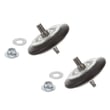
| Rumbling or heavy vibration | Drum support rollers | Dryer drum support roller 4581EL2002L |
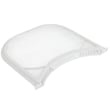
| Poor airflow or long dry times | Lint path and blower housing | Dryer lint filter 5231EL1003B |
We remove the front panel to access wear items like the drum belt, idler pulley, and rollers. Correct reassembly (especially wiring and panel alignment) helps prevent noise, vibration, and door-switch no-start problems.
Last updated: February 2026
What are the codes for Kenmore Elite dryer?
Kenmore Elite dryers use error codes to point you to a specific failure area (power, controls, heating, or temperature sensing). On Kenmore model 79690441900, common codes include PF, F:01, F:02, and several F:2x thermistor or heater-related codes; confirm the exact meaning and steps in the 79690441900 owner's manual.
- PF: Power failure during a cycle (outage, loose cord, tripped breaker)
- F:01: Main electronic control board problem
- F:02: Keypad or user interface problem
- F:20: Heater relay failure (heating circuit control issue)
- F:22 / F:23: Outlet thermistor failure (temperature sensing at exhaust)
- F:24 / F:25: Inlet thermistor failure (temperature sensing at intake)
- Reset the breaker or replace the fuse (do not upsize the fuse).
- For gas models: confirm the house gas shutoff and dryer gas shutoff valves are fully open.
- Clean the lint screen and check airflow; restricted venting can cause overheating and shutdowns.
- Power-cycle the dryer (unplug for 1 minute, then restore power) and recheck the code.
- If the code returns immediately, focus on the system named by the code (controls vs. temperature sensing).
| Code group | What it usually points to | Typical next step |
|---|---|---|
| PF | Incoming power interruption | Check outlet, cord, breaker, and home power stability |
| F:01 / F:02 | Control board or user interface | Inspect connections; consider control repair if persistent |
| F:20 | Heating control circuit | Check heating circuit components and wiring |
| F:22 to F:25 | Thermistor (temperature sensor) circuit | Check sensor wiring and sensor resistance per manual |
Using the code narrows troubleshooting so you do not replace the wrong part. For example, a thermistor code points to temperature sensing, while PF is usually a power supply issue, not a heating component.
Last updated: February 2026
How much does it cost to replace a heating element in a Kenmore dryer?
For Kenmore dryer model 79690441900, you typically do not replace a heating element because this model heats with gas components (igniter, burner, gas valve, and thermostats). Most “no-heat” repairs on this dryer run about $150 to $400 total with professional service, depending on which part failed.
On a gas Kenmore dryer, “no heat” is usually caused by one of these parts:
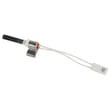
- Igniter (glows to light the burner)
- Gas valve (opens to feed gas to the burner)
- Burner assembly (produces the flame)
- High-limit thermostat (shuts heat off if overheating)
- Blower thermostat or thermistor (helps regulate temperature)
If you want model-specific safety and access guidance, use the 79690441900 owner’s manual.
| Repair item (gas heat system) | Typical part cost | Typical installed total |
|---|---|---|
| Igniter replacement | $30 to $90 | $150 to $300 |
| Gas valve replacement | $80 to $200 | $200 to $400 |
| Thermostat or thermistor replacement | $20 to $80 | $150 to $300 |
Common model-matched examples include the lg dryer burner igniter 5318EL3001A and the dryer gas valve AGM30063309.
- Which component failed: igniter vs. gas valve vs. temperature control
- Airflow condition: a restricted vent can overheat the dryer and trip thermostats
- Labor time and access: stacked installs, tight laundry closets, or heavy lint buildup
- Diagnostic time: intermittent heat issues take longer to confirm
Replacing the wrong “heating” part wastes money on a gas dryer. Confirming the gas ignition system and fixing venting issues restores normal drying times and helps prevent repeat no-heat failures.
Last updated: February 2026