Owner’s manual
 Error Codes


How can I tell how old my Kenmore Elite refrigerator is?
To tell how old your Kenmore Elite refrigerator model 10650504991 is, we use the serial number on the model and serial tag to identify the manufacturing date (the model number identifies the design, but the serial number is what dates the unit). For tag locations and identification details, use the owner's manual.
Where to find the model and serial number tag
On most Kenmore side-by-side refrigerators, the tag is typically in one of these spots:
- Inside the fresh food compartment on a side wall near the crisper drawers
- On the ceiling or side wall inside the refrigerator section
- Behind the lower toe grille (kick plate) area
- Along the door frame edge (hinge side) when the door is open
How to determine the age from the serial number
Once you have the serial number, match it to the date code format used for this style of Kenmore (many 106-prefix Kenmore models were built by Whirlpool). Use this process:
- Write down the full model and serial exactly as shown
- Look for a week/year or month/year pattern in the serial
- If the serial includes letters, note them; they often encode the production month
- Keep the purchase date handy; it helps confirm the manufacturing window
Quick reference: what each number tells you
| Identifier | What it tells us | Used to determine age? |
|---|---|---|
| Model number (10650504991) | Product platform and configuration | No |
| Serial number | Production date code | Yes |
| Purchase date | When it was bought/installed | Confirms timing |
Why it matters
Knowing the manufacturing date helps us choose the correct refrigerator parts and troubleshoot more accurately. It also helps when comparing symptoms to normal wear items such as door gaskets, the ice maker, or defrost components.
Last updated: February 2026
Where is the model number on a Kenmore Elite fridge?
On Kenmore Elite model 10650504991, the model and serial number label is located on the side wall inside the fresh food (refrigerator) compartment. The exact placement is shown in the Parts and Features section of the owner's manual.
Common places to check first
We recommend checking these spots in this order because they are the most common for Kenmore side-by-side refrigerators:
- Inside the refrigerator compartment on a side wall (most common)
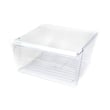
- On the inside wall near the crisper area (you may need to slide drawers out)
- Inside the freezer compartment on a side wall (less common)
- Behind the base grille or kick plate area (on some designs)
What the label looks like and what to record
The label typically includes both the model number and serial number. Recording both helps ensure you get the correct refrigerator parts and diagrams.
| Item on label | Why it matters |
|---|---|
| Model number | Matches parts to your exact Kenmore Elite configuration |
| Serial number | Helps identify production series and running changes |
| Purchase date (your record) | Useful for maintenance history and warranty paperwork |
Tips for finding it quickly
- Use a flashlight and look along the interior side walls at eye level and mid-shelf height.
- If you do not see it right away, remove the lower bins and crisper drawers to improve visibility.
- Wipe condensation or food residue off the wall; labels can blend into the liner.
Why it matters
Kenmore Elite side-by-side refrigerators can look similar across model families, but parts like an ice maker, water inlet valve, or door gasket must match the exact model number to fit and function correctly.
Last updated: February 2026
How many cubic feet is my Kenmore refrigerator by model number?
Your Kenmore Elite side-by-side refrigerator model 10650504991 has a specific cubic-foot capacity, but the most accurate way to confirm it is to look up the capacity in the specifications section of the owner's manual for your exact model (or on the model and serial number label location shown in the manual).
Fast ways to find the cubic-foot capacity
Use these options in order; they are the quickest and most reliable for model 10650504991:
- Check the specifications section in the owner's manual.
- Locate the model and serial number label inside the refrigerator compartment (the manual shows where this label is located).
- If you are measuring instead of looking it up, calculate interior volume (see below); this is useful after removing bins and shelves.
If you want to calculate capacity yourself (approximate)
This method gives an estimate, not the official rated capacity.
- Measure interior width, height, and depth (in inches) for the fresh food section and freezer section.
- Multiply each section:
W x H x Dto get cubic inches. - Add the two sections together.
- Convert to cubic feet by dividing by 1,728.
Quick conversion table
| What you have | Convert to | How |
|---|---|---|
| Cubic inches | Cubic feet | Divide by 1,728 |
| Cubic feet | Cubic inches | Multiply by 1,728 |
Why it matters
Cubic-foot capacity helps us match the right refrigerator parts and accessories (like an ice maker assembly, water filtration components, or storage bins) and set realistic expectations for storage space in a side-by-side layout.
Last updated: February 2026
What are the common problems with Kenmore Elite refrigerators?
Common problems on the Kenmore Elite 10650504991 side-by-side refrigerator include weak or warm cooling, ice maker not producing ice, water dispenser flow dropping, doors not sealing or closing smoothly, and louder-than-usual operating noises. Many of these issues trace back to dirty condenser coils, temperature settings, door gasket sealing, or water filtration and supply problems; see the owner's manual for model-specific troubleshooting steps.
Most common symptoms and what usually causes them
- Not cooling well or runs constantly: dirty condenser coils, doors not fully closed, blocked airflow vents
- Ice maker not making ice: freezer not cold enough, shut-off arm in OFF position, water shut-off valve closed
- Water dispenser flow is slow: clogged or incorrectly installed filter cartridge
- Doors hard to open or won’t close: dirty or sticky gaskets, refrigerator not level, door alignment issues
- Noises seem louder than normal: normal operating sounds, or the unit working harder due to dirty coils
Quick checks we recommend first (fast, no parts)
- Confirm doors close fully and seal all the way around.
- Clean the condenser coils (a top cause of poor cooling and long run times).
- Verify freezer temperature is cold enough; allow 24 hours after changes for temperatures and ice production to stabilize.
- If ice is not producing, make sure the ice maker shut-off arm is down (ON) and the household water valve is open.
- If water flow is weak, remove the filter cartridge and test dispenser flow; if flow improves, replace the filter.
When a part is commonly involved
If the basic checks do not fix the issue, these model-compatible parts are often involved in the most common complaints:
| Problem area | Commonly related part | What it affects |
|---|---|---|
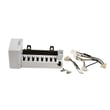
| Ice maker not producing | Ice maker assembly 4317943 | Ice harvest and fill cycles |
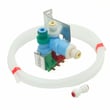
| No water to ice maker/dispenser | Refrigerator inlet valve W10408179 | Water supply into the refrigerator |
| Frost buildup, warm temps | Refrigerator defrost bi-metal WPW10225581 | Defrost temperature sensing |
| Frost buildup, poor airflow | Refrigerator heater WP2323198 | Melts frost off the evaporator |
Why it matters
Catching airflow, sealing, and water-supply problems early helps prevent food temperature swings, reduces compressor run time, and keeps ice and water dispensing consistent.
Last updated: February 2026
How to tell if a Kenmore refrigerator compressor is bad?
If your Kenmore Elite side-by-side refrigerator model 10650504991 is not cooling and you hear repeated clicking, constant running, or unusual high-pitched/pulsating compressor noise, the compressor or its start components may be failing. We confirm the cause by checking temperatures, airflow, and electrical readings; use the owner's manual to compare normal operating sounds.
Quick symptoms that point to a compressor problem
- Refrigerator and freezer both warm even though the unit runs
- Repeated clicking every few minutes (attempting to start, then stopping)
- Compressor is very hot to the touch after trying to run (use caution)
- Compressor is silent but fans and lights work
- Cooling is weak and the unit runs nearly all the time
Rule out common look-alikes first (important)
Many “bad compressor” complaints are actually airflow, defrost, or control issues.
- Listen for normal sounds: buzzing at ice maker fill, defrost timer clicks, gurgling refrigerant flow, evaporator fan noise, and condenser fan airflow can all be normal. The manual lists these typical sounds.
- Check airflow: make sure vents are not blocked by food packages.
- Check for frost buildup: heavy frost on the freezer back wall often points to a defrost problem (not the compressor). For this model, common defrost parts include the refrigerator defrost bi-metal WPW10225581 and refrigerator heater WP2323198.
- Check condenser cleanliness: dirty condenser coils can cause long run times and poor cooling.
What a technician tests (how we confirm)
| Test or observation | What it helps confirm |
|---|---|
| Compressor start attempt with clicking | Start device overload trip or locked compressor |
| Amp draw at startup and while running | Hard-start condition or internal mechanical failure |
| Continuity checks (windings) | Open or shorted compressor motor |
| Temperature split across evaporator | Whether the sealed system is moving heat |
Why it matters
A compressor is part of the sealed refrigeration system; misdiagnosing it can lead to replacing an expensive part when the real issue is a defrost failure, fan problem, or restricted airflow.
Last updated: February 2026