Installation guide
 Owner’s manual
 Error Codes




How do I reset my KitchenAid wall oven?
To reset your KitchenAid wall oven model KODE300ESS04, we recommend doing a full power reset: turn the oven off, shut off power at the breaker for about 1 minute, then restore power and set the clock. This clears many temporary control glitches.
Quick reset options (what to try first)
- Cancel the current cycle: press CANCEL (or Upper Cancel/Lower Cancel if shown) to stop cooking.
- Power reset: switch the oven circuit breaker OFF for about 60 seconds, then ON.
- Clear a locked keypad: press and hold START for about 3 seconds to toggle Control Lock.
- Wait for the cooling fan: after canceling, the cooling fan can keep running until the oven cools.
Step-by-step: breaker reset (recommended)
- Press CANCEL to stop any active bake, broil, or timed cooking.
- At your home electrical panel, turn the oven breaker OFF.
- Wait 1 minute.
- Turn the breaker ON.
- Set the time of day using the clock steps in the KODE300ESS04 owner’s manual.
If the display says “Control Locked”
Control Lock disables most keys to prevent unintended use. Only a few keys work while locked.
| What you see | What it means | What to do |
|---|---|---|
| “Control Locked” and a lock icon | Keypad is locked | Press and hold START for ~3 seconds |
| “Control Unlocked” | Keypad is active | Resume normal operation |
Why it matters
A reset restores normal operation after a power blip, a canceled timed cycle, or a control-panel hiccup. If the oven still will not respond after a reset, the issue is usually in the user interface, wiring, or the electronic control.
Parts that commonly relate to “won’t reset” or “dead display” symptoms
- Electronic control or power supply issues
- Loose or damaged wiring harness connections
- Overheat protection opening (thermal fuse)
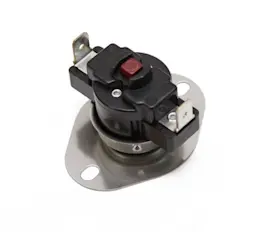
If you suspect an overheat shutdown, testing the wall oven thermal fuse W11610133 is a common next step.
Last updated: January 2026
What is the life expectancy of a KitchenAid wall oven?
A KitchenAid electric wall oven like model KODE300ESS04 typically lasts 10 to 15 years with normal household use. Keeping the oven clean, ensuring good airflow around the cabinet cutout, and addressing heating or control issues early helps you reach the full expected lifespan.
Typical lifespan and what affects it
Most built-in electric wall ovens fall into a 10 to 15 year life expectancy range. These factors have the biggest impact:
- Cooking frequency (daily use shortens lifespan)
- Self-clean cycle frequency (high heat stresses wiring and electronics)
- Power quality (surges can damage the control board)
- Venting and cooling airflow in the cabinet
- Prompt replacement of failing parts (elements, fuses, thermostats)
What the warranty tells you about long-term durability
For KODE300ESS04, the warranty structure highlights which components are designed for longer-term support:
| Coverage period | What’s covered (summary) | Why it matters |
|---|---|---|
| Year 1 | Parts and labor | Full coverage for early-life failures |
| Years 2 to 5 | Certain components parts only (no labor) | Key heating and touch-control components are supported longer |
For the exact warranty terms and maintenance guidance, use the KODE300ESS04 owner’s manual.
Signs your wall oven is nearing end of life
If you see these symptoms repeatedly, repairs can become more frequent:
- Oven takes much longer to preheat than it used to
- Uneven baking or temperature swings after calibration
- Display resets, beeps randomly, or loses settings
- Broil or bake heat is weak (element damage)
- Oven shuts off mid-cycle (overheat protection or fuse issues)
Common parts that restore performance
When heat or power problems show up, these model-compatible parts are often involved:
- Range bake element W11545804 (weak or no bake heat)
- Wall oven thermal fuse W11610133 (oven dead or intermittent power)
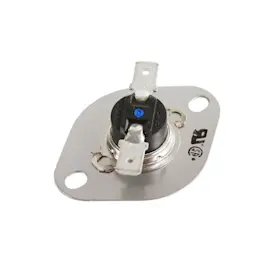
- Range high-limit thermostat WP4449751 (overheating or shutdown protection)
Why it matters
Knowing the expected lifespan helps you decide whether to repair or replace. If your KODE300ESS04 is under 10 years old, fixing a single failed element, fuse, or control-related issue is often the most cost-effective path.
Last updated: January 2026
How do I find the model number on my KODE300ESS04?
On the KitchenAid KODE300ESS04 built-in wall oven, the model number is printed on the model/serial label on the bottom edge of the control panel on the right-hand side. Use the steps below to locate it safely and read it clearly; see the KODE300ESS04 owner's manual for the label diagram.
Where to look on the oven
Check these common label locations for this model:
- Bottom edge of the control panel, right-hand side (primary location)
- Under the control panel area (also referenced in installation instructions)
- Model/serial/rating plate area used for electrical specs
Quick steps to find it
- Make sure the oven is cool and the door is closed.
- Stand in front of the oven and look along the bottom edge of the control panel.
- Focus on the right-hand side; find a label with Model and Serial.
- Write down the model number exactly as shown (letters and numbers).
- Use that exact model number when ordering parts like the control (with power supply) W11179310 or range bake element W11545804.
What the label typically includes
| Label item | What it’s used for |
|---|---|
| Model number | Matching the correct parts diagrams and replacement parts |
| Serial number | Identifying production details for service and documentation |
| Electrical rating | Confirming voltage, wattage, and circuit requirements |
Why it matters
KitchenAid wall ovens often have multiple versions that look similar. Using the exact model number from the label helps us match the correct control board, door glass, thermal fuse, and other parts for proper fit and safe operation.
Last updated: March 2026