Owner’s manual
 View engine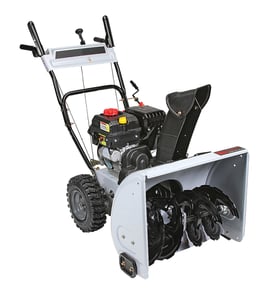



How to tell if a snowblower auger belt is bad?
On Craftsman snow thrower model 536886150, a bad auger belt shows up as poor snow discharge (auger/impeller slows or stops under load) and visible belt damage such as cracking, fraying, glazing, or missing chunks. If the belt is loose or damaged, replace it and then adjust the control cable.
Quick checks (safe and accurate)
Before inspecting anything, shut the engine off and let all moving parts stop; disconnect the spark plug wire to prevent accidental starting.
- Remove the belt cover and inspect the auger belt surface for cracks, frayed cords, glazing (shiny, slick look), or torn edges.
- Squeeze the auger clutch lever and watch for belt slip; slip often shows up as weak throwing distance.
- Smell for burnt rubber after use; that points to belt slip or a seized pulley/idler.
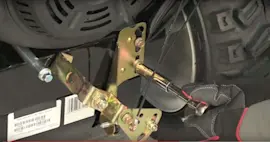
- Check the auger control cable for slack or droop at the “Z” fitting; incorrect cable adjustment can mimic a bad belt.
- If the machine vibrates abnormally, stop and inspect immediately; vibration is a warning sign of a mechanical problem that can damage belts.
What the manual says to check first
If your snow thrower will not discharge snow, we follow the same order the manufacturer recommends:
- Verify auger control cable adjustment.
- If the cable is correct, check the auger drive belt condition.
- If the belt is loose or damaged, replace it.
Use the 536886150 owner’s manual for the exact belt-cover removal steps, cable adjustment method, and belt guide settings.
Belt condition vs. symptoms
| What you see or feel | What it usually means | What to do |
|---|---|---|
| Cracks, fraying, missing chunks | Belt is worn out | Replace the belt |
| Shiny/glazed belt, burnt smell | Belt is slipping | Replace belt; check idler/pulleys and cable adjustment |
| Auger stops but engine runs | Belt loose/damaged or cable out of adjustment | Adjust cable; replace belt if worn |
| Repeated belt wear | Misadjusted belt guides or pulley issue | Set belt guides to spec; inspect pulleys/idler |
Parts that commonly solve the problem
For this model, the correct auger belt is the auger belt 37X120MA. After replacing or adjusting belts, the manual notes the control cables typically need adjustment as well.
Why it matters
A slipping auger belt reduces throwing performance and can overheat, glaze, and fail suddenly. Catching wear early helps protect the auger drive system and keeps the snowblower clearing consistently.
Last updated: February 2026
How many years should a snowblower last?
A gas snowblower like Craftsman model 536886150 typically lasts 15 to 20 years with normal residential use and consistent maintenance. Belts, shear pins, and other wear items are expected to be replaced over time; following the maintenance schedule in the 536886150 owner's manual helps you reach the full lifespan.
What affects snowblower lifespan most
- Maintenance frequency: oil changes, lubrication, and fastener checks
- Storage habits: dry storage, fuel treatment, rust prevention
- Snow conditions: heavy, wet snow and frequent ice ingestion increase wear
- Wear-item replacement: drive and auger belts, spark plug, skid shoes, shear pins
- Operator technique: avoiding impacts and clearing clogs safely
Typical lifespan by type (quick comparison)
| Snowblower type | Typical lifespan | Notes |
|---|---|---|
| Gas, 2-stage (like 536886150) | 15 to 20 years | Longest service life with routine tune-ups |
| Single-stage gas | 10 to 15 years | Lighter-duty drivetrain and auger system |
| Corded electric | 10 to 15 years | Motor can last; switches and cords are common wear points |
| Battery electric | 8 to 12 years | Tool life is solid; battery packs often need replacement first |
Maintenance habits that add years
We recommend these proven steps from the manual’s maintenance and storage guidance:
- Run the machine briefly after blowing snow to help prevent auger and impeller freeze-up.
- Treat or remove fuel for storage so gasoline does not form deposits in the carburetor.
- Inspect and tighten nuts, bolts, and screws; replace worn or damaged moving parts.
- Protect bare metal on the auger housing and impeller with a rust preventative spray.
- Plan a yearly tune-up to keep performance strong season to season.
Why it matters
A snowblower’s “life” is usually limited by neglected fuel, corrosion, and worn drive components, not the housing itself. Replacing common wear parts on schedule, such as the snowblower drive belt 1733324SM and auger belt 37X120MA, keeps the drivetrain working correctly and prevents bigger failures.
Last updated: February 2026
How to find Craftsman snowblower model number?
On a Craftsman snow thrower, the model number is printed on the product identification label. For your unit, the model is 536.886150 (often shown as 536886150 on parts sites). On most snowblowers, that label is typically on the rear of the frame between the wheels or on the side of the frame near the auger housing; confirm the exact label location in the 536886150 owner's manual.
Where to look on the snowblower
Check these common label locations first:
- Rear of the unit between the wheels (frame area)
- Side of the frame near the auger housing
- Near the handle support or control panel area
- On the engine shroud (sometimes shows engine model, not the snowblower model)
What number to use when ordering parts
Use the snowblower model number (not the engine model) when you search for parts diagrams and replacement parts.
| What you see on the label | What it means | Use it for |
|---|---|---|
| 536.886150 | Snowblower model number | Parts lookup, diagrams, manual |
| Engine model/type/code | Engine identification | Engine-specific parts only |
Tips to avoid mix-ups
- Write the model number exactly as shown on the label; include all digits.
- If the label is dirty or faded, wipe it clean and use a flashlight at an angle to read stamped or worn print.
- If you are comparing listings, treat 536.886150 and 536886150 as the same model format.
Why it matters
The model number ties your Craftsman snowblower to the correct parts list (belts, chute components, controls) and the correct adjustment and maintenance procedures. Using the engine number by mistake often leads to ordering the wrong parts.
Last updated: February 2026
Can you use 10W30 instead of 5W30 in a snowblower?
For the Craftsman snow thrower model 536886150, we use 5W-30 engine oil (20 oz capacity) for normal operation; using 10W-30 can make cold starting harder, especially at 20°F and below. For extreme cold (0°F and below), we use 0W-30 for easier starting (per the 536886150 owner's manual).
What the manual recommends (by temperature)
The oil choice matters most at startup because thicker oil flows slower in cold weather.
- 0°F and below: use 0W-30 (partial synthetic) for easier starting
- 20°F and below: 5W-30 helps starting
- Typical winter conditions: 5W-30 is the correct everyday choice for this model
| Outside temperature | Best choice for 536886150 | What to expect with 10W-30 |
|---|---|---|
| 0°F and below | 0W-30 | Hard starting, slow cranking |
| 1°F to 20°F | 5W-30 | May start sluggishly |
| Above 20°F | 5W-30 | Usually runs fine once warmed up |
If 10W-30 is already in the engine
We treat 10W-30 as a warm-weather substitute; if you need reliable winter starts, switch back to the recommended oil.
- Check the oil level on the dipstick; keep it between ADD and FULL
- Do not overfill; this engine takes 20 oz total
- If starting is difficult, drain and refill with 5W-30 (or 0W-30 for extreme cold)
- Change oil after the first 2 hours of operation, then on a regular schedule
Why it matters
Using the right viscosity helps the engine lubricate quickly during cold starts, reduces wear, and makes pull-starting or electric starting easier in freezing conditions.
Related maintenance that helps winter starting
- Use fresh, clean gasoline
- Check and replace the spark plug if needed (Champion RN4C or equivalent)
- Keep the machine clear of packed snow and ice after use
Last updated: February 2026
What kind of engine is on a Craftsman snowblower?
For Craftsman snowblowers, the engine brand can vary by model; for Craftsman model 536886150, the owner’s documentation identifies it as a 5.5 horsepower OHV gas engine with 120V electric start. Use the engine’s ID tag or stamping to match the correct tune-up and repair parts.
What we know for Craftsman 536886150
The 536886150 owner’s manual calls out these engine-related basics:
- 5.5 HP OHV (overhead valve) engine design
- Gas-powered snow thrower (dual stage)
- 120V electric start capability
- Also equipped with a recoil starter (pull start)
Quick reference
| Item | What to expect | Where to confirm |
|---|---|---|
| Engine type | 4-cycle OHV-style snowblower engine | Engine shroud or valve cover stamping |
| Starting system | 120V electric start plus recoil starter | Control panel and starter cord |
| Power rating | 5.5 horsepower | Model documentation |
How to identify the exact engine manufacturer and model
Craftsman snowblowers commonly use engines supplied by manufacturers such as Briggs & Stratton or Tecumseh (varies by production run). The fastest way to identify yours is to check the engine itself.
- Look for an engine model/type code label on the blower housing (shroud)
- Check near the valve cover or recoil starter area for stamped numbers
- Write down the full engine model and type numbers before ordering parts
- Match those numbers when shopping for carburetor, ignition, or gasket parts
Why it matters
Snowblower parts like spark plugs, carburetors, and ignition components are selected by the engine model, not just the Craftsman snowblower model number. Correct identification prevents wrong-part returns and helps restore easy starting and full power.
Last updated: February 2026
What are common Craftsman snowblower problems?
Common problems on the Craftsman 536886150 snow thrower include hard starting, rough running or stalling, loss of power, excessive vibration, the unit not driving itself, and the auger not throwing snow. These issues usually trace to fuel/spark maintenance, belt wear, cable adjustment, or a clogged chute.
Most common symptoms and what they usually mean
- Difficult starting: often a worn spark plug or contaminated fuel
- Engine runs erratically or stalls: fuel restriction, water or dirt in fuel, choke left on
- Loss of power: fuel delivery issue or carburetor needs adjustment
- Excessive vibration: loose hardware or damage in the impeller/auger area
- Unit fails to propel: drive belt loose/worn or friction drive wear
- Unit fails to discharge snow: chute clog, shear bolt issue, or foreign object in auger
Quick checks we recommend (in order)
- Safety first: disconnect the spark plug wire before inspecting belts, auger, or impeller.
- Fuel and choke: confirm fresh gasoline and move the choke to OFF after warm-up.
- Spark plug: check condition and gap (many small engines use a 0.030 inch gap); replace if fouled.
- Chute and auger: clear packed snow and remove any lodged debris (engine off).
- Belts and controls: inspect for glazing, cracking, looseness, and verify cable adjustments.
Parts that commonly wear on this model
| Problem area | Likely wear item | What you notice |
|---|---|---|
| Drive system | Snowblower drive belt 1733324SM | Won’t move, slips under load |
| Auger/impeller drive | Auger belt 37X120MA | Auger won’t engage or throws weakly |
| Chute rotation | Chute components | Chute binds, won’t hold position |
Why it matters
Catching belt wear, fuel contamination, and chute clogs early prevents bigger failures like damaged impeller components, broken shear hardware, and repeated no-start situations during heavy snow.
For model-specific adjustment points, lubrication locations, and the troubleshooting chart, use the 536886150 owner’s manual.
Last updated: February 2026
Is it worth fixing a snowblower?
Yes, it’s worth fixing a Craftsman snow thrower like model 536886150 when the repair is a normal wear item (belt, shear pin, tune-up) and the total cost stays well below the price of a comparable replacement. For major drivetrain or engine damage, replacement usually makes more sense.
Quick decision checklist
- If it starts reliably and just won’t drive or throw snow well, repair is usually smart.
- If the fix is a wear item (belts, spark plug, shear pins), repair is usually cost-effective.
- If the engine has low power, heavy smoke, or loud internal knocking, replacement is often the better value.
- If the auger or drive system needs only adjustment or a belt, repair is typically straightforward.
- If multiple big-ticket parts are needed at once (impeller, chute assembly, axle), compare total parts plus labor to a new unit.
Common “worth it” repairs on this model
These are typical fixes that restore performance without major teardown:
| Symptom | Likely fix | Example part for 536886150 |
|---|---|---|
| Wheels won’t move or slips in gear | Replace/adjust ground drive belt | Snowblower drive belt 1733324SM |
| Auger/impeller won’t spin or stops under load | Replace/adjust auger belt | Auger belt 37X120MA |
| Hard starting or rough running | Service spark plug, fuel, carburetor | Use the steps in the 536886150 owner’s manual |
When replacement is the smarter call
We recommend leaning toward replacement when:
- Repair cost is around half or more of a comparable new snowblower.
- The engine has internal damage (for example, a bent crankshaft from impact).
- The machine has multiple major failures at the same time (engine plus drive plus auger system).
Why it matters
Snowblowers often fail from normal wear items that are designed to be replaced. The manual for this Craftsman model also calls out items like spark plugs and drive belts as normal-wear components, and it emphasizes routine maintenance and seasonal storage steps that protect the engine and extend service life.
Last updated: February 2026
How to tell year of Craftsman snowblower by serial number?
For Craftsman snow thrower model 536886150, the fastest way to identify the build year is to use the unit ID tag serial number together with the engine date code. The engine date is the best time anchor; the snowblower is typically assembled the same year or shortly after. Use the 536886150 owner's manual to confirm you are reading the correct identification label.
What to record from the machine
Write these down exactly as shown on the unit tag and engine tag:
- Model number: 536886150
- Unit serial number (full string, including any letters)
- Engine model and engine code/date (often on the engine shroud)
- Any product/spec number listed near the model/serial
How to narrow down the year
Serial number formats vary by manufacturer, so we use a practical, repeatable method:
- Step 1: Confirm the correct tag (unit serial, not a cast-in part number).
- Step 2: Use the engine date code to establish the earliest possible build year.
- Step 3: Compare the unit serial format to common date-style patterns.
Common serial patterns (quick reference)
| Serial pattern | What it indicates | How to use it |
|---|---|---|
| 4 digits at the start | Often year and week | Read as YYWW or WWYY; verify against engine date |
| Letters early in the serial | Maker-specific coding | Use engine date to narrow the likely year range |
| No obvious date pattern | Internal sequence | Engine date becomes the primary year estimate |
Why it matters
The correct production year helps us match the right diagrams and wear parts, especially belts and drive components. For example, belt routing differences can affect fit when replacing the snowblower drive belt 1733324SM or the auger belt 37X120MA.
Last updated: February 2026