Owner’s manual
 Error Codes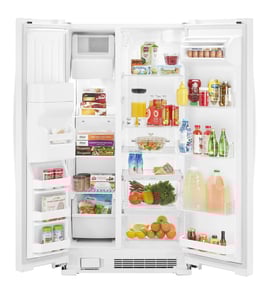




Where is the model number on a Kenmore side by side refrigerator?
On Kenmore side-by-side refrigerator model 10641122210, the model number is printed on the appliance identification label, typically inside the fresh food (refrigerator) compartment around the door opening. We use that model number to match the correct parts and diagrams for your exact unit.
Most common label locations to check
Look for a white or silver sticker with MODEL and SERIAL information in these spots:
- Inside the refrigerator section on the left or right wall near the front
- On the ceiling of the refrigerator compartment near the light housing
- Along the door jamb (the frame you see when the door is open)
- Inside the freezer section on a side wall near the front (less common)
- Behind the toe grille or lower kickplate area (occasionally)
What the label looks like and what to write down
The label usually includes both a model number and a serial number. For parts lookup, the model number matters most.
| Item on the label | What it’s used for | Example format |
|---|---|---|
| Model number | Identifies the exact design and parts list | 10641122210 |
| Serial number | Identifies production run and date info | Letters plus numbers |
Why it matters
Kenmore 106-series refrigerators can look similar across multiple model numbers, but parts like the electronic control, door bins, and light components can vary. Using the exact model number helps us avoid ordering the wrong replacement part.
Helpful next step
If you find the label but the print is hard to read, compare what you see to the model number format shown in the 10641122210 owner’s manual.
Last updated: February 2026
How wide is a Kenmore side by side refrigerator?
Most Kenmore side-by-side refrigerators are about 33 inches to 36 inches wide; the exact width depends on the specific model and whether it is standard-depth or counter-depth. For Kenmore 10641122210, we recommend confirming the cabinet width and door-clearance requirements in the 10641122210 owner's manual.
Typical widths you will see (and what changes them)
Side-by-side refrigerator width is usually driven by capacity, door style, and hinge clearance.
- Standard-depth models are commonly 35 1/2 in. to 36 in. wide
- Counter-depth models are commonly 32 3/4 in. to 34 in. wide
- Door handles can add noticeable overall width beyond the cabinet
- Hinges and door swing can require extra side clearance even if the cabinet fits
- Leveling and floor slope can affect how doors align and how much clearance you need
Measure it the right way
Use a tape measure and capture both the cabinet size and the “real-world” space needed.
| What to measure | Where to measure | Why it matters |
|---|---|---|
| Cabinet width | Across the main box (not handles) | Confirms the unit fits the opening |
| Overall width | Widest point (often handles) | Prevents trim and cabinet interference |
| Door swing clearance | Side clearance needed to open doors | Ensures drawers and bins can pull out |
| Depth clearance | Back wall to front obstruction | Avoids pinched water line and airflow issues |
Why it matters
A refrigerator that is even 1/2 inch too wide (or lacks door-swing clearance) can prevent proper installation, reduce airflow around the cabinet, and make shelves, door bins, or crispers harder to use.
Related help
If you are also planning to service the dispenser area while measuring, follow the steps in how to disassemble a Kenmore refrigerator dispenser to avoid cracking trim pieces.
Last updated: February 2026
What are the most common problems with Kenmore refrigerators?
The most common problems we see on Kenmore refrigerators like model 10641122210 are cooling issues, water leaks, ice maker and dispenser failures, and unusual noises. These usually trace back to airflow restrictions (dirty coils or a failed fan), defrost system trouble, or worn door seals; the 10641122210 owner's manual helps confirm the correct checks for your exact configuration.
Most common symptoms and what they usually mean
- Not cooling or warm temperatures: dirty condenser coil, evaporator fan problem, defrost ice buildup, or a control issue
- Water under the refrigerator: clogged defrost drain, cracked drain pan, or a door not sealing
- Ice maker not making ice: water supply issue, frozen fill tube, failed ice maker, or inlet valve problem
- Noisy operation: fan blade rubbing ice, worn fan motor, or compressor start components
- Frost buildup in freezer: door left ajar, bad gasket, or defrost system fault
Quick checks we recommend first (fast, no parts guessing)
- Set temperatures to typical targets: 0°F freezer, 37°F fresh food.
- Clean the condenser area and confirm strong airflow at the grille.
- Listen for the evaporator fan; if it is loud or intermittent, inspect the blade area.
- Check door closing and gasket contact all the way around.
- Look for ice buildup on the freezer back panel (common sign of a defrost issue).
Parts that commonly relate to these problems (for this model)
| Symptom | Common suspect | Example part for 10641122210 |
|---|---|---|
| Frost buildup, warm fridge | Defrost thermostat | Refrigerator defrost bi-metal thermostat WPW10225581 |
| Loud scraping or poor airflow | Fan blade hitting ice | Refrigerator evaporator fan blade WP2169142 |
| Lights not working when door opens | Door switch | Refrigerator light switch W11384469 |
| Random temps or odd behavior | Control board | Refrigerator electronic control WPW10366605 |
| No ice production | Ice maker assembly | Ice maker W11700559 |
Why it matters
Most “big” refrigerator failures start as small airflow, defrost, or sealing problems. Catching them early helps prevent food spoilage, ice buildup, and extra strain on the compressor.
Last updated: February 2026
What does er if mean on kenmore elite refrigerator?
On Kenmore model 10641122210, the ER IF code points to a problem with the ice maker fan (ice room fan) airflow or feedback, so the ice compartment is not cooling correctly. If it keeps running this way, it can lead to warm ice, no ice production, and extra strain on the cooling system; check the steps in the 10641122210 owner's manual.
What you’ll notice with ER IF
- Ice maker stops making ice or makes hollow/small cubes
- Ice bin clumps or melts together
- Freezer temperature seems OK but the ice area is warm
- You hear a fan noise change (rattling, buzzing, or no fan sound)
- Frost buildup near the ice room vents or fan cover
Quick checks we recommend (in order)
- Power reset: Unplug the refrigerator (or turn off the breaker) for 2 minutes, then restore power.
- Check for ice blockage: Look for frost or ice around the ice room air vents and fan cover; clear visible ice carefully.
- Confirm the door seals: A leaking door gasket can cause frost that interferes with airflow.
- Listen for the fan: When the freezer door switch is held closed, you should typically hear airflow from the ice room area.
- Inspect the fan blade: If the blade is cracked, rubbing, or packed with ice, it can trigger the code.
If you find a damaged blade, replacing the refrigerator evaporator fan blade WP2169142 is a common fix when the fan motor itself is still good.
Common causes and what usually fixes them
| Likely cause | What it means | Typical fix |
|---|---|---|
| Ice buildup blocking the fan | Fan cannot move air | Defrost/clear ice, correct door sealing issues |
| Fan blade rubbing or broken | Fan spins poorly or not at all | Replace fan blade |
| Wiring/connection issue | Fan signal not reaching control | Reseat connectors, repair harness |
| Control problem | Fan not being powered/monitored correctly | Diagnose and replace control if needed |
Why it matters
The ice room depends on steady airflow to stay cold. When airflow drops, the refrigerator can run longer, temperatures can drift, and ice production becomes unreliable.
For model-specific access points, diagnostics, and any test mode steps, follow the 10641122210 owner's manual.
Last updated: February 2026
Where is the control panel on my Kenmore Elite refrigerator?
On Kenmore model 10641122210 (side-by-side), the control panel is typically located at the top front inside the fresh food (refrigerator) compartment or on the dispenser area on the freezer door, depending on the exact configuration. We use the panel location shown for your model in the 10641122210 owner's manual to confirm which style you have.
Common control panel locations on this Kenmore side-by-side
- Inside the refrigerator section: along the top “ceiling” area, above the shelves
- On the freezer door dispenser: behind the display and button pad
- Behind a trim cover: a snap-on bezel or light/control housing that hides mounting screws
- Near the temperature controls: often grouped with the thermostat or electronic display
How to access it safely (basic steps)
- Unplug the refrigerator or switch off the breaker.
- If the panel is inside the refrigerator, remove items from the top shelf for clearance.
- Look for visible screws (often Phillips) or locking tabs along the panel edge.
- Carefully release the cover; support it so wiring is not strained.
- If you’re inspecting wiring or a board, take a photo before disconnecting any plugs.
What you’ll usually need
| Task | Typical tool | Notes |
|---|---|---|
| Remove panel screws | Phillips screwdriver | Use the correct size to avoid stripping |
| Release trim tabs | Small flat screwdriver | Pry gently to avoid cracking plastic |
| Verify power is off | Non-contact voltage tester | Helpful before touching connectors |
If you’re looking for the “main control board” instead
Many Kenmore 106-series refrigerators have the main electronic control mounted on the back of the cabinet (often upper area) behind a small cover, while the user interface is at the front. If you suspect a control issue, checking the model’s diagnostics and symptoms first helps narrow it down.
- For display or button issues at the door, start with dispenser access steps in how to disassemble a Kenmore refrigerator dispenser.
- For error code guidance commonly used on Kenmore 106 models, use Kenmore 106 model refrigerator error codes.
Why it matters
Finding the correct control panel location helps you avoid removing the wrong trim pieces, prevents broken tabs and wiring damage, and speeds up troubleshooting for temperature control, dispenser, and display problems.
Last updated: February 2026
What causes a side-by-side refrigerator to stop cooling?
A Kenmore side-by-side refrigerator like model 10641122210 usually stops cooling because airflow or heat removal is blocked (dirty condenser coils, iced-up evaporator), a fan is not running, or the defrost system or compressor start components fail. Start with the quick checks in the 10641122210 owner's manual.
Quick checks we recommend first (no tools)
- Confirm the refrigerator has power and the interior lights come on.
- Make sure temperature controls were not accidentally set too warm.
- Check that air vents inside both compartments are not blocked by food packages.
- Verify both doors close fully and the gasket seals all the way around.
- Listen for the evaporator fan in the freezer; it should run when the compressor is running.
- Look for heavy frost on the freezer back wall (a strong sign of a defrost problem).
Most common causes and what you will notice
| What is failing | Typical symptom | What to check next |
|---|---|---|
| Dirty condenser coil | Gradual warming, long run times | Clean coil and ensure good airflow at the grille/back |
| Evaporator fan issue | Freezer cold spots, fridge warm | Inspect fan blade and fan operation; see evaporator fan blade WP2169142 |
| Defrost system problem | Freezer frosts over, airflow drops | Check for frost blanket; defrost thermostat is a common suspect; see defrost bi-metal thermostat WPW10225581 |
| Control or start components | No cooling, clicking, intermittent running | Check for compressor trying to start; run capacitor can be involved; see run capacitor WPW10662129 |
Safe troubleshooting steps (before replacing parts)
- Unplug the refrigerator for 5 minutes, then plug it back in to reset the control.
- Clean the condenser coil and confirm the condenser fan (if equipped) runs.
- If the freezer back wall is packed with frost, do a full manual defrost (unplug and leave doors open) and restore airflow; then focus on the defrost circuit.
- If the unit is silent and warm, verify the outlet and cord, then check for a failed control or compressor start issue.
Why it matters
Cooling depends on two things: moving cold air through the compartments and dumping heat at the condenser. When either airflow or heat rejection is restricted, temperatures rise quickly and food safety becomes a concern.
Last updated: February 2026
How to tell if a Kenmore refrigerator compressor is bad?
On Kenmore refrigerator model 10641122210, a bad compressor typically shows up as poor or no cooling even though the unit has power, along with repeated clicking (start attempts) or a compressor that runs but never brings temperatures down. Use the 10641122210 owner's manual to confirm normal operating sounds and basic checks.
Quick symptoms checklist
- Fresh food and freezer both warm (not just one section)
- Compressor area is very hot to the touch after running (normal is warm, not scorching)
- Repeated clicking every few minutes (often the start device trying to start the compressor)
- Fridge runs constantly with little or no temperature improvement
- You hear the condenser fan, but cooling performance stays poor
- Breaker trips or the unit shuts off shortly after trying to start
Rule out common look-alikes first
Many “bad compressor” complaints are caused by airflow, defrost, or control issues. Before condemning the compressor, we check these basics:
| What you observe | More likely cause | What to check next |
|---|---|---|
| Freezer cold, fridge warm | Airflow/evaporator issue | Frost buildup, vents blocked, evaporator fan operation |
| Heavy frost on freezer back wall | Defrost system problem | Defrost heater/thermostat, door left ajar |
| Clicking + no steady compressor run | Start device/capacitor issue | Start components, wiring, compressor terminals |
| Runs nonstop, weak cooling | Sealed system or compressor inefficiency | Condenser cleanliness, airflow, professional sealed-system diagnosis |
If you suspect a start/capacitor problem, a common related part is the refrigerator run capacitor WPW10662129.
Safe checks we recommend (no special tools)
- Verify the condenser fan is running when the compressor is running.
- Clean dust from the condenser area to restore heat transfer.
- Confirm doors seal and close fully; warm air leaks can mimic compressor failure.
- Listen for a pattern: steady hum (running) vs. click-hum-click (failed start).
Why it matters
The compressor is the heart of the sealed cooling system. Misdiagnosing it can lead to unnecessary high-cost repairs; checking fans, frost patterns, and start components first helps pinpoint the real failure faster.
Last updated: February 2026
How to read a Kenmore model number?
Kenmore model numbers are read left to right: the first 3 digits identify the manufacturer, and the remaining digits identify the product series and specific configuration. For your Kenmore side-by-side refrigerator, the model number 10641122210 indicates it is a Kenmore-built-on-Whirlpool platform (prefix 106); use the full number when ordering parts or checking specs in the 10641122210 owner's manual.
Where to find the model number on a refrigerator
We typically see the model and serial tag in one of these spots:
- Inside the fresh food compartment on a side wall
- On the ceiling of the refrigerator compartment near the light
- On the door frame (hinge side) when the door is open
- Behind the toe grille (lower front) on some designs
- On the back exterior panel (less common for daily access)
How to interpret the digits (what they usually mean)
Kenmore numbers are most useful in two ways: identifying the manufacturer and matching the exact configuration.
| Section of model number | Example from 10641122210 | What it tells you |
|---|---|---|
| Manufacturer prefix | 106 | Who built it for Kenmore (used for parts lookup) |
| Base model / platform | 4112 | Product family and core design |
| Version / variation | 2210 | Feature and production variation (color, dispenser, revisions) |
Why the full model number matters for parts
Even small digit changes can mean different shelves, controls, or door hardware. When you are troubleshooting or ordering, we recommend using the complete model number so you get the correct match for items like:
- Electronic controls (example: refrigerator electronic control WPW10366605)
- Door bins and rails (example: refrigerator door bin WPW10710203)
- Lighting components (example: refrigerator light switch W11384469)
- Ice maker assemblies (example: ice maker W11700559)
Helpful next step for Kenmore 106 refrigerators
If you are seeing a display code or performance issue, use the model-family troubleshooting info in Kenmore 106 model refrigerator error codes to narrow down the likely system (cooling, defrost, or dispenser).
Why it matters
Reading the model number correctly prevents wrong-part returns and speeds up diagnosis because Kenmore uses multiple manufacturers and many similar-looking refrigerator platforms.
Last updated: February 2026
What's the average lifespan of a Kenmore refrigerator?
Most Kenmore refrigerators average 10 to 15 years of service life; with consistent maintenance, many units reach the upper end of that range (and some run longer). For your Kenmore 10641122210 side-by-side refrigerator, routine care and quick fixes have the biggest impact on longevity; see the 10641122210 owner's manual for model-specific care guidance.
Typical lifespan and what changes it
A refrigerator’s lifespan is driven by heat management, door sealing, and how hard the sealed system has to work.
- 10 to 15 years is the typical range for full-size refrigerators
- Heavy use (frequent door openings, warm garage installs) shortens life
- Poor airflow around the cabinet and dirty coils raise compressor run time
- Worn door gaskets cause temperature swings and moisture issues
- Delayed repairs (fans, defrost parts, controls) often lead to bigger failures
Maintenance that adds years (high impact)
We recommend these habits for Kenmore side-by-side models like 10641122210:
- Clean condenser coils and the area around the condenser fan regularly
- Keep door gaskets clean; confirm the doors close and seal evenly
- Set stable temps (commonly 0°F freezer, 37°F fresh food)
- Don’t block interior air vents with food packages
- Replace failed lights and switches promptly to prevent heat buildup in compartments
Quick “what to check” table
| What you notice | Most common cause | What to do first |
|---|---|---|
| Warm fridge, freezer OK | Airflow/evaporator fan issue | Check vents; listen for fan; use how to fix your evaporator cooling fan |
| Frost buildup, warming | Defrost system problem | Inspect defrost pattern; consider refrigerator defrost bi-metal thermostat WPW10225581 |
| Door won’t close smoothly | Hinge/cam wear | Inspect bottom hinge area; consider refrigerator door cam (black) WP2182179 |
Why it matters
A refrigerator that runs hotter or longer than designed wears out the compressor, fans, and electronic control faster. Simple airflow and sealing maintenance reduces run time, stabilizes temperatures, and protects expensive components.
Last updated: February 2026
How many cubic feet is the Kenmore refrigerator model 10641122210?
The Kenmore side-by-side refrigerator model 10641122210 is typically in the 21 to 22 cu. ft. total-capacity class (refrigerator plus freezer). For the exact published cubic-foot rating for your unit, confirm the specification listing in the 10641122210 owner's manual.
How to find the exact capacity for model 10641122210
Use the manual and the model/serial tag to match the correct spec line.
- Open the 10641122210 owner's manual and look for Specifications, Product data, or Capacity
- Verify it lists total capacity (not just refrigerator or freezer)
- Check whether your unit has an in-door ice system or ice maker option; it changes usable space
- Compare your interior layout (shelves, bins, drawers) to the manual diagrams
- If the manual lists multiple variants, match the one that aligns with your features
Typical capacity range (what to expect)
This helps when you are shopping or planning, even before you locate the exact spec.
| Refrigerator type | Typical total capacity |
|---|---|
| Side-by-side (standard width) | 20 to 23 cu. ft. |
| Side-by-side (larger) | 23 to 26 cu. ft. |
Why “usable space” can feel different than cubic feet
Total cubic feet is a standardized measurement; day-to-day storage depends on configuration and airflow.
- Ice maker and ice bin reduce freezer room for bulky items
- Shelf and door-bin positions affect tall-item clearance
- Overpacking blocks vents and creates warm spots
- Frost buildup reduces effective space and cooling performance
Parts that help restore storage and organization
If storage feels tight because bins or shelves are broken, replacing them restores the original layout.
- Refrigerator door bin WPW10710203
- Refrigerator spill-safe shelf WPW10276348
- Refrigerator crisper drawer WPW10178772
Last updated: February 2026