Owner’s manual
 Error Codes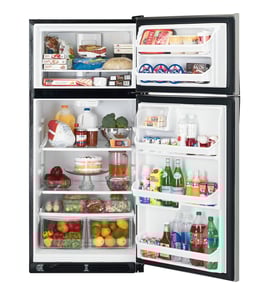


What are the disadvantages of a top mount fridge?
A top-mount refrigerator like Kenmore model 25369832990 typically makes fresh-food access less convenient because the refrigerator section sits lower, and it usually offers fewer premium organization and dispenser features than many bottom-freezer designs.
Common drawbacks you may notice
- More bending for daily use: fresh foods are below waist height, so you crouch more often.
- Less “grab-and-go” freezer access: the freezer is convenient, but the items you use most (produce, drinks, leftovers) are lower.
- Fewer built-in features on many models: external water and ice dispensers are less common on top-mount units.
- Organization can feel tighter: shelves and bins are often simpler than higher-end layouts.
- Door swing and placement matter: you need enough clearance so doors open fully without forcing you to walk around them.
Setup details that reduce the downsides
Good placement and leveling help doors seal and make access easier.
- Leave about 1/2 inch (10 to 15 mm) clearance on each side for easier installation and airflow.
- Elevate the refrigerator about 1 inch (25 mm) off carpeted floors for better circulation.
- Level the cabinet so doors close freely when opened halfway.
- If your kitchen layout is awkward, consider reversing the doors (instructions are in the manual).
For model-specific placement and door reversal steps, use the 25369832990 owner's manual.
Quick comparison: top-mount vs bottom-freezer
| Feature | Top-mount refrigerator | Bottom-freezer refrigerator |
|---|---|---|
| Fresh-food access | Lower, more bending | Higher, easier access |
| Freezer access | Eye-level, convenient | Lower drawer, more bending |
| Typical features | Simpler, fewer dispensers | Often more feature-rich |
| Cost and complexity | Often lower, simpler | Often higher, more complex |
Why it matters
Most day-to-day refrigerator use is in the fresh-food section. If you cook often or have back or knee discomfort, the lower refrigerator compartment on a top-mount design can be the biggest practical drawback.
Last updated: January 2026
What is the average lifespan of a Kenmore refrigerator?
Most Kenmore refrigerators last 12 to 15 years. With steady upkeep (clean airflow paths, good door sealing, correct temperature settings), many units run longer; the Kenmore 25369832990 top-mount refrigerator is built for years of dependable household food storage when operated and maintained as described in the 25369832990 owner's manual.
Typical lifespan and what affects it
A refrigerator’s service life is mostly driven by heat management, door sealing, and how hard the sealed system has to work.
- Keep condenser and ventilation areas clear so the compressor runs cooler
- Make sure doors close fully and gaskets seal all the way around
- Avoid overpacking so air can circulate in both compartments
- Set stable temperatures and avoid frequent large adjustments
- Address unusual noises, warm temps, or heavy frost early
What “sealed system” coverage tells you
Your Kenmore documentation describes multi-year coverage on the sealed refrigeration system (refrigerant, tubing, compressor motor) when the refrigerator is operated and maintained per the owner’s instructions. That aligns with the expectation that the core cooling system is designed for long-term operation.
| Component area | What it includes | Why it matters for lifespan |
|---|---|---|
| Sealed refrigeration system | Compressor, refrigerant, connecting tubing | The heart of cooling; failures are typically the most expensive |
| Airflow and controls | Fans, thermostats, control board | Poor airflow or control issues can mimic cooling failure |
| Doors and sealing | Gaskets, hinges, handles | Warm air leaks increase run time and wear |
Quick “extend the life” checklist for model 25369832990
- Verify the door seal is clean and making full contact; replace if torn or warped
- Keep interior vents unblocked to prevent warm spots and icing
- If you see heavy frost or warming, inspect defrost-related parts and airflow
- Replace failed interior lighting promptly to avoid switch and wiring issues
Why it matters
A refrigerator that runs warmer than normal or runs constantly uses more energy and puts extra strain on the compressor and fans. Simple maintenance steps help your Kenmore 25369832990 cool evenly, reduce wear, and reach the typical 12 to 15 year lifespan.
Last updated: January 2026
What are the dimensions of a Kenmore refrigerator model 25369832990?
The exact exterior dimensions (height, width, depth) for Kenmore model 25369832990 should be taken from the product specifications section of the 25369832990 owner's manual. The manual also gives the clearance spacing you need around the cabinet for proper airflow and door opening.
What you can confirm from the manual right now
The manual for model 25369832990 specifies installation clearances (space around the refrigerator) that you should include when planning a cabinet opening:
- Leave 1 inch behind the refrigerator for air circulation
- Leave 3 inches above the refrigerator
- In a recessed installation, allow an extra 1/2 inch on each side for easier installation
- Install on a level, solid floor that supports a fully loaded refrigerator
- Avoid locations below 60°F or above 110°F for proper cooling performance
How to measure your refrigerator (so your numbers match real-world fit)
Measure the cabinet and then measure again including anything that sticks out.
- Width: widest point of the cabinet (measure doors separately if they extend past the cabinet)
- Height: floor to top of cabinet; measure a second time to the top hinge cover if present
- Depth: back of cabinet to the front; measure with handles and without handles
- Door swing: confirm you have room for doors to open fully without hitting walls or counters
Quick planning table
| Measurement you need | Measure from | Also account for |
|---|---|---|
| Width | cabinet side to side | door bulge, 1/2 inch per side in a recess |
| Height | floor to cabinet top | 3 inches above for airflow |
| Depth | back to front | handles, door swing, 1 inch behind |
Why it matters
Using the manual dimensions and the required clearances prevents restricted airflow (warm temperatures, longer run times) and avoids installation problems like doors rubbing, bins hitting walls, or the cabinet not sliding into place.
Last updated: January 2026