Installation guide
 Owner’s manual
 Error Codes



Is a top mount freezer better than a bottom mount freezer?
A top-mount freezer is “better” if you want the freezer at eye level and a typically simpler layout; a bottom-mount (like the Electrolux EI23BC30KW1) is “better” if you want fresh foods at eye level and use the refrigerator section most often. Both can cool equally well when installed and leveled correctly per the installation guide.
Quick comparison
| Feature | Top-mount freezer | Bottom-mount freezer (EI23BC30KW1 style) |
|---|---|---|
| Most-used items at eye level | Freezer | Fresh food compartment |
| Ergonomics for daily fridge use | More bending for produce/dairy | Less bending for produce/dairy |
| Freezer access | Easier for frequent freezer use | Often a pull-out drawer; can require more bending |
| Typical cost and complexity | Often lower, fewer features | Often higher, more features |
When a top-mount freezer is the better choice
- You use frozen foods more than fresh foods.
- You want a straightforward design with fewer door seals and moving drawer parts.
- You prefer lighter freezer access (no heavy drawer to pull out).
- You want a layout that is often easier to fit into tighter kitchens.
When a bottom-mount freezer is the better choice
- You use the refrigerator section most and want shelves and crisper drawers at a comfortable height.
- You like wide refrigerator storage (common on French door designs).
- You want a freezer drawer that can hold bulky items (pizza boxes, bags of frozen food) in baskets.
Why it matters (performance and efficiency)
The “better” choice usually comes down to how you load and access food every day. Regardless of freezer location, installation details affect real-world performance: leveling, door alignment, and good gasket sealing help prevent warm air leaks, frost, and temperature swings. For EI23BC30KW1, follow the leveling and final-check steps in the installation guide to keep doors sealing properly.
Related maintenance tip for either style
Odors can make any refrigerator feel like it is not working well. If smells are a concern, using an air filter and replacing it on schedule helps; EI23BC30KW1 uses the refrigerator door air filter EAFCBF.
Last updated: February 2026
What are the most common issues with EI23BC30KW1?
The most common issues we see with the Electrolux EI23BC30KW1 bottom-mount refrigerator involve cooling performance, water dispensing or ice maker water supply, door sealing and alignment, and frost buildup from defrost or airflow problems. Many of these symptoms trace back to a few serviceable parts and basic checks in the owner's manual.
Common symptoms and what they usually point to
- Warm refrigerator or freezer: restricted airflow, evaporator fan issue, dirty condenser area, or a temperature sensing problem.
- No water at dispenser or no ice: water supply shutoff, clogged filter path, or a failing inlet valve.
- Leaking or puddles: drain tube restriction, door not sealing, or water line connection seepage.
- Frost buildup or noisy fan: defrost system problem or ice contacting the fan blade.
- Doors not closing or moisture on gaskets: gasket not sealing, hinge alignment, or cabinet not level.
Parts that commonly solve these problems (when symptoms match)
If your symptoms line up, these model-compatible parts are frequent fixes:
| Symptom | Common part to check | Example part on this model page |
|---|---|---|
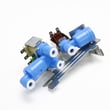
| No water to dispenser/ice maker | Water inlet valve | Refrigerator water inlet valve assembly 242252702 |
| Odors inside fresh food section | Air filter | Refrigerator door air filter EAFCBF |
| Frost buildup, poor cooling | Defrost heater | Refrigerator defrost heater 5303918410 |
| Warm temps, fan noise | Fan blade or sensor | Refrigerator evaporator fan blade 5308000010, refrigerator temperature sensor 240597220 |
| Moisture, warm spots near doors | Door gasket | Refrigerator door gasket 5304537408 |
Quick checks we recommend before replacing parts
- Confirm temperature settings; typical targets are 37°F fresh food and 0°F freezer.
- Make sure vents inside the refrigerator are not blocked by food containers.
- Verify doors close squarely; level the cabinet so doors self-close.
- Inspect gaskets for gaps, tears, or hardened sections; clean and reseat.
- If water is slow, confirm the household shutoff valve is fully open and purge air from the dispenser.
Why it matters
On the EI23BC30KW1, small issues like a weak door seal or restricted airflow can quickly cause temperature swings, excess frost, and higher run time. Catching the symptom early helps protect food and prevents secondary problems like fan noise and ice buildup.
Last updated: March 2026
What is the average lifespan of EI23BC30KW1?
The average lifespan of the Electrolux EI23BC30KW1 bottom-mount refrigerator is 13 years with normal household use and routine maintenance (cleaning coils, keeping door seals tight, and replacing filters on schedule). Good airflow and correct temperatures help it reach that full service life.
Typical lifespan and what affects it
Most bottom-mount refrigerators last longest when the sealed system stays healthy and the unit can shed heat efficiently.
- Condenser cleanliness: dust buildup makes the compressor run hotter and longer
- Door seal condition: air leaks cause longer run times and frost issues
- Fan performance: weak airflow leads to warm spots and temperature swings
- Water system upkeep: clogged filters and low water flow strain the dispenser and ice maker
- Room conditions: high ambient heat and tight clearances shorten life
Maintenance checklist (best ROI)
Use these habits to keep EI23BC30KW1 running efficiently:
- Set fresh food to about 37°F and freezer to about 0°F
- Vacuum and brush the condenser area every 6 to 12 months
- Keep vents inside the refrigerator and freezer unblocked
- Replace the air filter when odors linger; use the refrigerator door air filter EAFCBF
- Inspect and clean the door gasket sealing surfaces; replace if torn or warped (example: refrigerator door gasket 5304537408)
Quick guide: symptoms that suggest wear vs. a simple fix
| What you notice | Common cause | What to check first |
|---|---|---|
| Fridge warm, freezer OK | Airflow issue in fresh food section | Vents blocked, evaporator fan noise, frost buildup |
| Frost or moisture around doors | Door not sealing | Gasket condition, door alignment |
| No ice or weak water flow | Water supply or valve issue | Filter, line kinks, inlet valve |
| Loud humming or overheating | Dirty condenser area or fan issue | Clean coils, check condenser fan |
Why it matters
A refrigerator near end-of-life often shows up as higher energy use, inconsistent temperatures, and more frequent icing or water issues. Staying ahead of airflow, seals, and filters helps protect the compressor and cooling system.
For model-specific operating and care details, follow the maintenance schedule in the EI23BC30KW1 owner’s manual.
Last updated: March 2026