Owner’s manual
 View engine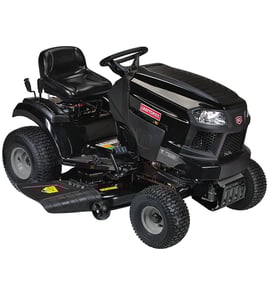

Where can I find my Craftsman model number?
On a Craftsman front-engine lawn tractor like model 247203722, the model number is typically printed on a product identification label located under the seat or on the frame near the seat area. We use that exact model number to match the correct diagrams, parts, and manuals.
Where to look on model 247203722
Check these common label locations first:
- Under the seat (lift the seat pan and look for a sticker or metal tag)
- On the frame rail near the seat or rear fender area
- Near the engine compartment opening (on the frame, not on the engine)
- Under the hood on the tractor body (if your unit has a hood)
- Near the footrest area on the frame
For pictures and model-specific references, use the 247203722 manual.
What to write down (so parts match correctly)
We recommend recording the full identification details from the label:
- Model number (example: 247203722)
- Serial number
- Any additional product number or manufacturing code shown
Quick ID checklist
| Item on label | Why it matters for parts | Example format |
|---|---|---|
| Model number | Identifies the correct tractor family | 247203722 |
| Serial number | Helps confirm production run variations | Letters and numbers |
| Product code (if listed) | Can narrow down compatible assemblies | Varies |
Why it matters
Craftsman tractors can look similar across multiple model series, but parts like a wire harness, transaxle, or steering shaft can vary by model. Using the exact model number helps us avoid mismatches and returns.
Last updated: January 2026
What kind of engine does a Craftsman riding lawn mower have?
For the Craftsman front-engine lawn tractor model 247203722, the exact engine make, model, and horsepower cannot be confirmed from the model-specific information we have here. The most reliable way to identify it is to match the engine ID numbers on the engine itself with the specifications in the 247203722 owner’s manual.
How to identify the engine on model 247203722
Look for the engine identification label and record the numbers exactly as shown:
- Engine model / type / code (common on Briggs & Stratton engines)
- Spec number (often needed to get the correct tune-up parts)
- Serial number
- Displacement (cc) and horsepower rating (if listed)
- Emissions family label (sometimes on the valve cover or blower housing)
Typical label locations on front-engine lawn tractors:
- Top of the engine shroud (blower housing)
- Valve cover area
- Near the starter motor
- On the engine block, above the oil drain
What “kind of engine” usually means (and what varies)
Even within the Craftsman 247203722 model family, engine details can vary by production run and supplier. Here are the most common engine attributes customers are asking about:
| Engine detail | What it tells you | Why you need it |
|---|---|---|
| Make (Briggs & Stratton, Kohler, etc.) | Who built the engine | Helps narrow parts and service info |
| Model/type/code or spec | Exact engine configuration | Required for correct filters, plugs, carb parts |
| Single-cylinder vs V-twin | Power delivery and maintenance | Impacts tune-up parts and troubleshooting |
Why it matters
We use the engine ID (not just the tractor model number) to ensure you get the right maintenance and repair parts, especially for items like the air filter, spark plug, fuel filter, and carburetor components.
Related parts you may replace during engine service
These are tractor-level parts commonly serviced alongside engine work:
- Fuel system components (inspect for leaks and cracked lines)
- Steering and drive components (check for wear while the hood is open)
- Decals and safety labels (replace if unreadable)
- Fuel tank condition and cap seal
If you are dealing with fuel odor, leaks, or contamination, the lawn tractor fuel tank 651P08849 is one compatible replacement part for this model.
Last updated: January 2026
How much does it cost to replace a riding mower engine?
For a Craftsman riding mower like model 247203722, a full engine replacement is typically a high-cost repair because the engine itself is the biggest expense and labor can be significant. In most cases, plan on $800 to $2,500+ total (engine plus labor), depending on engine type, availability, and whether related parts are replaced at the same time.
What drives the total cost
Engine replacement pricing varies a lot by mower configuration and what else is worn out. Use the 247203722 owner's manual to confirm your mower’s engine family, controls, and service notes before pricing parts or labor.
Common cost drivers include:
- Engine type and horsepower (single-cylinder vs V-twin)
- Crankshaft specs (diameter/length, keyed vs tapped) and PTO setup
- Wiring and charging system compatibility (stator/regulator connections)
- Fuel system condition (tank, lines, filter, carburetor)
- Labor time (shop rates and how seized/corroded fasteners are)
Typical price ranges (parts and labor)
These ranges are practical planning numbers for most front-engine lawn tractors.
| Scenario | What you’re paying for | Typical total |
|---|---|---|
| Repair instead of replace | Carburetor, ignition, starter, tune-up parts | $150 to $700 |
| Used engine swap | Used engine plus install | $500 to $1,500 |
| New replacement engine | New engine plus install | $800 to $2,500+ |
When replacement makes sense (and when it doesn’t)
We usually recommend replacing the engine when the block is damaged, compression is low, or there is severe internal wear. If the mower otherwise needs major drivetrain work, it can be smarter to repair smaller issues first.
Check these before committing:
- Compression and oil consumption
- Excessive smoke or knocking
- Charging output and wiring condition
- Hydrostatic drive performance (if equipped)
- Deck and spindle condition
Related parts you may end up replacing
An engine swap often exposes other weak points. For example, if fuel contamination contributed to failure, you may also need to clean or replace the fuel tank. A compatible option listed for this model is the lawn tractor fuel tank 651P08849.
Why it matters
A correct engine match (mounting pattern, crankshaft, PTO, wiring) prevents belt alignment problems, vibration, and premature clutch or pulley wear, which can quickly erase any savings from a cheaper engine.
Last updated: January 2026