Owner’s manual
 Error Codes



How to remove the bottom drawer of a GE refrigerator?
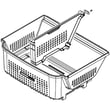
On the GE GFE26GSKJSS bottom-mount refrigerator, you remove the bottom drawer by pulling it out to the stop, then lifting the front of the drawer up and out of the slide rails. Reinstall by extending both slides and seating the drawer back in place (then push closed). See the GFE26GSKJSS owner's manual for the exact drawer and basket steps.
- Pull the drawer straight out until it stops.
- Lift the front of the drawer up.
- Lift and pull the drawer up and out of the slides.
- Set the drawer on a towel to protect the floor and drawer front.
- Pull the left and right slides out until fully extended.
- Set the back of the drawer onto the slides first.
- Rotate the drawer front down to seat it on the slides.
- Push the drawer in to the closed position.
Many GE bottom-mount models use a basket-and-slide setup in the freezer. The common removal sequence is:
- Open the freezer door fully.
- Pull the lower basket and slide mechanism to full extension using both hands.
- Lift the top freezer drawer up and out (if equipped).
- Lift the basket off the slides.
| Drawer type | Where it is | Typical removal move | What usually stops it |
|---|---|---|---|
| Temperature controlled drawer | Refrigerator section | Lift front up and out | Slide stop position |
| Freezer basket/drawer | Freezer bottom | Lift drawer/basket up and out | Basket resting on slides |
Removing the drawer the right way prevents bent slide rails, cracked plastic, and door alignment issues that can cause warm temperatures or frost buildup.
Last updated: January 2026
How do you put the bottom grill on a GE refrigerator?
On the GE GFE26GSKJSS bottom-mount refrigerator, the bottom grill (base grille) typically snaps into position along the lower front edge; align the tabs, press it in evenly, and reinstall any retaining screws if your grille uses them. For model-specific access points and fastener locations, use the GFE26GSKJSS owner's manual.
- Unplug the refrigerator or switch off power at the breaker if you will be working near wiring.
- Line up the grill with the lower front opening so the mounting tabs match the slots.
- Start at one end and press the grill in until you feel it seat, then work across to the other end.
- If your grill uses screws, reinstall them with a Phillips screwdriver and snug them down (do not overtighten).
- Confirm the grill is flush and not rubbing the doors or freezer drawer.
- Look for broken or bent tabs on the grill or damaged slots on the cabinet frame.
- Make sure the refrigerator is level; a tilted cabinet can make alignment harder.
- Verify nothing is pinched behind the grill (wiring, water line, insulation).
- If you recently pulled the unit out, push it straight back in and recheck alignment.
| Check | What “good” looks like | What to fix if not |
|---|---|---|
| Fit | Even gap, sits flush | Re-seat tabs, check for obstructions |
| Stability | Does not pop loose when tugged | Replace damaged grill tabs or mounting points |
| Door clearance | Doors and freezer drawer move freely | Reposition grill, confirm it is fully seated |
A properly installed bottom grill helps protect components at the lower front of the refrigerator and supports normal airflow around the base area, which helps the refrigerator run efficiently.
Last updated: January 2026
What is the most common problem with a GE refrigerator?
The most common issue we see on a GE refrigerator like model GFE26GSKJSS is a cooling problem (fresh food warm, freezer not holding temp, or temps swinging). In many cases, the root cause is airflow or defrost trouble, not the sealed system.
- Dirty condenser coils causing poor heat release and longer run times
- Evaporator fan not running or running intermittently (reduced airflow)
- Frost buildup from a defrost failure (ice blocking airflow)
- Door not sealing or doors not aligned (warm air leaks)
- Temperature sensor or control board issues (bad readings or erratic control)
- Confirm settings: freezer near 0°F and fresh food near 37°F.
- Clean condenser coils and make sure the condenser fan area is clear.
- Listen for the evaporator fan in the freezer; it should run when cooling is needed.
- Check for heavy frost on the freezer back panel (a strong sign of defrost trouble).
- If the unit is warm and the compressor is running, check for error indications and follow the diagnostic guidance in the GFE26GSKJSS owner's manual.
If basic checks point to a component failure, these model-matched parts are common suspects:
| Symptom | Common part area | Example model-matched part |
|---|---|---|
| Temps swing or read wrong | Temperature sensing | Refrigerator temperature sensor WR55X10025 |
| Frost buildup, warm fridge | Defrost system | Defrost heater, defrost thermostat |
| No airflow, warm sections | Fan system | Evaporator fan motor and blade |
| Random cooling behavior | Controls | Main control board |
Cooling problems can spoil food quickly and also force the compressor to run longer than normal. Catching airflow, defrost, or sensor issues early often prevents bigger failures and reduces energy use.
Last updated: January 2026