Owner’s manual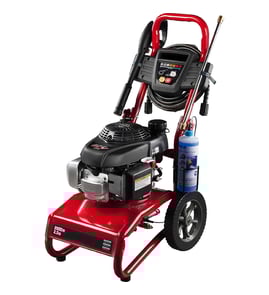

What is a good PSI for a gas pressure washer?
A good PSI for a gas pressure washer depends on what you’re cleaning. For most home jobs, 2,000 to 3,000 PSI is the sweet spot because it handles driveways, siding, and decks without being overkill. For model WP2500, confirm the rated PSI and nozzle guidance in the WP2500 owner's manual.
Quick PSI guide by task
- 1,300 to 2,000 PSI: cars, patio furniture, grills, delicate surfaces
- 2,000 to 3,000 PSI: concrete, brick, fences, most home exteriors
- 3,000+ PSI: heavy-duty stripping and large concrete areas (higher risk of damage)
- Use a wider spray tip (like 25° or 40°) for general cleaning
- Use a narrower tip (like 0° or 15°) only when you truly need it and can control distance
PSI vs GPM (why both matter)
PSI is the “force,” but GPM (gallons per minute) is the “rinse power.” For faster cleaning, a little more GPM often helps more than chasing the highest PSI.
| What you’re comparing | What it affects most | What to prioritize for home use |
|---|---|---|
| Higher PSI | Cutting power, stripping | Medium to high (2,000 to 3,000) |
| Higher GPM | Speed, rinsing, productivity | As high as practical |
| Nozzle angle | Surface safety and control | Start wide, narrow only as needed |
How to choose the right PSI for your surfaces
- Start with the lowest effective pressure and a wider nozzle
- Keep the spray moving; don’t “park” the stream in one spot
- Increase cleaning power by adjusting nozzle, distance, and detergent, not just PSI
- Test in an inconspicuous area first (especially on wood, paint, and vinyl)
Why it matters
Using too much PSI can gouge wood, etch concrete, and force water behind siding. Using too little PSI wastes time and can leave detergent and grime behind. Matching PSI to the job gives better results and helps protect your Westinghouse pressure washer pump, hose, and spray gun.
Last updated: February 2026
Is 1.2 gallons per minute good for a pressure washer?
Yes; 1.2 GPM is a solid flow rate for light-duty cleaning, but it is slower on big surfaces because higher GPM rinses faster. For your Westinghouse WP2500, use the flow rate listed in the WP2500 owner's manual to judge performance for your specific unit.
What 1.2 GPM is best for
A 1.2 GPM pressure washer works best when you want control and do not need fast rinse speed.
- Washing cars, bikes, and outdoor toys
- Patio furniture, grills, and small mats
- Small porches, steps, and entryways
- Spot-cleaning dirt on siding
- Rinsing after applying detergent
When you will want more GPM
For large, flat surfaces, GPM drives productivity because it determines how quickly you flush away loosened grime.
- Driveways and long sidewalks
- Large decks and fences
- Full-house siding washes
- Heavy mud or thick algae buildup
Quick comparison (typical results)
| Flow rate (GPM) | Typical use | What you will notice |
|---|---|---|
| 1.2 to 1.6 | Light-duty | Slower rinsing; more time on large areas |
| 2.0 to 2.5 | Medium-duty | Faster cleaning and rinsing |
| 2.6+ | Heavy-duty | Best productivity for big jobs |
Why it matters (GPM vs PSI)
We use GPM to estimate cleaning speed and rinse power, and PSI to estimate how aggressively the spray breaks soil loose. A lower-GPM washer can still clean well, but you spend more time rinsing and making extra passes.
Tips to get the best results at lower GPM
- Use the widest nozzle that still cleans (wider spray covers more area per pass)
- Pre-soak with detergent and let it dwell briefly (do not let it dry)
- Work in sections; rinse top to bottom on vertical surfaces
- Keep a consistent tip distance to avoid streaks
Last updated: February 2026
Is a 2000 or 3000 PSI pressure washer better?
A 3000 PSI pressure washer is better for heavy-duty cleaning on hard surfaces, while 2000 PSI is better for lighter jobs and delicate materials. Your Westinghouse WP2500 sits in the middle at about 2500 PSI, which makes it a strong all-around choice; use the WP2500 owner's manual for the correct nozzle and operating guidance.
How to choose: match PSI to the job
Use the surface and soil level to decide, not just the biggest PSI number.
- Around 2000 PSI: vehicles, patio furniture, screens, outdoor rugs, general rinsing
- Around 2500 PSI (WP2500 range): most home cleaning, sidewalks, moderate mildew, typical driveway grime
- Around 3000 PSI: large concrete areas, brick, heavy buildup, faster stripping and prep work
- Higher PSI cleans faster but increases the risk of etching concrete or damaging wood fibers
- Nozzle angle and distance often matter as much as PSI for preventing damage
PSI vs GPM (flow): what you feel in real use
PSI is the “cutting” force; GPM is the “rinsing” and “flushing” power. A balanced combination usually cleans faster than PSI alone.
| Item | Higher value does what | Common tradeoff |
|---|---|---|
| PSI | Breaks stuck-on grime faster | More surface-damage risk if you get too close |
| GPM | Rinses and clears debris faster | Uses more water; needs a capable pump |
| Nozzle angle | Changes how concentrated the spray is | Narrow tips can damage surfaces quickly |
Practical starting points (safe technique)
- Start with a wider fan tip and increase aggressiveness only if needed
- Keep the wand moving; avoid holding the spray in one spot
- Test a small, hidden area first on wood, paint, and siding
- Use detergent application methods recommended in the WP2500 owner's manual
Why it matters
Choosing the right PSI range and spray pattern helps you clean efficiently while protecting siding, wood, concrete, seals, hoses, and spray tips from unnecessary wear.
Last updated: February 2026