Owner’s manual
 Error Codes



What year did the Kenmore Elite come out?
Kenmore Elite launched as a premium Kenmore line in 1999. For your specific Kenmore Elite bottom-mount refrigerator model 59676579600, the exact build year is determined by the serial number on the model and serial label, not by the Elite brand launch date.
How to find the year for model 59676579600
We use the model and serial label to date a specific refrigerator. On this model, the manual indicates the model and serial number sticker is inside the refrigerator section on the left wall. Check the 59676579600 owner's manual for the label location details.
- Open the fresh food (refrigerator) door.
- Look on the left interior wall for the model and serial label.
- Write down the full serial number exactly as shown.
- Use the serial number format to determine the manufacture date (year and often week).
- If the label is missing or unreadable, check for a secondary label near the rear exterior panel.
What “Kenmore Elite” means vs. your refrigerator’s build year
“Kenmore Elite” is a product line name; it does not identify a single release year for every Elite refrigerator. Sears sold Kenmore Elite appliances across many years, and model 59676579600 represents a specific design generation within that timeline.
| Term | What it tells you | What it does not tell you |
|---|---|---|
| Kenmore Elite | Premium feature tier and styling | Exact manufacture year |
| Model number 59676579600 | The specific product design family | Exact build date |
| Serial number | The unit’s manufacture date code | Feature tier by itself |
Why it matters
Knowing the manufacture year helps us match the right refrigerator parts (like a door gasket, thermistor, or ice maker), confirm compatibility, and troubleshoot issues based on the correct production run.
Last updated: January 2026
What is the average lifespan of a Kenmore Elite refrigerator?
Most Kenmore Elite refrigerators, including model 59676579600, typically last 10 to 15 years with normal household use. Regular care (cleaning, good door sealing, and stable temperatures) helps you reach the high end of that range and avoid early cooling-system wear.
Typical lifespan and what to expect
Here’s a practical way to think about service life for a Kenmore Elite bottom-mount refrigerator:
- 10 to 15 years is the normal average lifespan
- Units that get routine cleaning and good airflow often last longer
- The most expensive “end-of-life” repairs usually involve the sealed system (compressor, refrigerant components)
- Wear items (lights, switches, gaskets, ice maker parts) are common and usually repairable
| Age of refrigerator | What’s most common | What we usually recommend |
|---|---|---|
| 0 to 5 years | Minor adjustments, occasional ice/water issues | Keep temps steady; follow cleaning schedule |
| 6 to 10 years | Fans, sensors, defrost issues, door sealing | Diagnose early; replace worn parts |
| 10 to 15 years | Higher chance of major cooling failures | Compare repair cost vs. replacement |
Maintenance that extends lifespan
We recommend these habits for Kenmore Elite refrigerators like 59676579600:
- Clean the condenser area regularly so the compressor runs cooler
- Keep door gaskets clean and sealing tightly (warm air leaks shorten compressor life)
- Avoid overpacking so air can circulate through the fresh food and freezer sections
- Use the correct temperature settings and features described in the 59676579600 owner's manual
- Address unusual noises or warming quickly (small issues can become major failures)
Parts that commonly affect longevity
If performance problems show up, these parts are often involved:
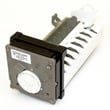
- Ice production issues: Refrigerator ice maker D7824706Q
- Warm fresh food section: damper and airflow components
- Intermittent cooling or clicking: start device and compressor circuit
- Frost buildup: defrost heater, defrost thermostat, or sensor
- Moisture or poor sealing: door gasket
Why it matters
A refrigerator that runs hot, leaks air, or has restricted airflow cycles longer and stresses the compressor. Keeping the cabinet sealed and the cooling system clean is the simplest way to protect the most expensive components.
Last updated: January 2026
What size is Kenmore refrigerator model 59676579600?
Kenmore Elite refrigerator model 59676579600 is a bottom-mount style refrigerator; the exact exterior dimensions (width, height, depth) vary by configuration and are listed in the 59676579600 owner's manual. If you are planning a cabinet opening, measure your space and compare it to the refrigerator’s measured width, height, and depth.
How to measure the refrigerator size correctly
Use a tape measure and record all three dimensions; then compare to your kitchen opening.
- Width: measure the widest point across the cabinet (often door edges)
- Height: floor to the top hinge cover or top of cabinet
- Depth: front of doors (or handles) to the back panel
- Door swing clearance: allow space for doors to open fully
- Ventilation clearance: leave space around the cabinet for airflow
Typical size range for this style (planning guidance)
Most Kenmore bottom-mount refrigerators of this type are commonly planned around these ranges:
| Dimension | Typical planning range |
|---|---|
| Width | 30 to 33 inches |
| Height | 66 to 70 inches |
| Depth | 30 to 35 inches (more with handles) |
Why it matters
A refrigerator that is even 1 inch too wide or too deep can prevent proper installation, reduce door opening clearance, and restrict airflow, which can affect cooling performance and energy use.
Last updated: January 2026
What are the common problems with Kenmore Elite refrigerators?
Common issues on the Kenmore Elite 59676579600 bottom-mount refrigerator include warm temperatures from airflow or coil problems, frost buildup from a defrost or door-seal issue, water leaks from the drain or water line, and normal-to-loud operating sounds. Use the 59676579600 owner's manual to match symptoms to the right checks.
Most common symptoms and what usually causes them
- Not cooling well or temperature swings: dirty condenser coils, blocked vents, damper not opening, or evaporator fan issues
- Runs too often: doors opened frequently, warm room conditions, dirty condenser coils, or door not sealing
- Frost or ice buildup: door gasket not sealing, defrost system problem (heater, thermostat, sensor)
- Water leaking: clogged/iced drain, loose water connection, or tubing/valve issues
- Slow water flow or small/hollow ice cubes: low water pressure or a clogged filter (if equipped)
Quick checks we recommend first (safe, high-impact)
- Confirm doors seal and close fully: look for bins/drawers preventing closure; check gasket contact all the way around.
- Clean condenser coils: dirty coils can make the refrigerator run more and cool poorly.
- Check airflow: avoid blocking return vents; do not pack items tightly against vents.
- Verify freezer temperature: most bottom-mount units are set around 0°F for the freezer.
- If you have water/ice issues: confirm the shutoff valve is fully open and the supply line is not kinked.
Parts that commonly fix these problems on this model
| Symptom | Common part to inspect/replace | Example part for 59676579600 |
|---|---|---|
| Warm fresh food section | Damper not opening | Refrigerator electronic damper WPW10196393 |
| Clicking/buzzing, won’t start | Start device/relay issue | Refrigerator start device W10613606 |
| Frost buildup/defrost trouble | Defrost heater or thermostat | Refrigerator defrost heater WP67002493, refrigerator defrost bi-metal thermostat WP67003426 |
| Ice maker problems | Ice maker assembly | Refrigerator ice maker D7824706Q |
Why it matters
Catching airflow, sealing, and water-supply problems early helps prevent food spoilage, excessive run time, and ice buildup that can restrict cooling.
Last updated: January 2026