Owner’s manual
 Error Codes



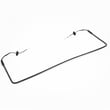
What is the bottom part of a refrigerator called?
On a KitchenAid KRFC300EWH01 bottom-mount refrigerator, the “bottom part” is most often the machine compartment (also called the compressor compartment). It’s the area where major cooling-system components sit, and it may also include a lower cover or toe grille and a drain pan underneath.
- Machine compartment: the service area that houses cooling components
- Compressor compartment: focuses on the compressor location
- Toe grille / kick plate: the front lower cover that helps direct airflow and hides components
- Base pan / drain pan: the pan underneath that catches defrost water
These parts work together to move heat out of the refrigerator so the fresh food and freezer sections can stay cold:
- Compressor (pumps refrigerant through the sealed system)
- Condenser coils (release heat to the room)
- Condenser fan (moves air across the condenser on many designs)
- Electrical controls and wiring connections
- Drain pan (evaporates defrost water)
If you’re identifying parts or removing covers on KRFC300EWH01, use the KRFC300EWH01 owner’s manual for the correct access points and safety steps.
| Symptom near the bottom | Most common area involved | Example part you may see on this model page |
|---|---|---|
| Warm fridge, loud hum/click | Compressor compartment | Compressor (sealed system) |
| Water on floor near front | Drain system / drain pan | Drain tube components |
| No ice or no water fill | Water supply and valve area | Water inlet valve |
For water supply problems tied to the lower rear area, the refrigerator water inlet valve assembly WPW10420083 is a common component to check.
Knowing the correct name helps you find the right diagram, instructions, and replacement parts faster. It also helps you describe the issue accurately when diagnosing cooling, water leaks, or airflow problems.
Last updated: January 2026
Are bottom mount fridges better?
Yes for most households: a bottom-mount refrigerator like KitchenAid KRFC300EWH01 keeps fresh-food items at eye and waist level, so daily use is easier and more ergonomic than bending for the crisper or milk. The tradeoff is that freezer access is lower and often drawer-based (great for bulk storage, less ideal for quick grab items).
- You use the refrigerator section more than the freezer (produce, dairy, leftovers).
- You want easier access to shelves and crispers with less bending.
- You like a wide refrigerator compartment for platters and meal prep.
- You prefer a pull-out freezer drawer for organizing frozen foods.
- You want a layout that supports frequent cooking at home.
- You access frozen foods many times per day (top-freezer can feel faster).
- You want the lowest upfront cost (top-freezer models are often simpler).
- You dislike digging through a deep freezer drawer (some people prefer shelves).
| Style | Best for | Common downside |
|---|---|---|
| Bottom-mount | Everyday fresh-food access, ergonomic use | Freezer is lower and can be “stacked” |
| Top-freezer | Budget-friendly, quick freezer access | Fresh-food section is lower |
| Side-by-side | Narrow door swing, equal access | Narrower shelves for wide items |
Most households open the fresh-food doors far more than the freezer. With a bottom-mount design, the items you reach for most often stay in the most comfortable zone, which can reduce strain and make the refrigerator feel more convenient day to day.
- Set the refrigerator to about 37°F and the freezer to about 0°F.
- Keep airflow paths clear; avoid packing items tight against vents.
- Use bins to group freezer items (meats, veggies, breakfast) so the drawer stays organized.
- If you have water and ice features, keep filtration and water flow maintained using the how to replace the water filter in a KitchenAid refrigerator steps.
- For model-specific features and storage configuration, follow the KRFC300EWH01 manual.
Last updated: January 2026
What is the average lifespan of a KitchenAid refrigerator?
Most KitchenAid refrigerators last 14 to 17 years on average, and a typical overall lifespan range is 10 to 20 years with normal use and basic maintenance. For your KitchenAid KRFC300EWH01 bottom-mount refrigerator, keeping airflow clear and fixing small issues early helps you reach the high end of that range.
Refrigerator life varies most by usage, installation conditions, and maintenance.
- Average: 14 to 17 years
- Common range: 10 to 20 years
- Best-case (well maintained, stable power, good ventilation): closer to 18 to 20 years
| Lifespan bucket | What it usually means | What to do now |
|---|---|---|
| 0 to 5 years | Early failures are uncommon | Keep condenser area clean, verify temps |
| 6 to 12 years | Wear parts start showing up | Watch door sealing, fan noise, ice maker issues |
| 13 to 20 years | Major components may fail | Decide repair vs. replace based on cost |
These steps reduce compressor run time, prevent frost and airflow problems, and protect food temperatures.
- Keep door gaskets clean and sealing tightly; warm air leaks make the compressor work harder.
- Vacuum dust from the condenser area regularly (more often with pets).
- Set and confirm temperatures (about 37°F fresh food, 0°F freezer).
- Avoid overpacking; leave space for air circulation around vents.
- Address water and ice issues quickly to prevent leaks and icing.
For model-specific care and cleaning guidance, follow the KRFC300EWH01 owner’s manual.
We typically recommend repairing when the fix is a common wear item and the refrigerator is otherwise cooling normally.
- Often worth repairing: door sealing problems, fan noise, ice maker issues, water leaks
- Bigger decision: sealed-system or compressor-related repairs, especially on older units
If you are troubleshooting cooling performance, the evaporator fan system is a common checkpoint; parts like the refrigerator evaporator fan motor W11024089 are tied directly to airflow.
A refrigerator that is struggling to cool can run longer, waste energy, and shorten the life of major components like the compressor. Simple maintenance and timely part replacement usually cost less than running the unit in a stressed condition.
Last updated: January 2026
What is the most common problem with a KitchenAid refrigerator?
For KitchenAid refrigerators like model KRFC300EWH01, the most common issues we see are ice maker problems (no ice, slow ice, small cubes) and cooling complaints (warm fridge, frost buildup, noisy fan). These symptoms usually trace back to airflow, water supply, or door sealing problems; see the KRFC300EWH01 owner's manual for model-specific checks.
- Ice maker not making ice or slow production: restricted water supply, a failing ice maker, or a water inlet valve issue
- Fridge not cold enough: poor airflow from an evaporator fan problem, dirty condenser coils, or a control issue
- Frost buildup in the freezer: door not sealing, frequent door openings, or airflow/defrost-related issues
- Water leaking or puddles: drain tube restriction or water line connection issues
- Noisy operation: evaporator fan blade rubbing ice, fan motor wear, or vibration from items touching the cabinet
- Confirm temperatures: 37°F for fresh food and 0°F for freezer (typical targets).
- Make sure vents are not blocked by food packages.
- Clean condenser coils (dust buildup commonly reduces cooling efficiency).
- Check door closure and gasket contact all the way around.
- For ice maker issues, verify the household shutoff valve is fully open and the supply line is not kinked.
| Symptom | Common suspect | Example part for this model |
|---|---|---|
| No ice / slow ice | Ice maker assembly | Refrigerator ice maker assembly W10884390 |
| Warm temps / noisy fan | Evaporator fan motor or blade | Refrigerator evaporator fan motor W11024089, refrigerator evaporator fan blade WP2169142 |
| Water dispenser/ice fill issues | Water inlet valve | Refrigerator water inlet valve assembly WPW10420083 |
| Leaks/puddles | Drain tube routing/clog | Extension-dr W10619951 |
Ice maker and cooling problems can look similar (for example, a weak evaporator fan can cause warm temps and also reduce ice production). Starting with airflow, temperatures, and water supply checks helps you avoid replacing the wrong part.
Last updated: January 2026