Owner’s manual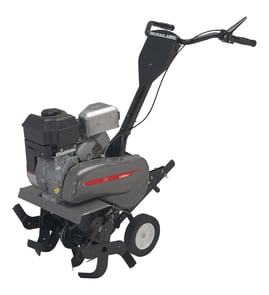



Where is the model number on a Craftsman tiller?
On a Craftsman tiller, the model number is printed on the model and serial label. For Craftsman model 917291481, the label is typically located on the handle/control area; confirm the exact label location and format in the 917291481 owner's manual.
Look for a sticker or metal tag with a model number and serial number. Check these spots first:
- Handle column or control panel area (near the tine control lever and grips)
- Tine shield or tine guard area (near the rotating tines)
- Belt guard area (near the belt guard and pulley components)
- Frame rail near the engine mounting brackets
- Near the depth stake or wheel bracket area
Most Craftsman tiller labels include a clear “MODEL NUMBER” line and a serial number. For this model, you are looking for 917.291481 (often shown with a dot in printed manuals) or 917291481.
| You see on the label | What it means | Use it for |
|---|---|---|
| 917291481 (or 917.291481) | Tiller model number | Matching parts diagrams and parts like belts, tines, and controls |
| Serial number | Unique unit identifier | Verifying production details and correct revisions |
Using the exact model number helps us match the correct Craftsman tiller parts and diagrams for your machine, especially for wear items and drive components like the tine control cable, belt guard parts, and hardware.
Last updated: February 2026
Are front tine tillers any good?
Yes. A front-tine tiller like the Craftsman 917291481 is a solid choice for small-to-medium gardens and routine soil prep. It’s best for loosening pre-worked soil, making seed beds, and cultivating between rows; it takes more hands-on effort than larger rear-tine machines.
- Loosen and condition soil before planting (typical tilling depth is 4 to 6 inches)
- Cultivate between rows to control weeds (typical cultivating depth is 1 to 3 inches)
- Work in tighter spaces where a larger tiller is harder to maneuver
- Handle seasonal soil conditioning when the ground is in good condition
| Topic | Front-tine tiller (like 917291481) | Larger rear-tine tiller |
|---|---|---|
| Best use | Garden beds, light-to-moderate soil | New ground, heavy soil, larger areas |
| Effort | More operator effort | Less operator effort |
| Maneuvering | Easier in tight areas | Heavier, wider turns |
| Cost | Typically more affordable | Typically higher cost |
- Till when soil is slightly moist; very dry soil is hard to penetrate and can cause bouncing, and very wet soil clumps.
- Start shallow in hard ground or sod; set the depth stake and wheel height for shallow passes, then increase depth.
- Avoid trying to till too deep too fast; it overloads the machine and reduces control.
- For easier handling, leave a row untilled between passes, then come back and fill it in.
- Remove vines and long grass first so they do not wrap around the tine shaft.
Matching the tiller type to your yard and soil saves time and wear on parts like the drive system and tine controls. Proper depth and soil moisture also improve seed-bed quality and reduce difficult handling.
For operating depth settings, tine arrangements, and safety steps (including disconnecting the spark plug wire before checks), follow the 917291481 owner’s manual.
Last updated: February 2026
Who builds Craftsman tillers?
For Craftsman front-tine tiller model 917291481, the 917 model prefix is widely associated with American Yard Products (AYP) manufacturing, a long-time supplier for Craftsman outdoor power equipment. Use the 917291481 owner's manual to confirm the exact model identification and specifications for your unit.
We use the model number format and the product identification information to narrow down the original manufacturer.
- Look at the full model number on the ID tag (use the complete number, not just “917”).
- Match the model number to the parts diagrams and spec pages in the manual.
- Check the engine brand and model listed in the manual (this tiller uses a Briggs & Stratton engine family).
- Use the parts list to confirm you are shopping the correct chassis and tine assembly.
- If you are comparing to similar machines (Cub Cadet, Husqvarna, etc.), compare the transmission and tine hardware, not just paint and decals.
The 917 prefix is a strong clue about the equipment’s source, but it is not the same as the engine brand.
| Item you’re checking | What it tells you | Example on this model |
|---|---|---|
| Model prefix (917) | Who built the tiller chassis for Craftsman | 917291481 |
| Engine label | Who built the engine | Briggs & Stratton engine shown in the manual |
| Parts diagrams | Confirms the exact configuration | Tine assembly and transmission breakdowns |
Knowing the original manufacturer helps you match the correct parts and diagrams for repairs like belt routing, tine replacement, and transmission hardware. For example, the tine assembly on this model uses common retainers and pins such as the spring retainer 532003146 and related clevis-style hardware shown in the parts breakdown.
Last updated: February 2026
How to lubricate a tiller?
For the Craftsman 917291481 front-tine tiller, routine lubrication focuses on external pivot points and cables; the transmission is sealed and does not need lubrication unless it has been serviced. Lubricate at the intervals in the 917291481 owner's manual to reduce wear and keep controls moving freely.
- Control pivots and linkages: tine control lever pivot, engagement linkage points
- Cables: light lubrication where the cable moves (avoid soaking the cable housing)
- Depth stake and wheel adjust points: where metal parts slide or pivot
- Exposed rotating points: any visible bushings or shafts that have a lube point
- Fasteners and pins: clevis pins and retainers if they squeak or bind
The manual states the transmission is sealed and will not require lubrication unless serviced. Over-greasing sealed areas can attract dirt and speed up wear.
- Shut the engine off, let it cool, and disconnect the spark plug wire.
- Brush off dirt and dried mud first; lubricant works best on clean parts.
- Apply a small amount of oil to pivots and linkages; wipe off excess.
- Use a light oil on cable ends and moving joints; keep oil off belts and pulleys.
- Cycle the tine control lever several times to work lubricant into the joints.
| Location | Best choice | Avoid |
|---|---|---|
| Pivots, linkages, pins | Light machine oil or spray lubricant | Heavy grease that holds grit |
| Sliding adjusters (depth stake) | Light grease film | Oil that runs off quickly |
| Belts, pulleys, sheaves | None (keep dry) | Any oil or grease |
Proper lubrication reduces friction at the tine control and adjustment points, which helps prevent stiff controls, premature wear, and poor tilling performance.
Last updated: February 2026
Why won't the tines on my garden tiller turn?
If your Craftsman front-tine tiller model 917291481 runs but the tines will not turn, the problem is usually in the tine-drive system: the tine control is not engaging, the drive belt is slipping or broken, or a linkage/pulley issue is preventing power from reaching the tine shaft. Use the 917291481 owner's manual to follow the tine operation check and adjustment steps.
- Shut the engine off and wait until all moving parts stop.
- Disconnect the spark plug wire and keep it away from the plug.
- Never operate the tiller without guards and shields in place.
- Keep children, pets, and bystanders away while testing.
- Confirm tine control engagement: With the engine running, lift the handles to tip the tines off the ground, then engage the tine control and watch for rotation (this is also part of the break-in procedure).
- Look for belt slip: A squeal, burning rubber smell, or intermittent tine movement points to a loose or worn belt.
- Check for jammed tines: Vines, long grass, or debris wrapped around the tine shaft can stop rotation.
- Inspect the drive path: A damaged pulley, bent linkage, or missing retainer can keep the belt from transferring power.
These model-matched parts commonly affect tine engagement and belt tracking:
| What you notice | Likely area to inspect | Example model-matched part |
|---|---|---|
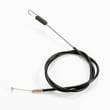
| Tine control feels loose or does not return | Control linkage/cable | Cbl/cltch t 583731701 |
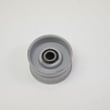
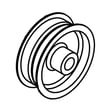
| Belt rides off or does not stay tensioned | Idler/tension system | Idler pulley 532161806 |
| Tines start then stop under load | Drive pulley wear or misalignment | Pulley 592642101 |
When the tines do not turn, the tiller cannot maintain the recommended working depth (often about 4 to 6 inches for tilling). Continuing to run the engine with a slipping belt or misadjusted tine control accelerates wear on belts, pulleys, and the tine-drive components.
Last updated: February 2026
What kind of engine is on a Craftsman tiller?
The Craftsman front-tine tiller model 917291481 uses a Briggs & Stratton engine; the engine family shown for this model is Briggs & Stratton model 126302, type 0206-E1. We also see this tiller listed as 5.0 HP in the owner’s documentation.
Use the engine ID tag on the engine itself (not the tiller frame tag) and match it to what’s listed in the 917291481 owner’s manual.
- Look for a label stamped or printed on the blower housing or valve cover
- Record model, type, and code from the engine label
- Compare the model and type to 126302 / 0206-E1
- If the engine was replaced at some point, the label on the engine is the final word
Once you have the Briggs & Stratton model and type, you can select the correct maintenance items (spark plug, air filter, engine oil) and avoid mismatches.
| Item you’re buying | Match it to | Why it matters |
|---|---|---|
| Spark plug | Engine model/type | Correct reach and heat range |
| Air filter | Engine model/type | Proper airflow and filtration |
| Engine oil | Manual spec for temperature range | Easier starting and less wear |
| Belts/tines (tiller side) | Tiller model 917291481 | Fit and safe operation |
If your issue is tine engagement or control feel (not an engine problem), these model-matched parts are common fixes:
- Control lever 584447601 (tine control)
- Cbl/cltch t 583731701 (clutch/control cable)
- Idler pulley 532161806 (belt tensioning)
Engine identification prevents ordering the wrong Briggs & Stratton service parts, while the tiller model number (917291481) keeps chassis parts like controls, pulleys, and shields matched for proper operation.
Last updated: February 2026