Installation guide
 Owner’s manual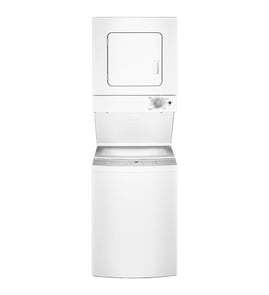


Do washer dryer combos need to be vented?
Yes. The Whirlpool WET4024EW0 laundry center uses a conventional dryer that must be exhausted outdoors with a 4-inch heavy metal vent; it is not a ventless condenser-style combo. Follow the venting rules in the WET4024EW0 installation guide.
This model’s dryer section needs an exhaust duct that carries moist, hot air and lint outside.
- Exhaust must go outdoors (not into an attic, crawlspace, wall, or chimney)
- Use 4 in. (102 mm) heavy metal vent (rigid metal is best)
- Do not use plastic vent
- Do not use metal foil vent
- Keep the vent run as short and straight as possible
Use this as a fast install and safety check for the WET4024EW0.
| Item | Recommended | Avoid |
|---|---|---|
| Vent material | 4" rigid metal duct | Plastic or foil duct |
| Vent termination | Outdoor exhaust hood | Indoor termination |
| Airflow maintenance | Clean lint screen every load | Running with restricted airflow |
| Vent cleaning | Clean full vent path periodically | Letting lint build up |
Proper venting helps the dryer heat and dry efficiently, reduces drying time, and lowers the chance of overheating from restricted airflow.
For airflow performance details (lint screen cleaning and vent system checks), we also cover it in the WET4024EW0 use and care manual.
Last updated: January 2026
How does the whirlpool washer dryer combo work?
The Whirlpool WET4024EW0 is a stacked laundry center with two separate appliances in one cabinet: a top-load washer on the bottom and a vented electric dryer on top. You wash first, then move the load to the dryer; it is not a single “wash-and-dry in one drum” combo. For cycle details, use the WET4024EW0 use and care guide.
- Add detergent to the washer basket before loading clothes (helps prevent residue on fabrics).
- Select a washer cycle and wash temperature; water levels are intentionally lower than older washers.
- When the washer finishes, transfer clothes to the dryer (do not overload so items can tumble).
- Clean the lint screen before each dryer load.
- Choose Automatic Dry for most loads (senses moisture/temperature) or Timed Drying for set time.
Some washer/dryer combos wash and dry in the same drum and often use condenser or heat-pump drying. The WET4024EW0 does not work that way; it uses a traditional vented dryer that must exhaust outdoors.
| Feature | WET4024EW0 stacked laundry center | True all-in-one combo |
|---|---|---|
| One drum for wash + dry | No | Yes |
| Dryer needs an exhaust vent | Yes | Often no |
| You move laundry between machines | Yes | No |
Poor airflow is the most common reason drying takes too long. For this model, we recommend:
- Use 4-inch heavy metal venting (avoid plastic or foil).
- Keep the vent run as short and straight as possible.
- Limit elbows; each bend reduces airflow.
- Clean lint from the vent system periodically.
- Replace crushed or kinked ducting.
For installation and venting requirements, follow the WET4024EW0 installation instructions.
Understanding that the WET4024EW0 is a washer plus a vented dryer (not a single-drum combo) helps set expectations for total laundry time, prevents overdrying or poor drying, and reduces lint and airflow problems that can lead to shutdowns or no-heat symptoms.
Last updated: January 2026
What is the downside of a washer/dryer combo?
For the Whirlpool WET4024EW0 laundry center, the biggest downside versus separate machines is throughput: you cannot wash and dry at the same time, so laundry can take longer overall even if each cycle performs normally (see the WET4024EW0 use and care guide).
- No simultaneous washing and drying: loads must be done back-to-back.
- More scheduling friction: one finished load can block the next step if you are not ready to switch it.
- Venting has a bigger impact on dry time: restricted airflow can make drying noticeably slower.
- More wrinkles if clothes sit: removing items promptly helps reduce wrinkling.
- Service access can be tighter: stacked designs can be harder to move and work on than separate units.
The WET4024EW0 documentation focuses on operation, venting, and installation; it does not publish a simple “wash capacity vs dry capacity” comparison that would let us claim you must dry smaller loads than you wash. Instead, we recommend sizing loads based on real-world drying results and airflow.
The manual and installation instructions emphasize that good airflow reduces dry times and improves efficiency.
| Airflow item | What to do | Why it helps |
|---|---|---|
| Lint screen | Clean before each load | Prevents restricted airflow |
| Vent material | Use 4-inch heavy metal vent | Reduces crushing and lint buildup |
| Vent path | Keep it short, limit elbows | Improves exhaust flow |
| Vent cleaning | Clean the full vent periodically | Helps prevent long dry times |
For venting requirements and clearances, follow the WET4024EW0 installation instructions.
Most “combo” complaints come from expecting the convenience of two separate appliances. With a laundry center like the WET4024EW0, planning load timing and keeping the vent system clear are the keys to faster, more consistent drying.
Last updated: January 2026