Owner’s manual
 Error Codes



How do I remove the base grille on my Whirlpool refrigerator?
On the Whirlpool WRF560SMHZ00 bottom-mount refrigerator, we remove the base grille by opening the doors, releasing the grille’s retaining clips or screws (varies by version), then pulling the grille forward and off. This gives you access to the condenser area for cleaning.
Before you start (safety and prep)
- Unplug the refrigerator or switch off power at the breaker.
- If you will be cleaning, have a soft brush and a vacuum ready.
- Protect the floor with a towel or thin cardboard to prevent scratches.
- Keep track of any screws so they go back in the same locations.
Step-by-step: removing the base grille
- Open both fresh food doors so you can reach the grille ends.
- Look along the top edge and both ends of the grille for:
- Snap-in clips (most common)
- Quarter-turn fasteners
- Small screws
- If it uses clips: grip the grille near each end and gently pull the top edge forward to release the clips, then lift or pull the grille away.
- If it uses screws/fasteners: remove them first, then pull the grille forward and off.
- Set the grille aside and clean dust from the condenser area if needed.
Reinstalling the grille
Align the tabs with the slots, then press evenly until it snaps in (or reinstall the screws/fasteners). Confirm the grille sits flush and does not rub the doors.
| What you see at the grille | What to do | Common reason |
|---|---|---|
| No screws, grille feels springy | Pull to release clips | Clip-mounted grille |
| Screws or quarter-turn locks | Remove fasteners first | Fastener-mounted grille |
| Grille won’t sit flat after reinstall | Re-align tabs and press evenly | Tabs not seated |
Why it matters
A properly installed base grille helps protect the condenser area and supports steady airflow; keeping that area clean helps the refrigerator cool efficiently.
For model-specific diagrams and handling notes, use the WRF560SMHZ00 owner’s manual.
Last updated: January 2026
How do I find the model number on my WRF560SMHZ00?
On Whirlpool model WRF560SMHZ00, the model number is printed on the appliance’s rating label. On most Whirlpool bottom-mount refrigerators, that label is inside the fresh food compartment along a side wall or near the ceiling, and sometimes on the door frame.
Where to look first (fastest checks)
- Inside the refrigerator compartment on the left or right side wall.
- On the door frame behind the refrigerator door (hinge side area).
- Near the top interior (ceiling area) behind bins or shelves.
- If you have a freezer drawer, check the drawer frame/liner edge for an additional label.
What the label looks like
| Label wording | What it means | Why you need it |
|---|---|---|
| Model | The full model number (example: WRF560SMHZ00) | Ensures correct parts and diagrams |
| Serial | Unique unit identifier | Helps match production details |
| Type/Code | Manufacturing identifiers | Useful for service diagnostics |
Tips to avoid mix-ups
- Copy the model number exactly; include all letters and zeros.
- Take a clear photo of the label before ordering parts.
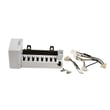
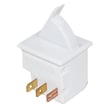
- Use the model number to match parts like the refrigerator ice maker assembly 4317943 or refrigerator light switch W11384469.
Why it matters
Whirlpool often uses similar-looking cabinets across multiple model numbers. Using the exact rating-label model number prevents ordering the wrong gasket, control, ice maker, or door hardware.
For label locations and identification details specific to this refrigerator, use the WRF560SMHZ00 manual.
Last updated: March 2026
What is the average lifespan of WRF560SMHZ00?
The average lifespan of a Whirlpool bottom-mount refrigerator like model WRF560SMHZ00 is about 13 years. Keeping condenser airflow clear, maintaining good door seals, and staying on top of filter changes helps this refrigerator reach its full service life.
What affects lifespan most
- Condenser cleanliness and airflow (dust buildup makes the compressor work harder)
- Door seal condition and alignment (warm air leaks increase run time)
- Ice maker and water system upkeep (clogs and leaks create repeat failures)
- Temperature settings (steady, moderate settings reduce cycling stress)
- Power quality (surges can damage controls and start components)
Typical lifespan by component (what to expect)
| Component | Typical service life | What you notice when it’s failing |
|---|---|---|
| Compressor | 10 to 15 years | Warm temps, loud hum, hard starting |
| Evaporator fan motor | 8 to 12 years | Warm fridge, freezer OK, noise in freezer |
| Ice maker assembly | 5 to 10 years | No ice, small cubes, leaking or jams |
| Door gaskets | 5 to 10 years | Frost, sweating, warm spots near doors |
Maintenance that pays off (simple, high impact)
- Vacuum the condenser area and keep vents unobstructed.
- Confirm doors close on their own and sit level; adjust if needed.
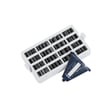
- Replace consumables on schedule; for odors and airflow, use the correct refrigerator air filter W10311524.
- Use the cleaning and care guidance in the WRF560SMHZ00 owner's manual to keep airflow paths and settings correct.
- If you have ice maker issues, follow proven checks in common refrigerator ice maker problems and solutions.
Why it matters
A refrigerator that runs longer than necessary uses more energy and wears out key parts faster (especially the compressor and start device). Basic maintenance reduces run time, stabilizes temperatures, and extends the life of the sealed system.
Last updated: March 2026